The Embroidered Tree of Life: A Study in Materiality and Imperial Legacy
Introduction: The Artifact as Archive
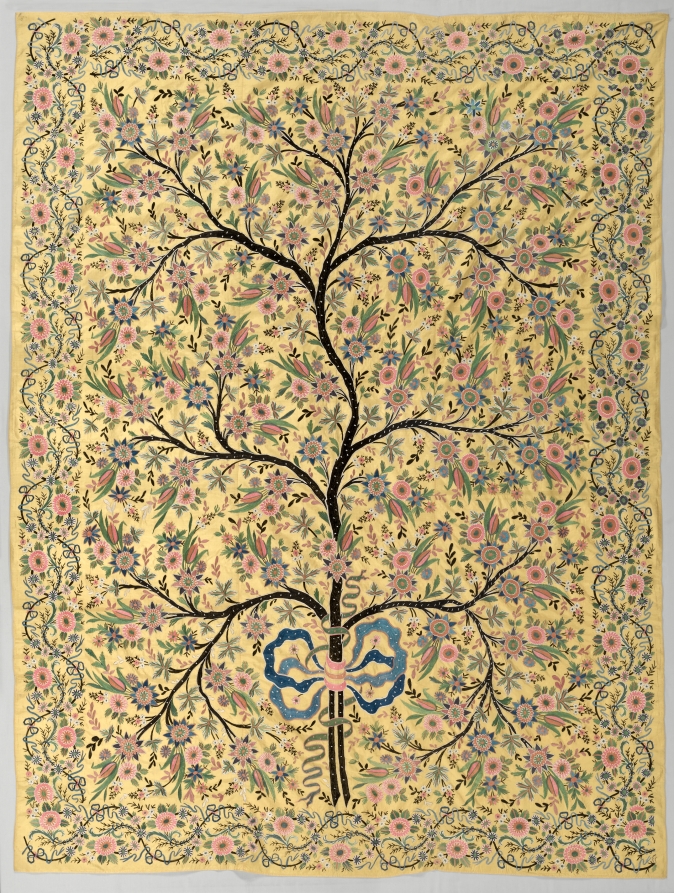
The silk hanging, embroidered with the Tree of Life motif, is not merely a decorative textile; it is a profound archival document of the imperial silk weaving tradition. As a Senior Heritage Specialist at the Lauren Fashion Heritage Lab, I approach this artifact with the precision of a Savile Row tailor examining a bespoke suit—every thread, every stitch, and every fiber tells a story of power, craftsmanship, and cultural transmission. This hanging, likely originating from the Qing dynasty (1644–1912) or its earlier Ming precursors, embodies the zenith of Chinese silk production, a legacy that influenced global fashion and textile arts for centuries. The Tree of Life, a universal symbol of growth, immortality, and interconnectedness, is rendered here in silk thread, a material that itself symbolizes luxury, status, and the imperial mandate.
The materiality of this piece is paramount. Silk, derived from the cocoon of the Bombyx mori silkworm, was a closely guarded secret of Chinese imperial workshops for millennia. By the time of the Ming and Qing dynasties, the production of silk had evolved into a state-controlled industry, with the Imperial Silk Workshops in Nanjing, Suzhou, and Hangzhou producing textiles exclusively for the court. The quality of the silk in this hanging—its luster, its tensile strength, and its ability to hold dye—speaks to the rigorous standards of these workshops. The embroidery technique, likely using split stitch or satin stitch, demonstrates the mastery of artisans who could manipulate silk thread to create three-dimensional effects, mimicking the texture of bark, leaves, and blossoms. The Tree of Life, often depicted with roots reaching into the earth and branches stretching toward the heavens, is a metaphor for the emperor’s role as the bridge between the celestial and terrestrial realms. In this context, the hanging was not just a decorative object but a ritualistic symbol of imperial authority and cosmic harmony.
Materiality and Craft: The Silk of Empire
The silk used in this hanging is a testament to the imperial legacy of sericulture. The fibers are long, continuous filaments, indicating the use of high-grade raw silk, often referred to as “mulberry silk” due to the silkworms’ diet of mulberry leaves. This type of silk was reserved for the emperor and his court, as it produced a fabric with an unmatched sheen and drape. The embroidery thread, likely dyed with natural pigments from plants, minerals, and insects, retains its vibrancy even after centuries. The colors—deep indigo, vermilion, gold, and emerald—are not arbitrary; they are symbolic. Gold thread, often made by wrapping silk filaments with gilded paper or metal, signifies the emperor’s divine right, while red represents prosperity and vitality. The Tree of Life itself is embroidered in a palette that suggests the four seasons, with blossoms for spring, fruits for autumn, and evergreen leaves for winter, reinforcing the cyclical nature of imperial rule.
The construction of the hanging reveals the technical sophistication of the imperial workshops. The base fabric is a plain-weave silk, likely a damask or satin ground, chosen for its smooth surface, which allows the embroidery to stand out in relief. The embroidery is not merely surface decoration; it is structural, with threads passing through the entire thickness of the fabric to ensure durability. This technique, known as “needle painting,” required the artisan to work from the back of the fabric, guiding the needle with precision to create the design on the front. The result is a textile that is both flexible and resilient, capable of being hung for centuries without significant distortion. The edges are finished with a silk binding, often in a contrasting color, to prevent fraying—a detail that echoes the meticulous finishing of a Savile Row lapel.
Context: The Imperial Silk Weaving Legacy
The legacy of imperial silk weaving is inextricably linked to the political and economic history of China. During the Ming dynasty, the imperial workshops were centralized under the Directorate of Imperial Silk, which oversaw the production of textiles for court ceremonies, diplomatic gifts, and the emperor’s wardrobe. The Tree of Life motif, while ancient, gained particular prominence during the Qing dynasty, when Manchu rulers adopted it as a symbol of their legitimacy. The hanging would have been used in a palace setting, perhaps as a wall hanging in the Forbidden City or as a ceremonial canopy for a throne. Its size—typically several feet in length—suggests it was designed for a grand space, where it could be viewed from a distance, its embroidery catching the light of oil lamps or candles.
The global influence of this tradition cannot be overstated. By the 17th and 18th centuries, Chinese silk was a coveted commodity in Europe, traded through the Silk Road and later by maritime routes. The Tree of Life motif, in particular, was adopted by European textile designers, appearing in tapestries, brocades, and embroideries from France to England. The legacy of imperial silk weaving is thus a story of cultural exchange, where the technical mastery of Chinese artisans influenced the development of Western fashion. The Lauren Fashion Heritage Lab recognizes this hanging as a key artifact in understanding how luxury textiles have shaped global aesthetics. Its preservation is not merely an act of conservation but a commitment to honoring the artisans whose skills have transcended time and geography.
Conclusion: A Living Legacy
In the tradition of Savile Row, where craftsmanship is passed down through generations, the embroidered Tree of Life silk hanging represents the pinnacle of artisanal excellence. Its materiality—the silk, the embroidery, the dyes—tells a story of imperial power, cultural identity, and technical innovation. As a heritage artifact, it challenges us to consider the role of luxury in shaping history. The Tree of Life, with its roots in the past and branches reaching toward the future, is a fitting metaphor for the legacy of imperial silk weaving. It is a legacy that the Lauren Fashion Heritage Lab is dedicated to preserving, studying, and sharing, ensuring that the threads of this history remain unbroken.