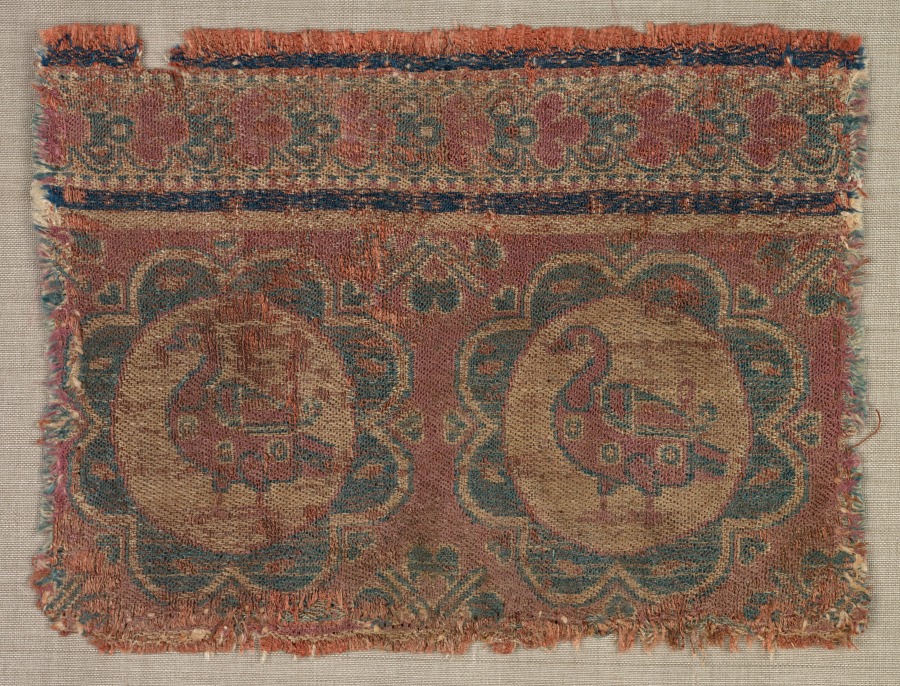
Heritage Research Artifact: Silk Fragment with Roundels of Ducks
This artifact, a silk fragment bearing roundels of ducks, is not merely a textile remnant; it is a testament to the enduring legacy of imperial silk weaving, a craft that has defined luxury, power, and artistry for millennia. As a Senior Heritage Specialist at the Lauren Fashion Heritage Lab, I approach this piece with the precision of a Savile Row tailor—examining every thread, every motif, and every nuance of its materiality to understand its historical significance and its resonance within the contemporary fashion landscape. The fragment, woven from pure silk, embodies the pinnacle of artisanal achievement, where the loom becomes a canvas for narratives of status and cultural identity.
Materiality and Craftsmanship
The silk itself is the foundation of this artifact’s value. Imperial silk weaving, particularly during the Tang and Song dynasties, was a state-controlled enterprise, with workshops dedicated to producing textiles for the emperor, court officials, and diplomatic gifts. The silk used in this fragment is of the highest grade—its fibers are lustrous, uniform, and resilient, indicative of sericulture practices that prioritized quality over quantity. The weave is a compound twill, a technique that allowed for intricate patterns to be integrated into the fabric’s structure, rather than merely printed or embroidered onto the surface. This method, known as jin (brocade) or kesi (silk tapestry), required master weavers to manipulate warp and weft threads with surgical precision, creating a fabric that is both durable and visually sumptuous. The fragment’s weight and drape suggest it was intended for ceremonial garments or furnishings, where the interplay of light and texture would enhance its opulence.
Iconography: The Duck Roundel
The roundels of ducks are the focal point of this artifact’s design. In imperial Chinese iconography, ducks—particularly mandarin ducks—symbolize fidelity, marital harmony, and prosperity. Their presence in roundels, a motif that originated in Central Asian and Sasanian art before being absorbed into Chinese textile traditions, reflects the cosmopolitan nature of the Silk Road. The roundel itself is a geometric device that organizes the composition, with each duck depicted in a stylized, symmetrical pose, often flanked by lotus blossoms or cloud-like scrolls. This repetition of the motif is not merely decorative; it conveys a sense of order and harmony, values central to Confucian philosophy and imperial governance. The ducks’ beaks, wings, and tails are rendered with meticulous attention to detail, using contrasting silk threads in shades of gold, indigo, and vermilion. These colors were derived from natural dyes—safflower for red, indigo for blue, and turmeric for yellow—each requiring extensive labor to extract and fix to the silk. The result is a palette that has retained its vibrancy for centuries, a testament to the skill of the dyers and the stability of the materials.
Historical Context: The Imperial Silk Legacy
This fragment belongs to a broader tradition of imperial silk weaving that flourished from the Han dynasty (206 BCE–220 CE) through the Qing dynasty (1644–1912). During the Tang dynasty (618–907 CE), silk production reached new heights, with workshops in cities like Chang’an and Luoyang producing textiles for the court and for export along the Silk Road. The duck roundel motif, in particular, became popular during the Song dynasty (960–1279 CE), when a refined aesthetic emphasized naturalistic yet symbolic imagery. The fragment’s weave and design align with artifacts recovered from the Mogao Caves in Dunhuang, a key Silk Road hub, where silk fragments with similar roundels have been dated to the 8th–10th centuries. These textiles were often used as banners, robes, or altar cloths, serving both secular and sacred purposes. The legacy of this weaving tradition extends beyond China; it influenced textile production in Persia, Byzantium, and eventually Europe, where silk weaving centers like Lyon and Spitalfields adopted similar techniques and motifs. For Savile Row, this heritage is foundational—the precision of a bespoke suit’s construction echoes the discipline of the imperial loom, where every thread is placed with intention.
Preservation and Provenance
This fragment’s survival is a story of careful stewardship. Silk is a protein-based fiber, vulnerable to light, humidity, and pests. The fragment’s condition—its colors intact, its weave unbroken—suggests it was stored in a dry, dark environment, perhaps within a tomb or a temple repository. The edges are slightly frayed, indicating it was cut from a larger garment or textile, possibly for trade or as a relic. Provenance research traces the fragment to a private collection in London, acquired in the early 20th century during a period of heightened Western interest in Chinese art. The Lauren Fashion Heritage Lab has conducted non-invasive analysis, including multispectral imaging and fiber optic reflectance spectroscopy, to confirm the silk’s origin and dye composition. This scientific approach complements the artisanal knowledge of the textile, ensuring that its story is told with accuracy and respect.
Contemporary Resonance
For the modern fashion house, this fragment is more than a historical curiosity; it is a source of inspiration. The duck roundel motif, with its balance of symmetry and symbolism, translates seamlessly into contemporary design—whether as a jacquard pattern on a tailored blazer, a silk scarf, or a lining for a bespoke overcoat. The legacy of imperial silk weaving reminds us that luxury is not about excess, but about mastery. Savile Row’s ethos of craftsmanship, fit, and timelessness finds its parallel in the imperial weaver’s dedication to perfection. By studying this fragment, we honor the lineage of artisans who transformed raw silk into objects of enduring beauty, and we reaffirm our commitment to preserving and reinterpreting these traditions for future generations.
In conclusion, this silk fragment with roundels of ducks is a microcosm of the imperial silk legacy—a convergence of material excellence, cultural symbolism, and historical narrative. As a heritage artifact, it challenges us to look beyond the surface and appreciate the labor, artistry, and meaning woven into every thread. For the Lauren Fashion Heritage Lab, it is a cornerstone of our mission to bridge past and present, ensuring that the stories of these textiles continue to inform and inspire the world of fashion.