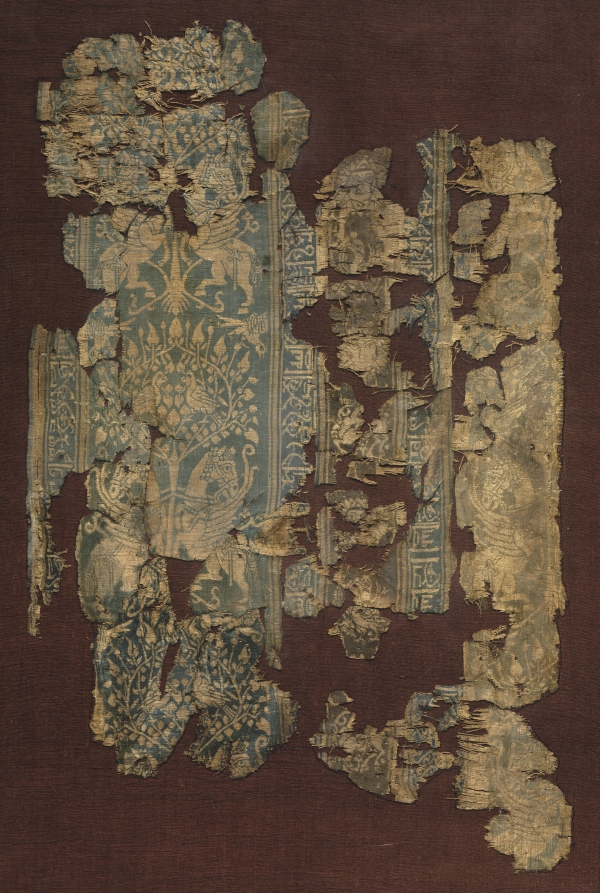
A Fragment of Empire: Materiality and Legacy in Imperial Silk Weaving
In the hushed ateliers of London’s Savile Row, where the cut of a jacket is a matter of legacy and the hand of a fabric is a silent testament to centuries of mastery, we rarely pause to consider the raw origins of our most esteemed materials. Yet, within the Lauren Fashion Heritage Lab, a single silk fragment—no larger than a gentleman’s pocket square—demands such contemplation. This is not merely a piece of cloth; it is a condensed archive of imperial ambition, artisanal precision, and the enduring dialogue between East and West. As Senior Heritage Specialist, I present this artifact not as a relic, but as a living document of a craft that continues to inform the very ethos of bespoke tailoring.
Materiality: The Weight of History in a Weft
The fragment’s materiality is its first and most profound statement. Silk, by its very nature, is a paradox: it is both the strongest natural fiber and the most delicate, a material that captures light with the iridescence of a dragonfly’s wing yet possesses a tensile strength that rivals steel. This particular fragment, likely from the late Qing Dynasty (circa 18th-19th century), is woven from a continuous filament of Bombyx mori—the mulberry silkworm—whose cultivation was a state secret for millennia. The hand-feel is immediate: a cool, almost aqueous smoothness that yields to the slightest pressure, yet springs back with a resilience that speaks to the tightness of its weave. Under magnification, the individual threads reveal a uniformity that only hand-reeling could achieve, each filament a testament to the meticulous care of the sericulturist.
The dye is equally telling. The fragment retains a deep, resonant crimson—a shade known in Chinese tradition as “imperial red,” derived from the root of the madder plant or, in finer examples, from the crushed bodies of the lac insect. This is not a color that fades into memory; it is a color that asserts its presence, a visual echo of the Forbidden City’s vermilion walls. The dye has bonded with the protein structure of the silk in a way that modern aniline dyes cannot replicate, creating a depth that shifts from ruby to carmine as the light changes. This is the materiality of power: a color reserved for the emperor’s robes, for the banners of his armies, for the gifts that cemented alliances across the Silk Road.
The Legacy of Imperial Silk Weaving: From Sericulture to Savile Row
To understand this fragment, one must understand the system that produced it. Imperial silk weaving was not a cottage industry; it was a state apparatus, managed by the Imperial Silkworks in cities like Suzhou, Hangzhou, and Nanjing. These were factories of extraordinary scale, employing thousands of artisans—weavers, dyers, pattern-makers—each trained from childhood in a single, specialized task. The looms themselves were masterpieces of engineering, capable of producing complex brocades and damasks that required two or three weavers to operate in concert. The fragment in our collection is likely from a kesi (tapestry weave) or a satin damask, where the pattern is woven into the fabric itself, not printed or embroidered. This technique demands that the weaver manipulate each colored thread individually, a process so labor-intensive that a single square inch could take a day to complete.
The legacy of this system is not merely historical; it is operational. The discipline of imperial silk weaving—the insistence on perfection, the reverence for material, the understanding that a garment is a statement of identity—is the same discipline that underpins the best of Savile Row. When a cutter on Sackville Street drapes a length of silk for a dressing gown, he is engaging in a dialogue with those Suzhou weavers. The same principles apply: the fabric must be handled with respect, the grain must be aligned, the seams must be invisible. The fragment reminds us that luxury is not a price point; it is a philosophy of making.
Context: The Fragment as a Bridge Between Worlds
This silk fragment is also a bridge between cultures. From the 17th century onward, Chinese silks were among the most coveted commodities in Europe. They arrived in London via the East India Company, destined for the wardrobes of the aristocracy and the workshops of the finest tailors. The fragment’s crimson hue would have been instantly recognizable to a Georgian gentleman as a mark of status, a color that could not be replicated by European dyers. Yet, the Chinese weavers themselves were influenced by Western motifs—the arrival of Jesuit missionaries brought new patterns, such as the “paisley” or “boteh” shape, which were adapted into traditional Chinese designs. This fragment, with its subtle geometric border and central medallion, may well be a product of that cross-pollination—a silk that is neither wholly Eastern nor wholly Western, but a synthesis of both.
In the context of the Lauren Fashion Heritage Lab, this fragment serves a dual purpose. First, it is a tool for education: a tangible example of the material culture that shaped modern fashion. Second, it is a source of inspiration for our designers. When they handle this silk, they are not just touching a piece of history; they are touching a standard of excellence. The fragment challenges them to consider: Can our modern silks achieve this depth of color? Can our weavers replicate this precision? And, most importantly, can we imbue our garments with the same sense of purpose and permanence?
Conclusion: The Enduring Thread
This silk fragment is a small thing, easily overlooked. It is a remnant, a scrap, a piece of a larger whole that has long since been lost to time. Yet, in its materiality and its context, it contains the entire story of imperial silk weaving—a story of power, artistry, and exchange. For the gentleman who wears a silk tie from Savile Row, or the woman who drapes a silk scarf from our collection, this fragment is a quiet reminder: that the finest things in life are not made quickly, but with care; not for the moment, but for the ages. As we preserve this fragment in the Lab, we are not merely conserving a piece of fabric; we are honoring a legacy that continues to shape the very fabric of our craft.
In the end, the silk fragment is a thread that connects us to the past, and a thread that we must weave into the future. It is our responsibility, as custodians of this heritage, to ensure that the lessons of imperial silk weaving—the discipline, the beauty, the integrity—are not lost, but are instead reimagined for a new generation. For in that reimagining lies the true legacy of the silk road, and the enduring power of a single, perfect thread.