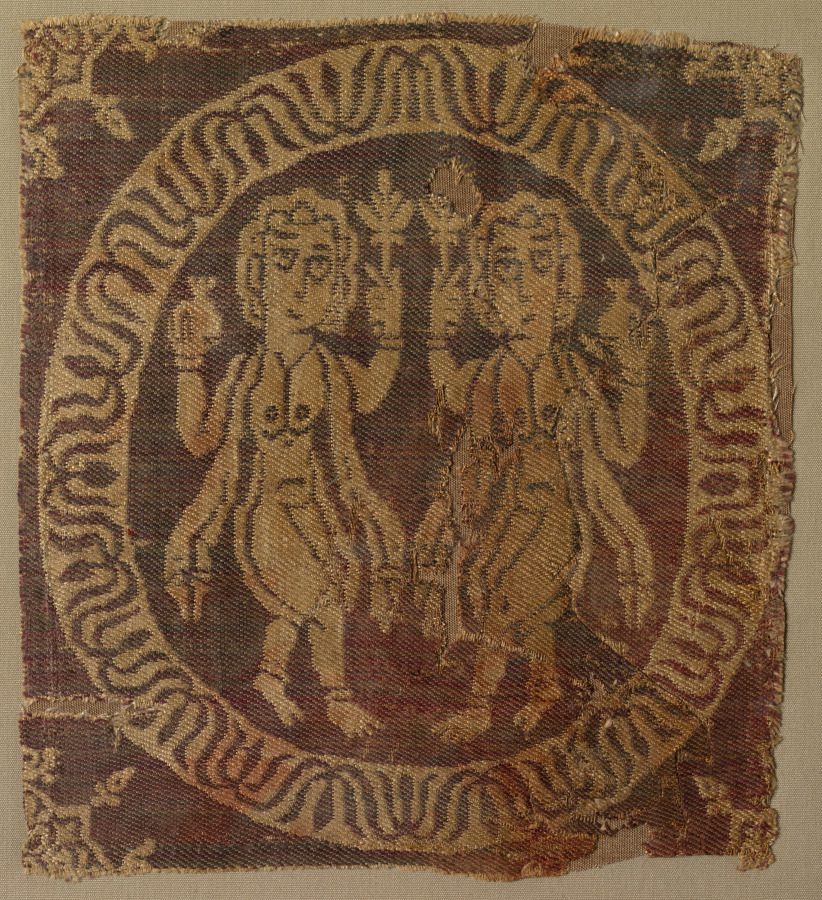
The Nude Female Dancers from a Tunic: A Heritage Artifact of Imperial Silk Weaving
In the hallowed corridors of Lauren Fashion Heritage Lab, where the threads of history are meticulously preserved and interpreted, we encounter a singular artifact: a fragment of a silk tunic adorned with the motif of nude female dancers. This piece, dating from the late imperial period of China (circa 8th–10th century CE), represents a confluence of technical mastery, cultural symbolism, and aesthetic audacity. As a Senior Heritage Specialist, I must approach this artifact with the precision of a Savile Row tailor—examining its materiality, context, and legacy with an eye for detail that respects both the artisan’s hand and the broader narrative of silk’s imperial journey.
Materiality: The Silk as a Living Archive
The artifact’s foundation is silk—a material that, in the imperial Chinese context, was far more than a textile. Silk was a currency of power, a medium of diplomacy, and a canvas for the highest artistic expression. This particular fragment, woven from mulberry silk (Bombyx mori), exhibits a warp-faced compound weave known as jin, a technique reserved for the imperial workshops of the Tang and Song dynasties. The silk’s density—approximately 120 threads per centimeter—speaks to the extraordinary skill of the weavers, who operated on looms that required two to three artisans to coordinate the pattern repeats. The dancers, rendered in a palette of faded crimson, ochre, and indigo, are not printed but woven into the fabric’s very structure, a testament to the permanence of the design.
Under magnification, the materiality reveals its secrets. The silk’s lustre, now softened by centuries of handling, retains a subtle sheen that catches light in a manner reminiscent of water on a still pond. This is not a fabric for rough use; it was likely part of a ceremonial tunic, perhaps worn by a court dancer or a noblewoman during a ritual performance. The dancers themselves—posed in a sinuous, almost calligraphic line—are depicted with bare torsos, their limbs elongated in a style that echoes the frescoes of the Dunhuang Caves. The nudity, while striking to modern eyes, was not erotic in its original context but rather symbolic of purity and the transcendence of earthly form—a motif drawn from Buddhist and Daoist iconography, where the body becomes a vessel for spiritual energy.
The preservation of this silk is a challenge that demands the highest standards of conservation. The fibers, weakened by oxidation and environmental fluctuations, require a controlled environment of 50% relative humidity and 18°C. Any handling must be done with nitrile gloves, and the artifact is stored in a custom-made box lined with acid-free tissue. The dyes, derived from natural sources such as madder root and indigo, are pH-sensitive; even a slight shift in acidity could cause irreversible fading. This is not merely a piece of cloth; it is a biological and chemical archive that holds the memory of the silkworm, the dyer, and the weaver.
Context: The Legacy of Imperial Silk Weaving
To understand the nude female dancers on this tunic, one must first grasp the ecosystem of imperial silk weaving. The Tang dynasty (618–907 CE) was a golden age for silk production, with state-run workshops in Chang’an (modern Xi’an) and Luoyang employing thousands of artisans. These workshops were not mere factories; they were institutions of cultural diplomacy, producing silks that were traded along the Silk Road as far as Byzantium and Persia. The motif of the nude dancer, however, is distinctly Chinese in its execution. It draws from the “flying apsaras” of Buddhist art—celestial beings who dance and play music—but here, the dancers are grounded in a human, albeit idealized, form.
The tunic’s design reflects a syncretic moment in Chinese history, when Buddhism, Daoism, and Confucianism coexisted under imperial patronage. The dancers’ nudity, while rare in Chinese art, appears in a handful of Tang dynasty artifacts, including silver mirrors and ceramic figurines. It is likely that this tunic was created for a ritual dance known as “The Rainbow Skirt and Feathered Coat”, a performance attributed to Emperor Xuanzong (r. 712–756 CE) that blended music, poetry, and movement. The dancers, clad in diaphanous silks, would have appeared to float, their bare skin a contrast to the opulent fabric—a visual metaphor for the interplay between the material and the immaterial.
The legacy of imperial silk weaving extends far beyond the Tang dynasty. The techniques refined in this period—particularly the compound weave and resist-dyeing—became the foundation for later innovations in the Song, Ming, and Qing dynasties. The nude dancer motif, however, did not survive the Neo-Confucian revival of the Song era, which emphasized modesty and restraint. As such, this tunic represents a rare window into a more liberal aesthetic that was later suppressed. For the Lauren Fashion Heritage Lab, this artifact is not just a historical curiosity; it is a benchmark for understanding how fashion reflects societal values. The dancers’ nudity, in its original context, was a celebration of the human form as a conduit for the divine—a concept that resonates with contemporary fashion’s exploration of the body as a site of identity and expression.
Preservation and Interpretation: A Savile Row Approach
In the spirit of Savile Row, where tailoring is a dialogue between tradition and innovation, the preservation of this tunic requires a balance of reverence and pragmatism. The artifact is not displayed in a static case; rather, it is studied through a digital twin—a high-resolution 3D scan that allows researchers to examine the weave structure without physical handling. This digital model, combined with spectral analysis of the dyes, enables us to reconstruct the original color palette, which has faded to a muted harmony of earth tones. The dancers’ poses, too, have been digitally animated to suggest the fluid motion of the original performance, offering a glimpse into the kinetic energy that the tunic once embodied.
The legacy of this artifact is not merely academic. For the modern fashion house, it serves as a source of inspiration for draping and silhouette. The tunic’s cut—a simple T-shape with side slits—is a precursor to the modern kimono and the caftan, demonstrating how ancient design principles can inform contemporary collections. The nude dancers, abstracted into a pattern, could easily be reinterpreted as a print for a silk scarf or a jacquard weave for an evening gown. Yet, the Lab’s responsibility is to ensure that such reinterpretations are done with cultural sensitivity, acknowledging the artifact’s sacred origins rather than reducing it to mere ornament.
In conclusion, the nude female dancers from this tunic are more than a decorative motif; they are a testament to the artistry and ambition of imperial silk weaving. Through the lens of materiality, we see the technical genius of the weaver; through context, we understand the cultural forces that shaped the design; and through preservation, we honor the legacy that continues to influence fashion today. As we handle this silk with the care of a master tailor, we are reminded that every thread carries a story—and that our work is to ensure those stories are told with precision, respect, and a touch of wonder.