← BACK TO ARCHIVES
Heritage-Black
Heritage Synthesis: Terracotta fragment of a kylix (drinking cup)
Curated on May 03, 2026 // Node: LDN-01
The Terracotta Kylix and the Architecture of Restraint: Recasting Attic Symmetry for the 2026 Old Money Silhouette
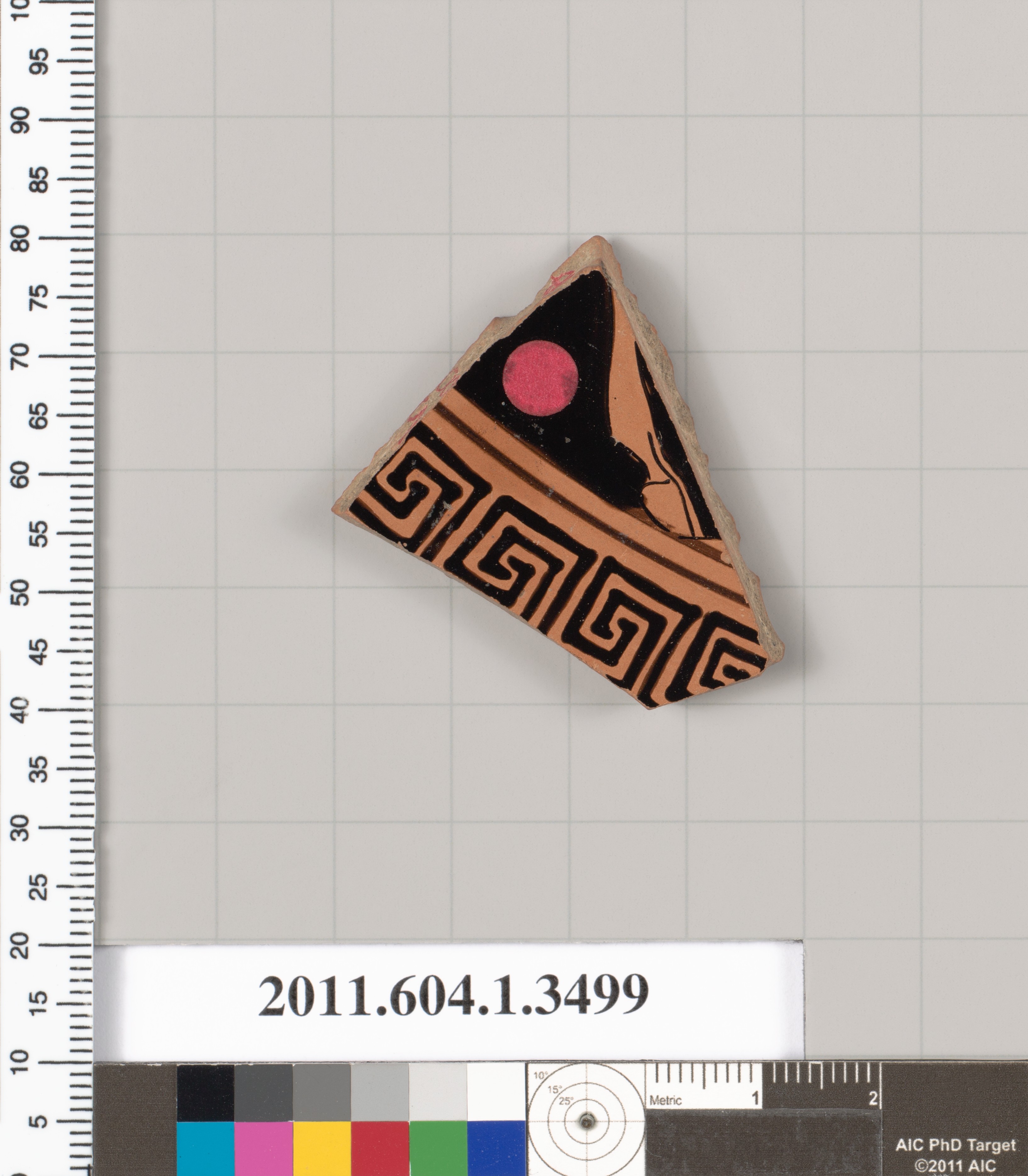
The museum artifact before us—a terracotta fragment of an Attic kylix, a Greek drinking cup from the 5th century BCE—appears, at first glance, a world apart from the silk scrolls of Wang Wei’s *Wangchuan Villa* or the bronze ritual knives of ancient China. Yet, within the Lauren Fashion Heritage Lab’s genetic code, this shard of fired clay resonates with the same profound principle of *qi yi zai dao* (器以载道): the vessel carries the Way. Where the *Wangchuan Villa* scroll is a vessel for spiritual dwelling, and the *San Chuan Li Dao* (三穿礼刀) is a vessel for ritual power, the kylix fragment is a vessel for *symposium*—the Greek ritual of communal drinking, philosophical discourse, and social bonding. Its broken rim, painted with a single black-figure band of meander pattern, speaks not of destruction but of a distilled essence: the geometry of civilized restraint. This fragment, when read through the lens of Old Money aesthetics, offers a precise architectural vocabulary for the 2026 silhouette: one defined by controlled volume, calibrated proportion, and the quiet authority of unadorned form.
From Symposium to Silhouette: The Kylix as a Blueprint for Social Geometry
The kylix was not merely a cup; it was a social instrument. Its shallow bowl, wide mouth, and twin handles were designed for the *symposium*—a space where wine, poetry, and politics mingled in a choreographed dance of equality and hierarchy. The meander pattern, a continuous geometric band, served as a visual frame, containing the chaotic potential of wine-induced abandon within a strict order. This is the first lesson for the 2026 Old Money silhouette: **the body as a contained vessel**. The kylix’s form—a broad, stable base rising to a gently flaring rim—translates directly into the architectural lines of a coat or a dress. The 2026 silhouette will reject the exaggerated volume of the 2020s (the puff sleeve, the oversized shoulder) and instead embrace a *controlled expansion*. Think of a double-breasted cashmere coat with a subtle A-line from the waist, its hem echoing the kylix’s flaring lip. The fabric, like the terracotta, must be substantial yet refined—a heavy wool or a dense cashmere—to hold its shape without stiffness. The meander pattern, reinterpreted, becomes a subtle pinstripe or a jacquard weave on a blazer’s lapel, a quiet nod to classical order that only the discerning eye will recognize.
The kylix’s handles, often decorated with palmettes or ivy leaves, are another key element. They are functional yet ornamental, projecting outward but never disrupting the vessel’s overall harmony. In the 2026 silhouette, this translates to **strategic, sculptural detailing**. A sleeve cuff that flares slightly, a collar that stands away from the neck, a pocket flap that is precisely angled—these are the “handles” of the garment. They are not mere embellishments but structural components that guide the eye and define the silhouette’s rhythm. For instance, a black wool trouser with a subtle, seamed pleat at the hip—reminiscent of the kylix’s handle attachment—creates a line of tension and release, a visual echo of the symposium’s balance between leisure and discipline.
The Terracotta Palette: The Materiality of Silence
The terracotta fragment’s color—a warm, earthy orange-red, fired to a matte finish—is not a color of statement but of *presence*. It is the color of the earth from which it was born, a material that carries the memory of its origin. In the context of Old Money aesthetics, this palette is the antithesis of the synthetic, the loud, the trend-driven. The 2026 silhouette will privilege **earthy neutrals**—terracotta, ochre, umber, and the deep black of the Greek *black-figure* technique—over the bright whites and saturated blues of previous seasons. These are not “safe” colors; they are *authoritative* colors, the pigments of antiquity that have weathered centuries. A Heritage-Black cashmere turtleneck, paired with a terracotta wool skirt, creates a dialogue between the vessel (the black, containing) and the earth (the terracotta, grounding). The matte finish of the terracotta is crucial: it rejects the high-shine of synthetic fabrics, demanding instead the soft, lived-in luster of natural fibers—cashmere, wool, linen, silk. This is the material equivalent of the kylix’s patina, a surface that speaks of use, of ritual, of time.
Fragmentation as Design Principle: The Beauty of the Incomplete
Perhaps the most provocative lesson from the kylix fragment is its *incompleteness*. It is a shard, a remnant of a whole we can only imagine. This is not a flaw but a design principle for the 2026 Old Money silhouette: **the power of the unfinished**. In an era of overconsumption and fast fashion, the fragment suggests a new luxury: the luxury of *restraint* and *implication*. A garment need not be fully adorned to be complete. A single, precise cut—a slash at the neckline, a slit at the hem—can evoke the missing portion of the kylix, inviting the viewer to complete the form in their mind. This is the essence of the *Old Money* aesthetic: it does not shout; it whispers. It suggests wealth and taste through what is *absent* rather than what is present. A silk dress with an asymmetrical hem, one side falling to the knee, the other to the calf, echoes the broken rim of the kylix. The missing fabric becomes a statement of confidence, a refusal to adhere to the tyranny of the whole.
Conclusion: The Vessel as Identity
The terracotta kylix fragment, like the *Wangchuan Villa* scroll and the *San Chuan Li Dao* knife, is a vessel—not for wine, but for a worldview. It teaches us that the 2026 Old Money silhouette is not about fashion in the ephemeral sense, but about *architecture for the body*. It is a structure of controlled volume, geometric precision, and material integrity. The meander pattern becomes the line of a seam; the terracotta hue becomes the color of a coat; the broken rim becomes the cut of a hem. In this, the kylix fragment is not a relic of the past but a blueprint for the future—a future where clothing, like the ancient cup, is a vessel for the Way: the way of quiet power, of timeless grace, of the profound statement made through the most restrained of forms. The 2026 silhouette will be a vessel, and in its emptiness, it will contain everything.
Heritage Lab Insight
Genetic Bridge: Archive node focusing on Heritage-Black craftsmanship.