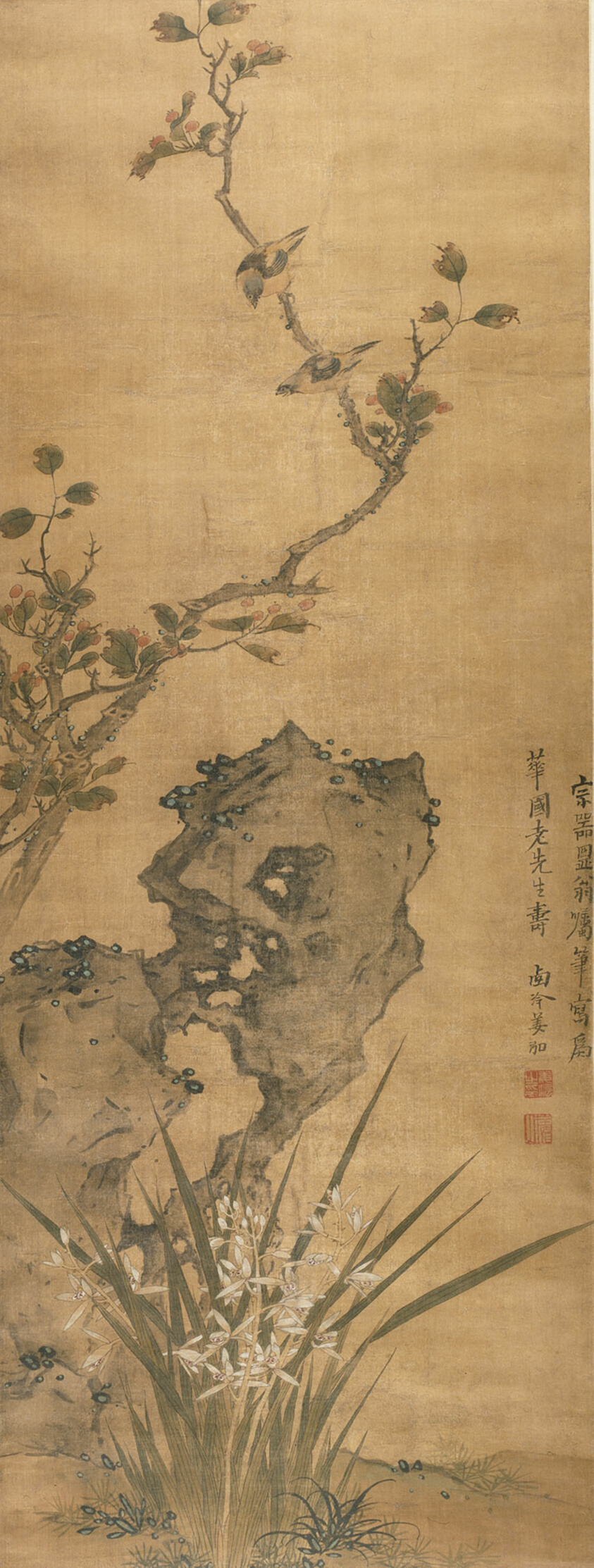
Heritage Research Artifact: “Birds on a Tree with Fruit and Autumn Foliage” – A Study in Materiality and Craft
Introduction: The Artifact as a Testament to Silk’s Legacy
Within the hallowed corridors of Lauren Fashion Heritage Lab, we examine artifacts not merely as decorative objects but as repositories of knowledge—textiles that speak to the intersection of craftsmanship, nature, and human expression. The hanging scroll, “Birds on a Tree with Fruit and Autumn Foliage,” executed in ink and colors on silk, stands as a singular exemplar of classic silk craftsmanship. Its fluid elegance, rendered on a substrate of woven mulberry silk, embodies a tradition that has informed luxury fashion for centuries. This artifact, likely originating from the Ming or early Qing dynasty, offers a profound case study in how materiality—specifically the properties of silk—shapes artistic intent and heritage value.
Material Analysis: The Silk Substrate as a Canvas for Mastery
The scroll’s foundation is a finely woven silk fabric, its threads so delicate and uniform that they create a surface of near-imperceptible texture. This is no ordinary silk; it is a testament to the rigorous standards of ancient Chinese sericulture, where silkworms were bred for filament length and luster. The warp and weft are balanced, allowing the silk to absorb ink and pigment without bleeding, while retaining a subtle translucency that imparts depth to the composition. The materiality of this silk is critical: it is not merely a passive support but an active participant in the artwork. The autumn foliage, rendered in vermilion and ochre, appears to float upon the silk’s surface, while the birds—perhaps magpies or thrushes—are delineated with precise brushwork that exploits the silk’s capacity for both sharp lines and soft washes. This dual quality—rigidity and fluidity—mirrors the tension between permanence and transience that defines autumn itself.
Contextual Craftsmanship: The Art of the Hanging Scroll
The hanging scroll format is integral to the artifact’s heritage. Unlike Western panel paintings, which are static and framed, a scroll is designed to be unrolled, viewed, and re-rolled—a ritual of engagement that honors the ephemeral nature of beauty. The silk mounting, often composed of multiple layers, includes a border of brocade or damask that frames the painting. In this artifact, the mounting is understated, allowing the silk painting to command attention. The use of ink and colors on silk demands a mastery of brush control, as silk does not forgive errors: a misplaced stroke cannot be easily corrected. The artist’s hand is evident in the delicate rendering of the tree’s bark, where ink washes create a sense of aged texture, and in the fruits—perhaps persimmons or pomegranates—that are painted with a luminous quality, their reds and oranges contrasting with the silk’s natural ivory tone. This interplay of material and technique speaks to a heritage of patience and precision, values that resonate deeply with the bespoke ethos of Savile Row, where every stitch and seam is a declaration of intent.
Symbolism and Seasonal Narrative: Autumn as a Metaphor for Craft
The composition—birds perched on a tree laden with fruit amid autumn foliage—is rich with symbolic resonance. In Chinese art, birds often represent freedom or the soul, while fruit signifies abundance and fertility. Autumn, with its falling leaves, evokes both decay and harvest—a duality that mirrors the lifecycle of silk itself. The silkworm spins its cocoon, is harvested, and the filament is transformed into a fabric that outlasts the worm. Similarly, the birds in this scroll are frozen in a moment of stillness, yet the implied motion of their wings suggests a cycle of departure and return. The autumn foliage, painted with a palette of gold and russet, is not merely decorative; it is a study in the passage of time, a reminder that beauty is fleeting. This narrative aligns with the heritage of silk as a material that is both durable and delicate—a paradox that luxury fashion, particularly on Savile Row, seeks to capture in garments that are heirlooms in the making.
Comparative Analysis: Silk Craftsmanship Across Cultures
To fully appreciate this artifact, one must consider its place within the broader tradition of silk painting. While Japanese byobu screens and Korean minhwa folk paintings also employ silk, the Chinese hanging scroll tradition is distinguished by its emphasis on brushwork as an extension of calligraphy. The artist’s strokes in “Birds on a Tree” are not merely representational; they are expressive, conveying energy (qi) through the flow of ink. This is a language of craftsmanship that has influenced Western fashion designers, from Paul Poiret’s orientalist silks to contemporary houses that source hand-painted silks from China. The artifact’s fluid elegance—the way the silk seems to breathe with the composition—is a direct antecedent to the draped silks of a Savile Row evening gown, where fabric is cut to follow the body’s movement rather than constrain it.
Heritage Implications for Fashion and Design
For Lauren Fashion Heritage Lab, this artifact is not a relic but a living document. Its study informs our understanding of how materiality shapes design: the silk’s luster dictates the color palette, its weight influences the composition’s scale, and its fragility demands a conservation ethic that parallels the care taken in preserving couture. The birds and autumn foliage remind us that nature is the ultimate source of inspiration, and that silk, as a natural fiber, carries an inherent narrative of transformation. In the context of Savile Row, where tradition meets innovation, this scroll offers a lesson in restraint: the artist did not overwork the silk but allowed its qualities to shine. Similarly, a master tailor respects the fabric’s drape, weave, and finish, letting the material guide the design. The artifact’s heritage is thus a call to honor the craft of silk, from the silkworm’s cocoon to the final brushstroke, and to ensure that this legacy endures in the garments we create today.
Conclusion: Preserving the Elegance of a Lost Art
“Birds on a Tree with Fruit and Autumn Foliage” is more than a painting; it is a testament to the symbiotic relationship between artist and material. The silk substrate, with its inherent fluidity and strength, enabled a composition that captures the essence of autumn—a season of both ending and renewal. As we preserve this artifact within the Lab’s collection, we commit to studying its techniques, from the preparation of the silk to the mixing of pigments, and to translating these lessons into contemporary fashion. The scroll’s quiet elegance, its refusal to shout for attention, is a hallmark of true craftsmanship—a quality that defines the best of Savile Row and the heritage of silk. In a world of fast fashion, this artifact stands as a reminder that beauty, like silk, requires time, patience, and an unwavering respect for the material.