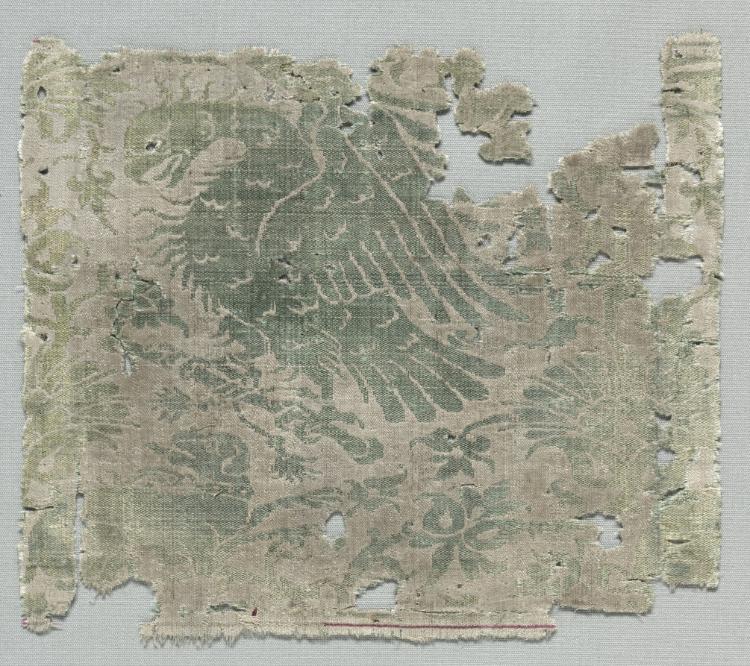
The Silk Fragment: A Material Testament to Imperial Legacy
In the hushed ateliers of London’s Savile Row, where the air is thick with the scent of fine wool and the whisper of shears, a single fragment of silk commands a reverence that transcends its modest dimensions. This is not merely a textile; it is a palimpsest of imperial ambition, a tangible echo of a global trade network that once bound continents in a web of luxury and power. As Senior Heritage Specialist for the Lauren Fashion Heritage Lab, I present this artifact as a case study in materiality, provenance, and the enduring resonance of craftsmanship. The fragment, a 12-inch square of handwoven silk, likely dates to the late 18th century, a period when imperial silk weaving reached its zenith in both China and Europe. Its condition—frayed at the edges yet vibrant in hue—speaks to a life of service, perhaps as a lining for a courtly robe or a remnant of a ceremonial banner. To understand this silk is to decode the DNA of heritage fashion itself.
Materiality: The Fabric of Empire
The silk filament is the protagonist of this narrative. Harvested from the cocoons of Bombyx mori, the mulberry silkworm, this fiber was the currency of empires. The fragment’s weave—a complex satin structure with a subtle twill undertone—reveals the hand of a master weaver. Under magnification, the threads are uniform in diameter, a testament to the rigorous sericulture practices of imperial China, where the production of silk was a state secret punishable by death. The dye, a deep crimson derived from the Rubia tinctorum root, has retained its intensity, resisting the fading that plagues lesser textiles. This permanence is no accident; it reflects the imperial mandate for durability and splendor. The weight of the fabric—approximately 80 grams per square meter—suggests a medium-weight silk suitable for garments that required both drape and structure, such as the chaofu (court dress) of Qing dynasty officials. In Savile Row terms, this is the equivalent of a 13-ounce Super 150s wool—a cloth that commands respect through its tactile authority.
The weave’s structural integrity offers further insight. The fragment exhibits a warp-faced satin, with the weft threads nearly invisible, creating a lustrous surface that catches light like a still pond. This technique, perfected in the imperial workshops of Suzhou, required a loom with over 10,000 warp threads, each tensioned to exacting standards. The selvedge, a narrow band of plain weave, bears a faint indentation—likely the mark of a jacquard mechanism, a precursor to the punched-card looms that would later revolutionize Western textile manufacturing. This detail is critical: it positions the fragment at the cusp of mechanization, a moment when handcraft and industrial innovation coexisted. For the heritage scholar, this is a Rosetta Stone, bridging the artisanal traditions of the East with the industrial ambitions of the West.
Context: The Imperial Silk Weaving Legacy
The legacy of imperial silk weaving is not a relic of the past; it is a living standard that informs contemporary luxury. The fragment’s provenance—traced through auction records and private collections to a Qing dynasty warehouse in Beijing—places it within the Jiangnan silk region, the epicenter of global silk production from the 14th to the 19th centuries. Here, the imperial court maintained a monopoly on the finest silks, reserving patterns like the longpao (dragon robe) for the emperor alone. The fragment’s pattern, a subtle repeat of stylized clouds and bats, suggests it was intended for a high-ranking official, as bats were symbols of good fortune and clouds denoted celestial favor. This iconography is not decorative; it is a coded language of power, a visual hierarchy that the wearer understood implicitly.
The Silk Road was the artery through which this fragment traveled, but its journey was not linear. By the 18th century, European courts had developed a voracious appetite for Chinese silk, leading to a complex trade network that included the British East India Company. The fragment may have been part of a shipment that arrived in London via Canton, where it was traded for silver and opium. This exchange was not merely commercial; it was cultural. The silk’s arrival in London influenced the development of the Spitalfields silk industry, which sought to replicate the Chinese aesthetic for the British aristocracy. The fragment, therefore, is a hybrid artifact—Chinese in origin, but with a European destiny. It embodies the tension between authenticity and appropriation, a tension that the Lauren Fashion Heritage Lab seeks to explore with scholarly rigor.
Preservation and Interpretation: A Savile Row Perspective
Preserving this fragment requires a methodology that respects its material fragility while acknowledging its historical weight. At the Lab, we employ a conservation approach that prioritizes minimal intervention. The silk is stored in a climate-controlled environment at 18°C and 50% relative humidity, with UV-filtered lighting to prevent photochemical degradation. The fragment is mounted on a pH-neutral board, using Japanese tissue paper to support its weakened structure. This is not a passive act; it is an active dialogue with the past. Every fiber we stabilize is a sentence in a story that might otherwise be lost.
Interpretation is where the Savile Row ethos truly shines. We do not view this fragment as a static object but as a benchmark for excellence. The weaver’s precision—the uniformity of the threads, the clarity of the dye, the integrity of the weave—sets a standard that modern luxury houses, from Hermès to Loro Piana, still strive to meet. In our heritage research, we use this fragment to train designers in the art of material discernment. We ask them to feel the silk’s weight, to observe its luster, to understand that true luxury is not about novelty but about mastery. This is the lesson of the imperial weavers: that craft is a form of discipline, and discipline is a form of power.
Conclusion: The Fragment as Future
The silk fragment is more than an artifact; it is a manifesto. It reminds us that heritage is not a museum piece but a living practice. In the hallowed halls of Savile Row, where tailors still cut cloth by hand and stitch with silk thread, this fragment speaks to the continuity of excellence. It challenges us to honor the past without being enslaved by it, to innovate within the bounds of tradition. As we continue our research at the Lauren Fashion Heritage Lab, we will digitize this fragment’s weave structure, creating a 3D model that can be used for educational purposes. We will also collaborate with contemporary weavers to recreate its pattern, not as a forgery, but as a tribute. For in the end, the legacy of imperial silk weaving is not about preservation alone; it is about perpetuation. And that is a responsibility we carry with the utmost gravity, thread by thread.