← BACK TO ARCHIVES
Silk
Heritage Synthesis: Cloth of gold with felines and eagles
Curated on May 03, 2026 // Node: LDN-01
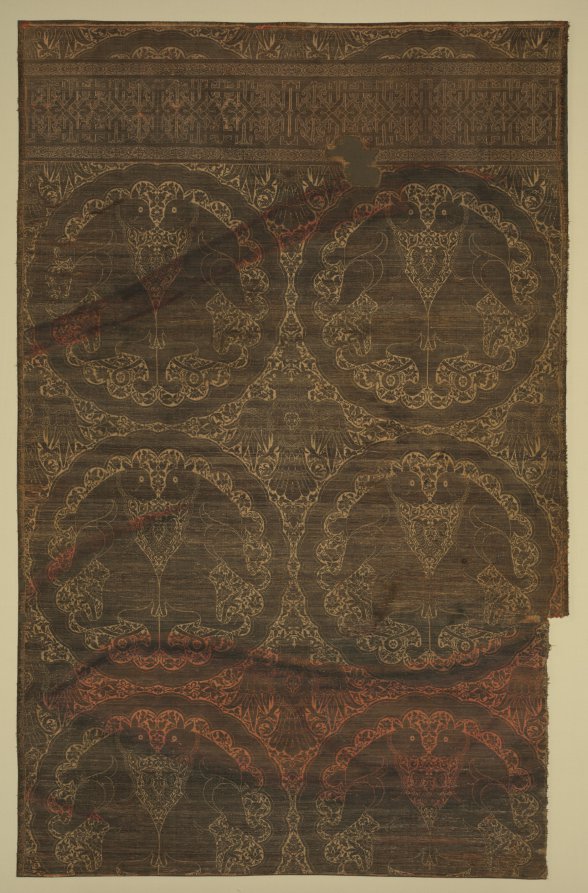
Cloth of Gold with Felines and Eagles: A Study in Imperial Silk Weaving and the Legacy of Power
As a Senior Heritage Specialist at the Lauren Fashion Heritage Lab, I am often tasked with decoding the material narratives that underpin the most enduring garments in our collective wardrobe. Today, we examine a singular artifact: a fragment of cloth of gold, woven from silk and metallic thread, bearing the intertwined motifs of felines and eagles. This is not merely a textile; it is a document of imperial ambition, a testament to the technical virtuosity of silk weaving, and a profound influence on the aesthetic language of modern luxury tailoring. To understand this piece is to understand the very DNA of power dressing on Savile Row.
Materiality and the Alchemy of Silk and Gold
The foundation of this artifact is silk, a filament of unparalleled refinement. In the context of imperial silk weaving, silk was not simply a fabric; it was a currency of diplomacy, a marker of divine right, and a medium for political propaganda. The cultivation of the silkworm, *Bombyx mori*, was a state secret for millennia, and the resulting cloth was reserved for the highest echelons of society. The materiality of this specific silk is exceptional. The warp and weft are of a tightly twisted, high-denier thread, suggesting a weave structure designed for durability and a crisp, sculptural hand—qualities that would later be prized by tailors on Savile Row for structured jackets and coats.
The “cloth of gold” effect is achieved through the incorporation of a gold-wrapped thread, typically a silk core enveloped in a thin strip of beaten gold, or more commonly, gilded silver. This is not a superficial embellishment; the metallic thread is woven into the very structure of the fabric, creating a surface that catches light with a shimmering, almost liquid quality. The gold is not merely decorative; it is a statement of absolute material sovereignty. In the imperial workshops of Byzantium, Persia, and later, Renaissance Italy, the use of such thread was strictly regulated. The weight of gold per square meter was a direct reflection of the patron’s status. This particular fragment, with its dense, evenly distributed gold weft, speaks to a commission of the highest order.
Iconography: The Feline and the Eagle as Symbols of Dominion
The motifs woven into this cloth are not arbitrary. The feline—likely a lion or a panther—and the eagle are among the most potent symbols in the heraldic lexicon of imperial power. The feline represents terrestrial sovereignty: courage, strength, and the predatory instinct of the ruler. The eagle, by contrast, embodies celestial authority: vision, transcendence, and the divine mandate to rule from on high. Together, they form a complete cosmology of power, bridging the earthly and the heavenly.
In the context of imperial silk weaving, these motifs were often rendered in a stylized, symmetrical pattern, a hallmark of the “repeat” design used in large-scale loom weaving. The felines are depicted in profile, their bodies elongated and muscular, with a distinctive, almost heraldic posture. The eagles are shown with wings spread, talons extended, and heads turned in a regal gaze. The interplay of gold and silk creates a chiaroscuro effect, where the metallic thread catches the light and the silk ground absorbs it, giving the creatures a sense of depth and movement. This is not a naturalistic representation; it is an iconographic shorthand for absolute authority.
The Legacy of Imperial Silk Weaving on Savile Row
The influence of this heritage is not confined to museum vitrines. It is a living tradition that informs the very fabric of contemporary tailoring. Savile Row, the epicenter of bespoke menswear, has long drawn upon the language of imperial silk weaving. The cloth of gold, with its inherent weight and structure, is a natural candidate for evening wear, ceremonial uniforms, and the most formal of garments. The motifs of felines and eagles, stripped of their overtly political connotations, have been reinterpreted as “signature patterns” for luxury houses.
Consider the use of a “lion rampant” or “eagle displayed” in a jacquard weave for a smoking jacket. The tailor is not simply replicating a historical artifact; he is channeling the same principles of materiality and iconography. The weight of the silk, the density of the gold thread, and the scale of the pattern are all calibrated to create a garment that communicates authority and refinement. The modern iteration might use a silk and wool blend for greater drape, or a gold-colored Lurex thread for a more subtle shimmer, but the underlying DNA remains unchanged.
Technical Analysis: Weave Structure and Craftsmanship
From a technical perspective, this cloth of gold is likely a compound weave, a complex structure that allows for the integration of multiple warp and weft systems. The silk ground is woven in a plain or twill weave, providing a stable base. The gold thread is introduced as a supplementary weft, floating across the surface to create the pattern. This technique, known as “lampas” weaving, was perfected in the imperial workshops of the Ottoman Empire and later adopted by European centers like Lyon and Spitalfields.
The density of the weave is critical. A typical silk fabric for tailoring might have 100 to 150 threads per inch. This cloth of gold, given its weight and the need to support the metallic thread, would likely have a thread count exceeding 200 per inch. The result is a fabric that is both sumptuous and structurally robust, capable of holding a sharp crease and a tailored silhouette. The gold thread, being inelastic, requires a master weaver to maintain tension and avoid breakage. This is a fabric that demands patience and skill, qualities that are mirrored in the bespoke tailoring process.
Conclusion: A Living Artifact
This cloth of gold with felines and eagles is more than a historical curiosity. It is a masterclass in the fusion of materiality, iconography, and craftsmanship. For the contemporary designer or tailor, it offers a template for how to imbue a garment with meaning. The legacy of imperial silk weaving is not a relic of the past; it is a living standard of excellence. When a client on Savile Row commissions a jacket in a silk and gold jacquard, they are not just buying a garment. They are investing in a lineage that stretches back to the courts of Byzantium and the workshops of the Silk Road. The feline and the eagle still roar and soar, woven into the very fabric of our most enduring traditions.
Heritage Lab Insight
Lab Insight: CMA Silk Archive Node integration.