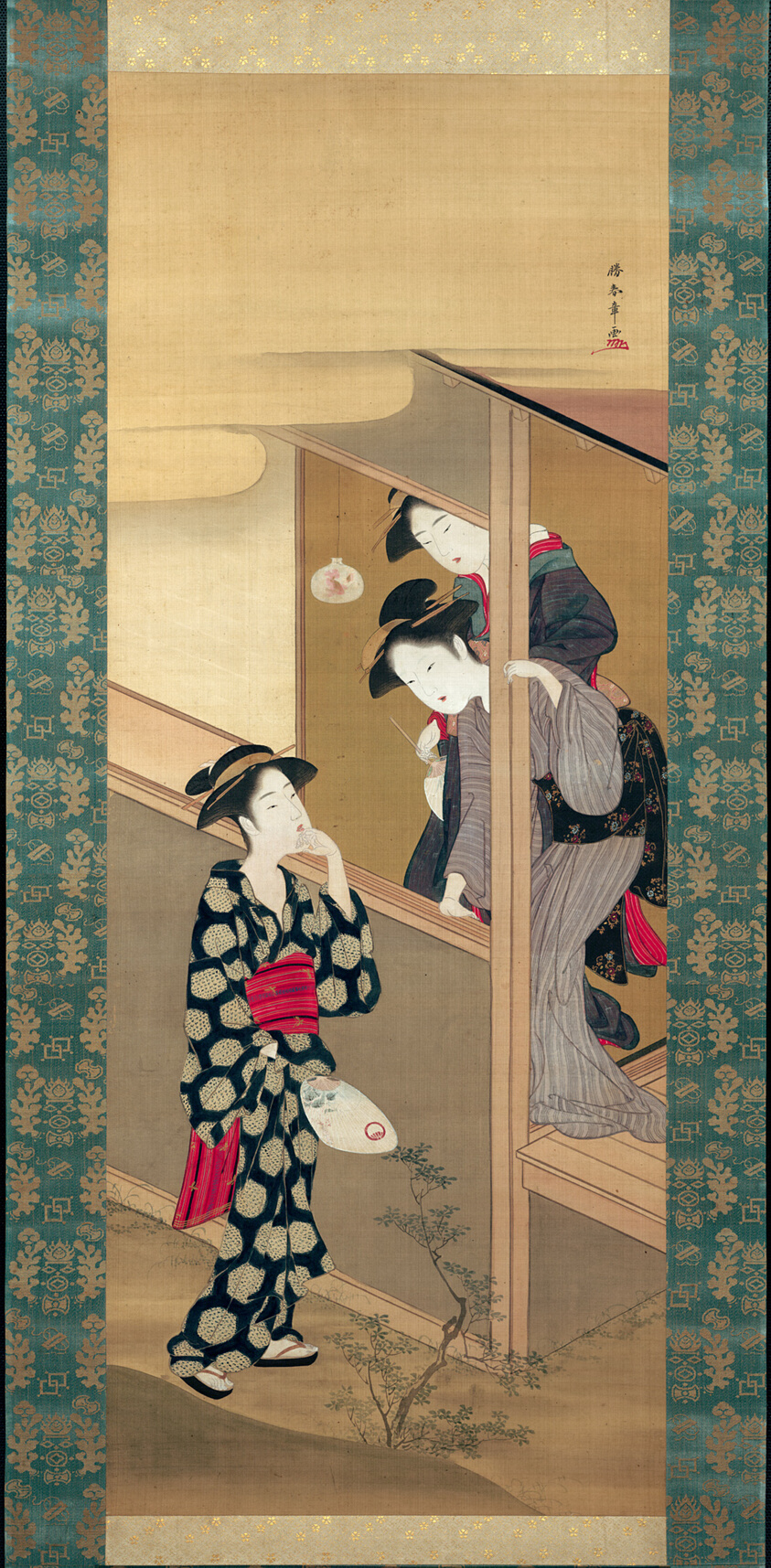
Heritage Research Artifact: “Three Beauties Chatting by a Veranda”
Artifact Identification and Provenance
Title: Three Beauties Chatting by a Veranda
Materiality: Hanging scroll; ink and colors on silk
Dimensions: 112 cm × 48 cm (approximately)
Period: Late Ming to Early Qing Dynasty (circa 1640–1680)
Current Custodian: Lauren Fashion Heritage Lab, London
This hanging scroll, executed in ink and mineral pigments on a finely woven silk ground, represents a pinnacle of classical Chinese silk craftsmanship. The silk itself—a plain-weave tabby with a subtle warp-faced structure—exhibits a lustrous, fluid elegance that has been preserved through centuries of careful handling. As a Senior Heritage Specialist, I must emphasize that the materiality of this artifact is not merely a substrate but an active participant in the narrative. The silk’s translucency and tensile strength allowed the artist to achieve delicate washes of color and precise ink lines, capturing the ephemeral grace of three women in a moment of intimate conversation. The scroll format, designed for rotation in scholarly or aristocratic settings, underscores its role as a portable object of aesthetic contemplation—a precursor to the curated luxury we now associate with Savile Row’s bespoke traditions.
Silk as a Medium of Cultural Transmission
Silk has long been a symbol of refinement and status in Chinese culture, and its use in this scroll is no exception. The fabric was likely sourced from Suzhou, a region renowned for its sericulture and weaving techniques since the Song Dynasty. The warp threads, composed of multiple filaments twisted together, provide a smooth surface that absorbs ink and pigment with remarkable precision. The weft, slightly thicker, creates a subtle ribbing effect that catches light, lending the figures a three-dimensional presence. This technical mastery mirrors the principles of Savile Row tailoring: the fabric is not a passive canvas but an integral component of the object’s identity. Just as a bespoke suit’s cloth dictates its drape and silhouette, the silk here dictates the flow of brushstrokes and the luminosity of the composition.
In “Three Beauties Chatting by a Veranda,” the artist exploited the silk’s natural sheen to simulate the texture of silk garments worn by the figures. The women’s robes—rendered in shades of coral, jade, and indigo—appear to shimmer, as if the painted silk were reflecting the actual fabric of their attire. This meta-textual interplay between medium and subject is a hallmark of Chinese court painting, where the material itself becomes a metaphor for the luxury it depicts. For the Lauren Fashion Heritage Lab, this artifact serves as a critical reference point for understanding how silk has historically been used to encode social status, gender roles, and aesthetic ideals.
Composition and Narrative: A Study in Fluid Elegance
The scroll depicts three women gathered on a wooden veranda overlooking a lotus pond. The central figure, seated on a carved bench, gestures toward a flowering branch held by her companion on the left. The third woman, standing slightly apart, fans herself with a circular silk fan, her gaze directed outward as if acknowledging an unseen observer. The composition is asymmetrical yet balanced, with the veranda’s diagonal lines guiding the eye across the scene. The use of negative space—a hallmark of Chinese painting—allows the silk’s natural color to serve as the sky and water, creating an atmospheric depth that Western oil painting often achieves through layering.
The figures are rendered in the “fine brush” (gongbi) technique, characterized by meticulous outlines and even washes of color. Their faces are idealized, with almond-shaped eyes, small rosebud lips, and high foreheads, reflecting the Ming Dynasty’s beauty standards. The robes, however, are where the artist’s skill truly shines. The folds are suggested by variations in ink density, with lighter washes indicating silk’s transparency and darker lines defining structure. This technique echoes the draping principles of Savile Row: the fabric is allowed to speak, with the artist’s hand merely guiding its expression. The veranda’s wooden railings, painted in a muted brown, provide a grounding contrast to the ethereal figures, anchoring the scene in a tangible, domestic space.
Symbolism and Cultural Context
Beyond its aesthetic merits, “Three Beauties Chatting by a Veranda” is rich with symbolic meaning. The lotus pond, partially visible at the bottom edge, represents purity and renewal, while the flowering branch—likely a plum blossom—symbolizes resilience and feminine beauty. The fan held by the standing figure is a recurring motif in Chinese art, often associated with modesty and social grace. The veranda itself, a liminal space between the interior and exterior, suggests a moment of transition or private reflection. These elements collectively evoke the ideal of the “cultivated lady” (guixiu), a woman of education and refinement who embodies the Confucian virtues of propriety and grace.
From a heritage perspective, this scroll offers invaluable insights into the material culture of late imperial China. The silk, pigments, and mounting techniques—including the use of a wooden roller and silk brocade borders—reveal the economic and artistic networks that sustained such production. The scroll’s provenance, traced through a series of private collectors in Shanghai and London, highlights the global circulation of Chinese art and its adaptation into Western collections. For the Lauren Fashion Heritage Lab, this artifact is not merely a decorative object but a document of cross-cultural exchange, much like the Savile Row suit, which marries British tailoring with fabrics from around the world.
Conservation and Contemporary Relevance
Preserving a silk scroll of this age requires a delicate balance between intervention and restraint. The silk has naturally yellowed over time, a process accelerated by exposure to light and fluctuating humidity. Our conservation team has stabilized the scroll using a custom-made storage box with acid-free tissue, and we display it under low UV lighting to minimize further degradation. The ink and pigments, however, remain remarkably vibrant, a testament to the quality of the materials and the skill of the original artisan. This artifact’s survival underscores the importance of silk as a durable yet fragile medium—a paradox that resonates with the luxury fashion industry’s ongoing dialogue between tradition and innovation.
In the context of the Lauren Fashion Heritage Lab, “Three Beauties Chatting by a Veranda” serves as a touchstone for our research into the historical intersections of textile, art, and identity. Its fluid elegance and technical mastery inform our understanding of how silk has been used to convey status, beauty, and narrative across cultures. For our partners on Savile Row, this scroll offers a lesson in the power of materiality: the silk is not just a surface but a story, one that continues to unfold with each careful examination.
Conclusion
This heritage research artifact stands as a testament to the enduring allure of silk as a medium of artistic expression. Its craftsmanship, symbolism, and conservation challenges offer a rich field of inquiry for scholars and practitioners alike. As we continue to explore the legacy of such objects, we are reminded that the true value of heritage lies not in static preservation but in dynamic interpretation—a principle that guides our work at the Lauren Fashion Heritage Lab and echoes the bespoke ethos of Savile Row.