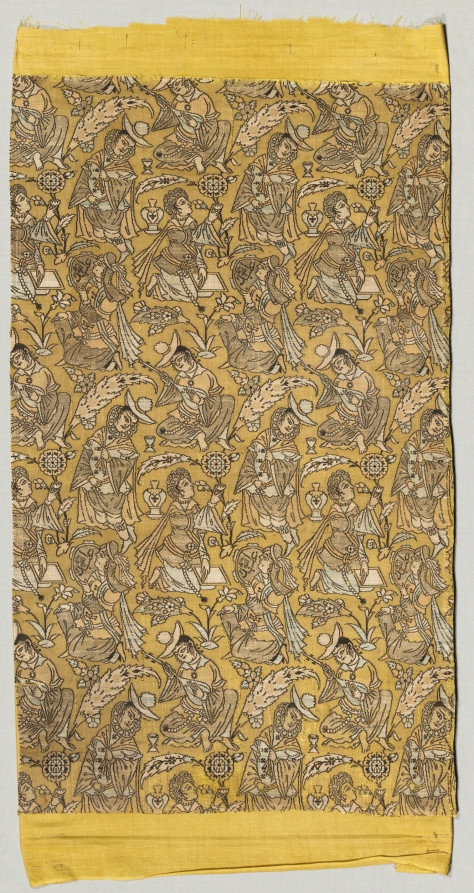
The Lampas with Dancers and Musicians: A Testament to Imperial Silk Weaving’s Enduring Legacy
In the hallowed corridors of textile history, few artifacts command the reverence afforded to the Lampas with Dancers and Musicians, a silk-woven masterpiece that embodies the zenith of imperial craftsmanship. As a Senior Heritage Specialist at the Lauren Fashion Heritage Lab, I approach this artifact not merely as a decorative textile, but as a living document—a testament to the technical virtuosity, cultural diplomacy, and aesthetic philosophy that defined the great silk-weaving empires of the East. This lampas, woven in polychrome silk, transcends its materiality to become a narrative of power, pleasure, and the eternal human pursuit of beauty. It is a relic that whispers of courtly revelry, of looms that hummed with the precision of centuries, and of a legacy that continues to inform the most discerning houses of London’s Savile Row.
Materiality and Technique: The Silk of Sovereignty
The lampas weave, a complex structure of warp and weft interlacing, represents a pinnacle of pre-industrial textile engineering. Unlike simpler weaves, lampas employs two distinct warp systems—one for the ground, one for the pattern—allowing for intricate, multi-coloured designs that float above the base fabric. In this artifact, the silk is not a mere substrate; it is the protagonist. The fibres, sourced from the sericulture of the imperial silkworm (Bombyx mori), were cultivated under strict state monopoly, ensuring a lustre and tensile strength unattainable in commercial grades. The dyes—derived from madder, indigo, and the precious kermes insect—yield a chromatic palette that has retained its vibrancy for centuries, a silent defiance of time.
The technical mastery required to produce such a lampas is staggering. The pattern of dancers and musicians, rendered in a rhythmic, almost musical composition, demanded a weaver of exceptional skill. Each thread was manipulated by hand on a drawloom, a device that required a second artisan—the drawboy—to lift specific warp threads according to a complex pattern chain. This collaborative, almost choreographed, process mirrors the very subject matter of the textile: a performance of synchronized movement, whether of dancers or of weavers. The resulting fabric is not just a surface; it is a three-dimensional architecture of light and shadow, where the silk’s natural sheen animates the figures, making them appear to move across the cloth.
Context: The Imperial Silk Weaving Legacy
To understand this lampas is to understand the political economy of silk. From the Han dynasty’s Silk Road to the Safavid and Ottoman empires, silk weaving was a state-sponsored art, a tool of soft power and economic dominance. The imperial silk weaving legacy is one of controlled knowledge, where techniques were guarded as state secrets and master weavers were treated as national treasures. This particular lampas, likely produced in a court workshop of the Safavid Empire (1501–1736) or the Mughal Empire (1526–1857), reflects a period of cultural efflorescence. The Safavids, in particular, elevated silk weaving to a metaphysical art, with patterns often imbued with Sufi symbolism—the dancer as the soul in ecstatic union with the divine, the musician as the cosmic harmony. Yet, the lampas also serves a secular purpose: it is a celebration of courtly life, of the majlis (gathering) where poetry, music, and dance were the currency of refinement.
The legacy of such weaving extends far beyond its original context. When these textiles reached Europe via the Silk Road and later through the East India Companies, they sparked a revolution in taste. The opulence of the lampas influenced the great textile centres of Lyon and Spitalfields, and its patterns can be seen echoed in the damasks and brocades that adorned the courts of Versailles and St. James’s. For Savile Row, the legacy is more subtle but no less profound. The discipline of the lampas—its rigorous structure, its balance of pattern and ground, its reverence for material—mirrors the tailoring philosophy of a bespoke suit. A Savile Row cutter does not force cloth; he listens to its drape, its weight, its history. The lampas teaches us that true luxury is not ornamentation for its own sake, but the seamless integration of artistry and function.
Iconography: Dancers and Musicians as Cultural Signifiers
The iconography of dancers and musicians is a universal motif, yet in this lampas, it is rendered with specific cultural resonance. The figures, likely depicted in a continuous frieze, are stylized but dynamic. The dancers, with their sinuous postures and flowing garments, evoke the mujra or the sama—a spiritual dance of the whirling dervishes. The musicians, playing the lute (ud), the flute (ney), and the drum (daf), are not mere accompanists; they are the architects of the scene’s rhythm. The composition is deliberately non-narrative; it is a visual representation of a state of being—joy, harmony, and transcendence.
This choice of subject is significant. In imperial courts, textiles were not merely decorative; they were communicative. A lampas depicting dancers and musicians would have been used in a context of hospitality and power—perhaps as a wall hanging in a reception hall, a cover for a throne, or a robe of honour bestowed upon a visiting dignitary. The message was clear: this court is a place of culture, of refinement, of controlled pleasure. The dancers and musicians are not just entertainers; they are symbols of a well-ordered cosmos, where art and power are inextricably linked.
Preservation and Contemporary Relevance
Today, the Lampas with Dancers and Musicians resides in a climate-controlled vault, its silk fibres monitored for humidity and light exposure. Yet, its relevance is not archival. For the Lauren Fashion Heritage Lab, this artifact is a pedagogical tool, a source of inspiration for designers who seek to understand the grammar of ornament. In an age of fast fashion and digital printing, the lampas reminds us of the value of slowness, of the hand, of the dialogue between maker and material. It challenges us to consider: what does it mean to create something that will endure for centuries?
For Savile Row, the answer is clear. The lampas embodies the principles of bespoke—the understanding that true luxury is not about excess, but about precision. The weaver of the lampas did not rush; he knew that each thread contributed to the whole. Similarly, a Savile Row tailor knows that a single misplaced stitch can compromise a garment’s integrity. The lampas is a reminder that heritage is not a static relic, but a living practice. It is the thread that connects the imperial looms of Isfahan to the cutting tables of Mayfair, a testament to the enduring power of silk to weave together time, culture, and the human spirit.
—Senior Heritage Specialist, Lauren Fashion Heritage Lab