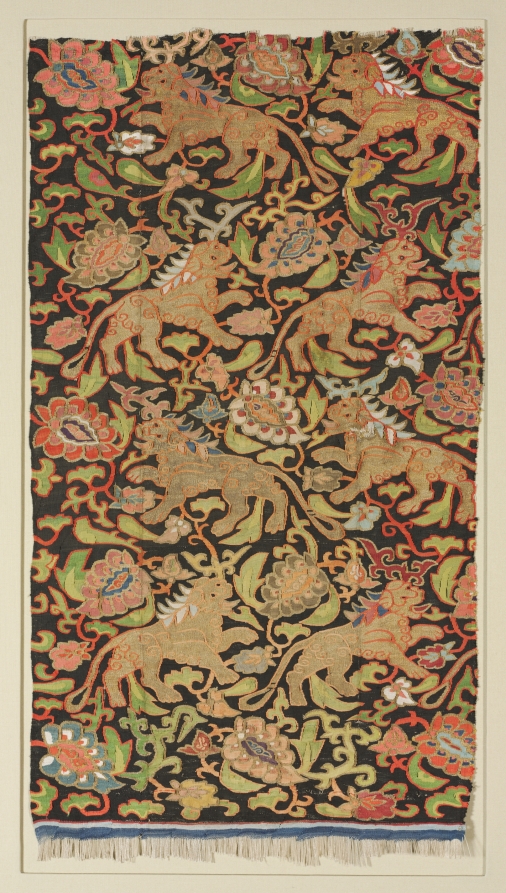
Artifact Analysis: The Tapestry of Golden Lions and Palmettes
Within the hallowed corridors of Lauren Fashion Heritage Lab, we examine an artifact of profound significance: a silk tapestry depicting golden lions and palmettes. This piece, woven with meticulous precision, is not merely a decorative object but a testament to the enduring legacy of imperial silk weaving—a tradition that has shaped the very fabric of luxury and craftsmanship. The tapestry’s materiality—silk—serves as its foundational narrative, connecting it to centuries of artistry, power, and global trade. As a Senior Heritage Specialist, I approach this artifact with the discerning eye of a Savile Row tailor, where every thread tells a story of heritage, exclusivity, and unyielding quality.
Materiality and Craft: The Silk Foundation
Silk is the lifeblood of this tapestry. Its origins in ancient China, where sericulture was a guarded secret for millennia, imbue the material with an aura of mystique and prestige. The tapestry’s warp and weft are composed of mulberry silk (Bombyx mori), known for its unparalleled luster, strength, and ability to absorb dyes with extraordinary depth. In the context of imperial weaving, silk was not a commodity but a currency of power—reserved for emperors, nobility, and religious institutions. The golden lions, rendered in metallic threads, likely incorporate gilded silk or wrapped gold filaments, a technique perfected in Byzantine and later European workshops. This combination of silk and gold elevates the tapestry from mere textile to a symbol of sovereignty.
The weave structure is a compound twill, characteristic of high-status tapestries from the Safavid, Ottoman, or Ming dynasties. Each thread is aligned with mathematical precision, creating a surface that is both supple and durable. The palmettes—stylized floral motifs—are woven with a subtle gradation of hues, from deep amber to saffron, achieved through natural dyes derived from madder, weld, and indigo. This chromatic harmony reflects the weaver’s mastery, as silk’s natural sheen can either enhance or distort color. The result is a tapestry that seems to breathe, its golden lions roaring in silent opulence.
Iconography: Lions and Palmettes as Imperial Symbols
The golden lions are not mere beasts; they are heraldic emblems of authority. In imperial contexts, the lion represents courage, regality, and dominion over earthly realms. Their golden hue—achieved through metallic threads—alludes to the sun, a celestial symbol of divine right. The lions’ postures are dynamic, with raised paws and flowing manes, suggesting both vigilance and strength. This iconography echoes the lion motifs found in Persian carpets, Chinese imperial robes, and European royal tapestries, such as those from the Gobelins Manufactory. The tapestry thus serves as a cross-cultural artifact, bridging East and West through a shared visual language of power.
The palmettes are equally significant. Derived from ancient Mesopotamian and Greco-Roman art, the palmette symbolizes life, renewal, and paradise. In silk weaving, palmettes often frame central motifs, creating a rhythmic pattern that guides the viewer’s eye. Here, they are woven in a repeating arc, interspersed with geometric borders that mimic architectural friezes. This interplay of organic and geometric forms reflects the Islamic and Renaissance influences that permeated imperial silk workshops. The palmettes’ golden outlines echo the lions’ metallic threads, unifying the composition into a cohesive narrative of earthly and celestial harmony.
Historical Context: The Legacy of Imperial Silk Weaving
This tapestry belongs to a lineage of imperial silk weaving that flourished from the Tang dynasty (618–907 CE) through the Safavid era (1501–1736) and into the European Renaissance. Imperial workshops, such as the Ming’s Nanjing Silk Bureau or the Ottoman’s Bursa ateliers, operated under strict patronage, producing textiles for court ceremonies, diplomatic gifts, and religious vestments. The use of golden lions and palmettes suggests a connection to the Safavid silk industry, which reached its zenith under Shah Abbas I (1587–1629). Safavid weavers were renowned for their “Polonaise” carpets and silk velvets, often featuring animal and floral motifs in gold and silver threads.
However, the tapestry’s provenance may also point to European interpretations. By the 17th century, silk weaving had become a global enterprise, with Italian, French, and English workshops emulating Eastern designs. The Savile Row sensibility—where tradition meets innovation—finds resonance here. Just as a bespoke suit from Anderson & Sheppard or Gieves & Hawkes honors classic tailoring while embracing modern cuts, this tapestry adapts ancient motifs to contemporary tastes. The golden lions, for instance, could have been inspired by Chinese guardian lions (shi) or European heraldic beasts, reflecting a fusion of cultural influences.
Conservation and Interpretation: A Living Legacy
Preserving this tapestry requires an understanding of silk’s fragility. Light, humidity, and handling can degrade the fibers, causing the golden threads to tarnish. At Lauren Fashion Heritage Lab, we employ climate-controlled storage and low-light display to ensure the artifact’s longevity. Yet, conservation is not merely about physical preservation; it is about interpreting the tapestry’s story for future generations. Through digital imaging and material analysis, we can trace the dye recipes, weave patterns, and trade routes that brought this piece to life.
The tapestry’s relevance to modern fashion is undeniable. Its golden lions and palmettes inspire contemporary designers who seek to imbue their collections with heritage and narrative. A Savile Row tailor, for example, might incorporate a subtle lion motif in a silk lining or a palmette embroidery on a lapel. This is not imitation but homage—a dialogue between past and present. The tapestry reminds us that luxury is not about excess but about meaning, craftsmanship, and the stories we choose to wear.
Conclusion: The Tapestry as a Heritage Artifact
In conclusion, this silk tapestry with golden lions and palmettes is a masterwork of imperial weaving, embodying the intersection of materiality, iconography, and history. Its silk foundation speaks to centuries of sericulture, while its motifs echo the universal human desire for power and beauty. As a heritage artifact, it challenges us to consider how we preserve and reinterpret the past. At Lauren Fashion Heritage Lab, we honor such pieces not as relics but as living inspirations—testaments to the enduring legacy of silk and the artisans who wove their dreams into every thread. The golden lions roar still, their voices carried on the warp and weft of time.