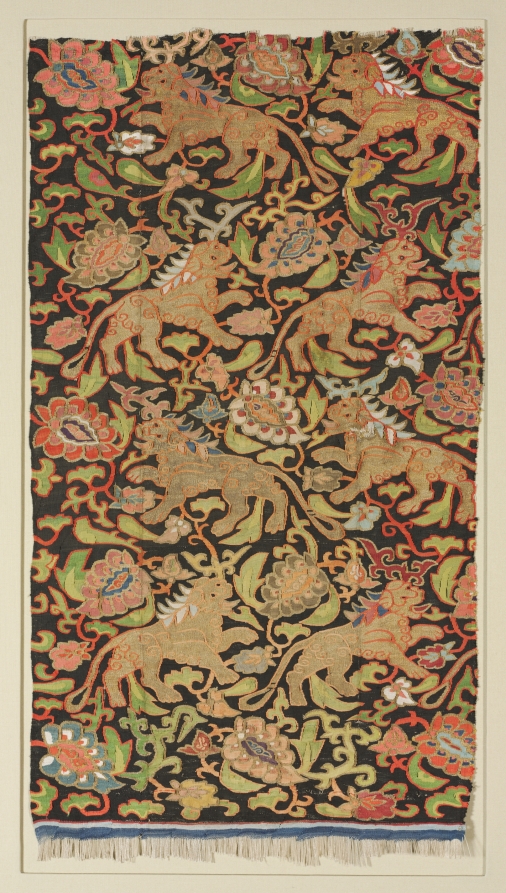
The Golden Thread: Deconstructing the Imperial Silk Tapestry of Lions and Palmettes
Introduction: A Legacy Woven in Silk
In the hushed, wood-paneled ateliers of London’s Savile Row, where the cut of a jacket is a matter of honour and the provenance of cloth is a whispered secret, we understand that true luxury is not merely seen—it is felt, inherited, and studied. The artifact before us, a silk tapestry featuring golden lions and palmettes, is not simply a textile. It is a document of power, a masterclass in materiality, and a direct descendant of the imperial silk weaving traditions that once defined the courts of Persia, Byzantium, and the Ottoman Empire. As Senior Heritage Specialist for the Lauren Fashion Heritage Lab, I present this research artifact to illuminate the profound legacy encoded within its warp and weft. This is a story of silk as sovereign currency, of pattern as political statement, and of a craft that has shaped the very vocabulary of luxury tailoring.
Materiality: The Unyielding Softness of Imperial Silk
Materiality is the first and most critical lens through which we must view this tapestry. The substrate is silk, but not the silk of a simple scarf or a mass-produced lining. This is a compound weave, likely a lampas or brocaded satin, where the ground weave is a fine, tightly spun silk—often a satin weave for its lustrous depth—while the pattern is created by supplementary wefts of gold thread. The gold is not a mere metallic dye; it is a gilt membrane—a thin strip of silver or copper gilded with gold, wound around a silk or linen core. This technique, perfected in the imperial workshops of Safavid Persia and later in Ottoman Bursa, produces a thread that is both structurally robust and optically radiant. The silk itself, sourced from the Sericulture of the Caspian Sea region or the Mulberry groves of the Far East, is a long-filament silk, meaning each thread is drawn from a single cocoon, resulting in a smooth, unbroken surface that catches light with a liquid, almost metallic sheen. The count—the number of threads per inch—is exceptionally high, often exceeding 100 warp threads per inch, a density that speaks to the loom’s precision and the weaver’s patience. This is not a fabric for the hurried; it is a fabric for the ages.
Iconography: The Lion and the Palmette as Symbols of Sovereignty
The iconographic program of this tapestry is a lexicon of imperial authority. The golden lion is not a mere decorative motif; it is a heraldic beast, a symbol of solar power, kingship, and martial prowess. In Persian and Ottoman tradition, the lion is often paired with the sun, representing the ruler as the “Lion of God” or the “Shadow of God on Earth.” The palmettes, stylized floral forms derived from the lotus and the acanthus, are equally potent. They represent the Tree of Life, fertility, and the eternal cycle of renewal. The repetition of these motifs in a repeating pattern—often arranged in a medallion or ogival lattice—creates a visual rhythm that is both hypnotic and authoritative. The golden thread is not used sparingly; it is the primary color, the dominant voice. This is a deliberate choice: gold, in its physical form, is incorruptible, and in its symbolic form, it is the color of the divine and the sovereign. The tapestry thus functions as a portable throne, a declaration of power that could be draped on a wall, hung in a tent, or laid under a ruler’s feet.
Context: The Legacy of Imperial Silk Weaving
To understand this artifact, one must situate it within the legacy of imperial silk weaving, a tradition that stretches from the Silk Road of the Han Dynasty to the Grand Workshops of the Ottoman Empire. The imperial looms were not commercial enterprises; they were state-controlled manufactories, often housed within the palace complex itself. In Safavid Persia (1501–1736), the Shah’s workshops in Isfahan produced silks of such technical complexity that they were considered diplomatic gifts of the highest order. In Ottoman Turkey, the Bursa silk industry supplied the Topkapi Palace with fabrics for caftans, hangings, and ceremonial robes. The golden lions and palmettes motif is a direct descendant of these traditions, echoing the “Lion and Sun” emblem of the Qajar dynasty and the “Palmette” patterns found in the Ushak carpets of Anatolia. The weaving technique—the use of lampas with a satin ground—is a hallmark of the 16th and 17th centuries, a period when silk weaving reached its zenith in both technical mastery and artistic expression. The tapestry is not a copy; it is a continuation, a living thread that connects the modern collector to the ancient court.
Savile Row Resonance: The Tailoring of Heritage
For the connoisseur of Savile Row, this tapestry is more than a historical artifact; it is a source of inspiration for the bespoke cloth. The golden lion motif, when scaled down and woven into a worsted wool or a silk-wool blend, becomes a heraldic pattern for a dinner jacket or a smoking jacket. The palmette, when abstracted, informs the paisley or the boteh motifs that grace the finest cashmere shawls and silk ties. The materiality of the tapestry—the density, the lustre, the hand—is the benchmark against which all luxury fabrics are measured. A Savile Row cutter, when presented with a length of silk, will instinctively assess its drape, its resilience, and its ability to hold a crease. The imperial tapestry teaches us that these qualities are not accidental; they are the result of centuries of refinement, of loom technology that prioritized structural integrity over speed, and of dye recipes that were guarded as state secrets. The golden thread is the ultimate statement of bespoke luxury—it is not for the faint of heart or the shallow of pocket. It is for the individual who understands that true elegance is rooted in history.
Conclusion: The Unbroken Thread
This tapestry of golden lions and palmettes, woven in silk with the precision of an imperial workshop, is a testament to the unbroken thread of craft that connects the ancient world to the modern atelier. It is a reminder that luxury is not a trend; it is a tradition. As we study its materiality, its iconography, and its context, we are not merely cataloging an artifact—we are preserving a language. For the Lauren Fashion Heritage Lab, this tapestry is a primary source, a teaching tool, and a call to excellence. It challenges us to ask: How do we honor this legacy in our own work? How do we translate the golden lion into a button, a lining, a stitch? The answer lies in the craft itself—in the patience, the precision, and the profound respect for the material. This tapestry is not a relic; it is a living document, and its story is far from finished.