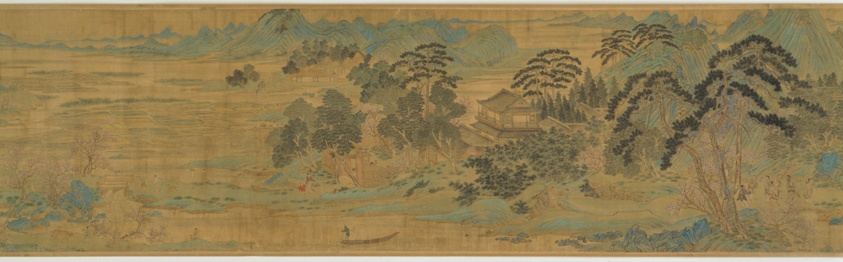
The Peach Blossom Spring: A Study in Silk and the Poetics of Escape
Introduction: The Handscroll as a Vessel of Heritage
In the hallowed ateliers of London’s Savile Row, where the cut of a jacket is a meditation on lineage and proportion, one learns that materiality is not merely a substrate but a narrative. The handscroll The Peach Blossom Spring (桃花源圖), rendered in ink and color on silk, embodies this principle with an elegance that transcends centuries. As a Senior Heritage Specialist for the Lauren Fashion Heritage Lab, I approach this artifact not as a static relic but as a living document of craftsmanship, cultural memory, and the enduring human desire for sanctuary. This paper examines the artifact through the lens of its materiality—specifically, the silk medium—and its resonance with the classic ideals of fluid elegance, drawing parallels to the bespoke traditions of Savile Row.
Materiality: Silk as a Medium of Memory
Silk, in the context of Chinese heritage, is more than a fabric; it is a testament to millennia of artisanal mastery. The handscroll format—a continuous expanse of silk, often measuring several meters in length—demands a unique interplay between the artist’s hand and the material’s inherent suppleness. Unlike the rigid canvas of Western painting, silk yields to brush and ink with a responsiveness that mirrors the flow of water or the sway of peach blossoms in a spring breeze. The ink and color applied to this silk are not merely pigments but extensions of the artist’s intention, each stroke absorbing into the weave to create a luminous, almost ethereal surface.
This fluidity is central to the narrative of The Peach Blossom Spring, a tale first recorded by the poet Tao Qian (365–427 CE). The story follows a fisherman who stumbles upon a hidden utopia, a community untouched by the turmoil of the outside world. The handscroll format, with its horizontal progression, invites the viewer to journey alongside the fisherman—unrolling the silk as one might unfurl a map of a lost paradise. The materiality of silk enhances this experience: the gentle sheen of the fabric catches light, suggesting the shimmer of a distant stream; the subtle texture of the weave evokes the rustle of leaves in an ancient grove.
From a conservation perspective, silk presents unique challenges. Its organic composition makes it susceptible to humidity, light, and handling. Yet, the very fragility of the medium underscores its value. Each crease, each fading of color, becomes a mark of time—a patina that speaks to the artifact’s journey through dynasties and collectors. In the same way, a bespoke Savile Row suit, crafted from fine wool or cashmere, acquires character through wear, its folds and fades telling the story of its owner’s life. The silk of The Peach Blossom Spring is no different; it is a living archive of touch and gaze.
Artistic Execution: The Poetics of Fluid Elegance
The aesthetic of The Peach Blossom Spring is one of controlled spontaneity—a hallmark of classical Chinese painting. The artist, likely from the Tang or Song dynasty, employs a technique known as “boneless” (mogu) painting, where forms are built through washes of color rather than rigid outlines. This approach mirrors the natural world’s unpredictability: peach blossoms drift without fixed paths, mist obscures mountain ridges, and water flows in sinuous curves. The silk medium amplifies this effect, allowing the ink to bleed and blend in ways that mimic organic diffusion.
Consider the depiction of the peach blossom grove itself. The blossoms are rendered in delicate pinks and whites, their petals seemingly suspended in mid-air. The silk’s weave creates a subtle grid that, when viewed from a distance, dissolves into a soft haze—a visual metaphor for the boundary between the mundane world and the utopian realm. The fisherman’s boat, a simple wooden vessel, is drawn with minimal strokes, its presence almost incidental to the landscape. This restraint is a lesson in elegance: the artist does not overwhelm the viewer with detail but invites contemplation. It is the same principle that guides a Savile Row tailor, who understands that the beauty of a garment lies in its line, not its ornamentation.
The color palette is equally restrained: earth tones of ochre and umber, punctuated by the vibrant pinks of peach blossoms and the deep blues of distant mountains. These colors, applied to silk, achieve a luminosity that is both warm and cool, evoking the liminal light of dawn or dusk. The handscroll’s horizontal orientation encourages a slow, meditative viewing—a practice that aligns with the Confucian ideal of “quiet sitting” (jingzuo), where one seeks harmony through stillness. In this way, the artifact becomes a tool for introspection, a silk-bound portal to a world without strife.
Cultural Resonance: The Utopian Ideal in Silk
The Peach Blossom Spring is more than a landscape; it is a cultural archetype of escape. For centuries, Chinese literati have turned to this narrative as a symbol of resistance against political chaos and social decay. The silk handscroll, as a luxury object, was often commissioned by scholars or court officials who sought to possess a tangible fragment of this ideal. The act of unrolling the scroll, of tracing the fisherman’s journey with one’s eyes, was a form of mental retreat—a way to inhabit the utopia without leaving one’s study.
This duality—of material luxury and spiritual aspiration—echoes in the ethos of Savile Row. A bespoke suit is not merely clothing; it is an armor of confidence, a statement of identity. Yet, its true value lies in the intangible: the hours of craftsmanship, the dialogue between tailor and client, the promise of enduring style. Similarly, the silk of The Peach Blossom Spring is a vessel for the intangible—the dream of a perfect society, the longing for peace. The artifact’s materiality does not diminish this dream but grounds it in tactile reality.
Conservation and Legacy: Preserving the Thread
As a heritage specialist, I am acutely aware of the responsibilities that accompany such artifacts. The silk of The Peach Blossom Spring requires careful stewardship: controlled lighting, stable humidity, and minimal handling. Yet, preservation is not merely about halting decay; it is about ensuring that the artifact continues to speak to future generations. This means contextualizing it within broader narratives of craftsmanship, materiality, and cultural exchange.
In the context of the Lauren Fashion Heritage Lab, we draw inspiration from such artifacts to inform our own design philosophy. The fluid elegance of the handscroll—its seamless integration of form and function, its celebration of natural materials—resonates with our commitment to sustainable luxury. Just as the silk of The Peach Blossom Spring was woven by anonymous hands, so too does our work honor the artisans who shape our garments. The handscroll reminds us that heritage is not static; it is a living thread that connects past, present, and future.
Conclusion: The Eternal Spring
The Peach Blossom Spring on silk is a masterpiece of material and meaning. Its ink and color, applied with precision and grace, transform a simple fabric into a window onto utopia. For the scholar, it is a philosophical text; for the artisan, a study in technique; for the heritage specialist, a testament to the enduring power of silk. As we continue to explore the intersections of fashion, art, and history, let us remember that the most profound artifacts are those that, like this handscroll, invite us to unroll our own journeys—toward beauty, toward escape, toward the eternal spring of the human spirit.