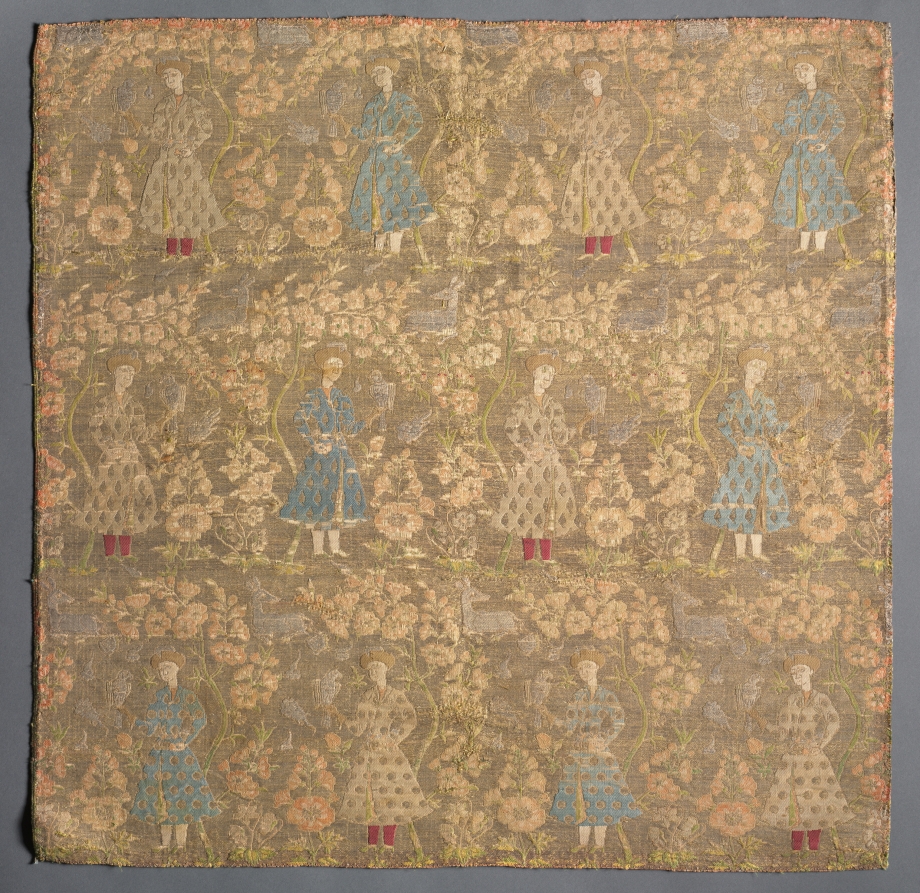
An Examination of Avian Majesty: The Falconer Motif in Imperial Silk Weaving
To comprehend the artefact in question—a section of silk depicting falconers amid rose bushes—one must first appreciate the profound materiality of its foundation. Silk is not merely a textile; it is a testament to human ingenuity, a filament of commerce, and a canvas of absolute authority. Its very presence in the imperial context speaks of a supply chain perfected over millennia, a monopoly of knowledge and resource so complete that the cloth itself became a currency of state. The hand that eventually held this fabric did so not simply to admire its pattern, but to feel, quite literally, the weight of empire woven into its substance. The cool, liquid drape, the subdued sheen that catches the light without vulgarity, the tensile strength belying its apparent delicacy—these are the inherent qualities that elevate the medium beyond the decorative. They establish the necessary gravitas for the narrative about to unfold upon its surface.
The Patronage of the Hunt: A Symbol Woven in Thread
The motif of the falconer is, of course, far from incidental. In the courts of imperial China, and indeed across Eurasian empires, the hunt was never a mere pastime. It was a meticulously choreographed theatre of power. The falcon, a creature of lethal speed and fierce independence, subdued to the wrist of the sovereign, served as the perfect allegory for dominion over both the natural world and, by extension, the realm itself. To commission a silk of such theme was to engage in a deliberate act of iconographic communication. The falconer is not depicted in the throes of the chase; rather, he is shown in a moment of poised readiness, amid the cultivated beauty of rose bushes. This juxtaposition is critical. It speaks not of wild, untamed conquest, but of control so absolute that majesty can be contemplated amidst the garden. The rose, with its thorns and its beauty, further complicates the allegory, suggesting a dominion that encompasses both the dangerous and the exquisite.
The technical execution required to render this scene is where the legacy of imperial workshops asserts itself with silent force. Consider the construction of the falcon’s plumage, each feather likely defined by a subtle shift in weft, a minute gradation of colour achieved through dyes of immense sophistication. The falconer’s robe, no doubt, exhibits a pattern within the pattern, a secondary geometric or cloud-band motif visible upon closer inspection, demonstrating a hierarchical approach to decoration. The rose bushes present a particular challenge—the translation of organic, blooming forms into the strict geometric logic of the drawloom. That this is achieved without sacrificing botanical recognisability is the hallmark of a tradition operating at its zenith. The design would have originated from a court painter, translated by a master pattern-draughtsman onto a lattice of points, which in turn dictated the actions of the weavers, a team of whom would labour for an incalculable period to render a single length of such narrative cloth.
Material Sovereignty and the Economics of Awe
Beyond the iconography lies the more profound statement of the artefact’s existence: its role within the political economy of silk. Imperial silk weaving establishments, such as those in Suzhou or Nanjing under the Ming and Qing dynasties, were not ateliers in the romantic sense. They were engines of state, combining the most advanced technology of the age with a captive, supremely skilled workforce. The output was strictly regulated; certain patterns, colours, and fibre qualities were reserved solely for the imperial household and for bestowal as gifts of immense political significance. A length of falconer silk might be granted to a loyal general, a tributary prince, or a foreign envoy. In that transaction, the fabric ceased to be an object of beauty and became an instrument of policy—a tangible fragment of the emperor’s grace, a reminder of the source of all privilege and power.
Its journey, should it have travelled the Silk Roads westwards, would have compounded its value at every stage. Passing through countless hands, its provenance and rarity elevating it from commodity to relic, it would have arrived in distant courts as a symbol of a civilisation so advanced that its very luxuries were beyond replication. The pattern of falconer and rose, viewed in a European context, would have been abstracted from its original narrative, yet its authority would remain undimmed, speaking in a universal language of craftsmanship and exclusive access.
A Legacy Measured in Threads per Inch
To hold this section of silk today is to conduct a forensic audit of an empire’s aesthetic and administrative confidence. The condition of the threads, the stability of the colours despite the passage of centuries, the precise alignment of the pattern repeat—each of these elements offers a silent critique on the standards of the age that produced it. The density of the weave speaks to the quality of the raw silk, itself the product of sericulture raised to a high art. The clarity of the imagery confirms the precision of the loom technology and the peerless skill of the weavers, whose names are lost to history but whose expertise is immortalised in every intersection of warp and weft.
In conclusion, this artefact—this Section of Silk Fabric with Falconers Amid Rose Bushes—transcends its decorative function. It is a confluence of statement and substance. The materiality of silk provides the requisite dignity and permanence. The falconer motif articulates a sophisticated ideology of controlled power. And the context of its manufacture places it at the very heart of a system where luxury was not an indulgence, but a tool of governance. It represents a pinnacle of focused tradition, where art, technology, and politics were woven together on the same loom, producing not just a textile, but a manifest testament to imperial legacy. Its value to the contemporary scholar lies not in nostalgia, but in its enduring capacity to demonstrate how the most refined expressions of human culture are invariably, and inextricably, bound to the structures of power that enable them.