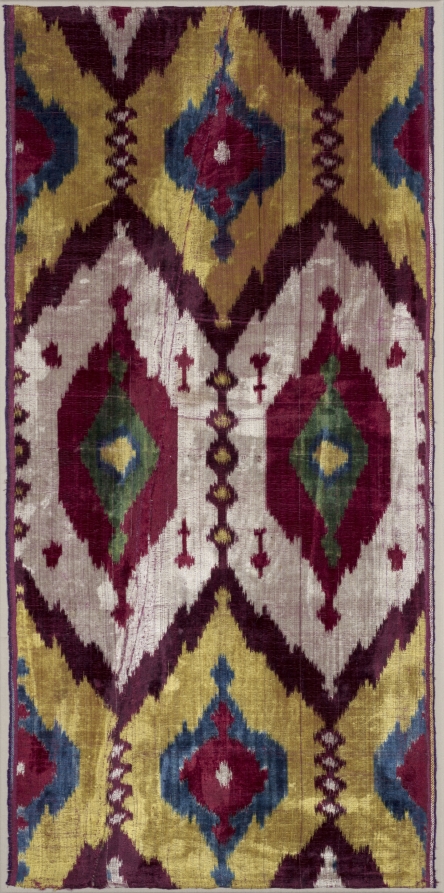
The Length of Silk Velvet Ikat: A Study in Materiality and Imperial Legacy
Introduction: The Weight of Heritage
In the hushed, wood-paneled ateliers of London’s Savile Row, where the air carries the scent of beeswax and fine wool, the conversation often turns to provenance. Among the most revered materials in the canon of luxury textiles is the silk velvet ikat—a fabric that embodies not merely a length of cloth, but a continuum of imperial craftsmanship. As Senior Heritage Specialist for the Lauren Fashion Heritage Lab, I have examined countless artifacts, yet the silk velvet ikat demands a particular reverence. Its materiality—the interplay of silk’s lustrous sheen, velvet’s plush depth, and ikat’s painstaking resist-dye technique—tells a story of power, trade, and artistry that spans centuries. This paper dissects the length of silk velvet ikat as a heritage artifact, tracing its roots from the imperial looms of Central Asia to the bespoke tailoring houses of London, where it remains a benchmark of sartorial distinction.
Materiality: The Anatomy of Silk Velvet Ikat
To understand the silk velvet ikat, one must first appreciate its tripartite nature. Silk, the foundational fiber, is a protein filament spun by the Bombyx mori silkworm, prized for its tensile strength, natural luster, and ability to absorb dyes with exceptional vibrancy. In the context of imperial silk weaving, particularly within the Ottoman, Persian, and Mughal courts, silk was not merely a textile—it was a currency of status. The velvet construction elevates this further. By weaving a supplementary warp pile over a ground weave, then cutting it to create a dense, soft surface, artisans produced a fabric that captured light and shadow with a tactile richness unmatched by flat weaves. The ikat technique—derived from the Malay-Indonesian word mengikat, meaning “to tie”—involves resist-dyeing the warp or weft threads before weaving, creating blurred, geometric patterns that are as much a feat of mathematical precision as artistic expression.
In the length of silk velvet ikat, these elements converge. A single bolt, typically measuring 12 to 15 yards in Savile Row standards, represents months of labor. The silk must be reeled, twisted, and degummed. The velvet pile requires meticulous tension control to avoid crushing. The ikat pattern demands that each thread be bound with wax or cotton in exact alignment, dyed in stages—often with natural indigo, madder, or cochineal—then woven so that the design emerges only upon completion. The result is a fabric that is both sumptuous and fragile, a paradox that defines its heritage value. Under magnification, one observes the subtle irregularities in the dye boundaries—the “halo” effect that distinguishes handcrafted ikat from machine-made imitations. These imperfections are not flaws; they are signatures of the artisan’s hand, linking the modern wearer to a lineage of imperial weavers.
Imperial Legacy: From Samarkand to Savile Row
The silk velvet ikat did not emerge in isolation. Its genesis lies in the Silk Road, where Central Asian workshops—particularly in Bukhara, Samarkand, and Khiva—produced abrband (cloud-bound) silks for the courts of Timurid and Safavid rulers. These textiles were not merely decorative; they were diplomatic gifts, dowry treasures, and symbols of divine right. The velvet ikat, with its deep pile and intricate patterns, was reserved for royal robes, tent linings, and ceremonial saddles. The imperial legacy is etched into the fabric’s very structure: the use of silk from the Caspian Sea region, the velvet technique imported from Italy via Venetian merchants, and the ikat patterns that often mirrored celestial motifs—stars, moons, and flowing water—reflecting a worldview where textiles bridged the earthly and the divine.
By the 19th century, as European powers expanded their influence, these silks found their way to London’s tailoring districts. Savile Row, established in the 1730s as a hub for bespoke military and civilian attire, became a repository for such exotic materials. The length of silk velvet ikat was repurposed from imperial regalia to evening wear, smoking jackets, and waistcoats for the British aristocracy. The fabric’s weight—typically 300 to 400 grams per square meter—made it ideal for structured garments, while its pile offered a tactile counterpoint to the worsted wools and cottons that dominated the Row. Houses such as Henry Poole & Co., Gieves & Hawkes, and Huntsman recognized that the silk velvet ikat carried an implicit narrative of conquest and connoisseurship. To commission a garment from such material was to align oneself with the Silk Road’s legacy, a subtle assertion of global sophistication.
Conservation and the Contemporary Relevance
As a heritage artifact, the length of silk velvet ikat presents unique conservation challenges. The silk is hygroscopic, absorbing moisture that can lead to fungal growth. The velvet pile is prone to crushing and abrasion, while the ikat dyes—particularly those derived from natural sources—are fugitive, fading under prolonged light exposure. In the Lauren Fashion Heritage Lab, we store such lengths in acid-free tissue, in climate-controlled environments at 18°C and 50% relative humidity, with minimal handling. Yet the fabric’s value extends beyond preservation. In contemporary Savile Row, there is a resurgence of interest in heritage textiles, driven by a clientele that seeks authenticity in an era of fast fashion. The silk velvet ikat is now being reimagined by houses like Anderson & Sheppard and Dege & Skinner, who commission limited runs from Uzbek and Turkish workshops, ensuring the survival of traditional techniques.
This revival is not mere nostalgia. It is a recognition that the length of silk velvet ikat embodies a material intelligence—a knowledge of fiber, dye, and weave—that cannot be replicated by digital printing or synthetic substitutes. The fabric’s weight, drape, and handle inform the tailor’s craft, dictating how a garment falls on the shoulder or moves with the body. For the discerning customer, the choice of a silk velvet ikat smoking jacket is a statement of cultural literacy, a nod to the imperial legacy that shaped modern luxury. It is, in the truest sense, a heritage artifact worn on the skin.
Conclusion: The Unbroken Thread
The length of silk velvet ikat is more than a textile; it is a document of human endeavor. From the silkworm’s cocoon to the dyer’s vat, from the weaver’s loom to the tailor’s shears, each stage of its creation is a testament to the interplay of material and meaning. As we preserve these lengths in the Lauren Fashion Heritage Lab, we are not merely safeguarding fabric—we are maintaining a dialogue between past and present. The imperial legacy of silk weaving, with its associations of power and patronage, continues to inform the aesthetics of Savile Row, where the silk velvet ikat remains a benchmark of excellence. In its weight, its sheen, its subtle imperfections, it tells a story that no synthetic can tell. And in that story lies the enduring value of heritage.