← BACK TO ARCHIVES
Heritage-Black
Heritage Synthesis: Terracotta fragment of an olpe (jug)
Curated on May 06, 2026 // Node: LDN-01
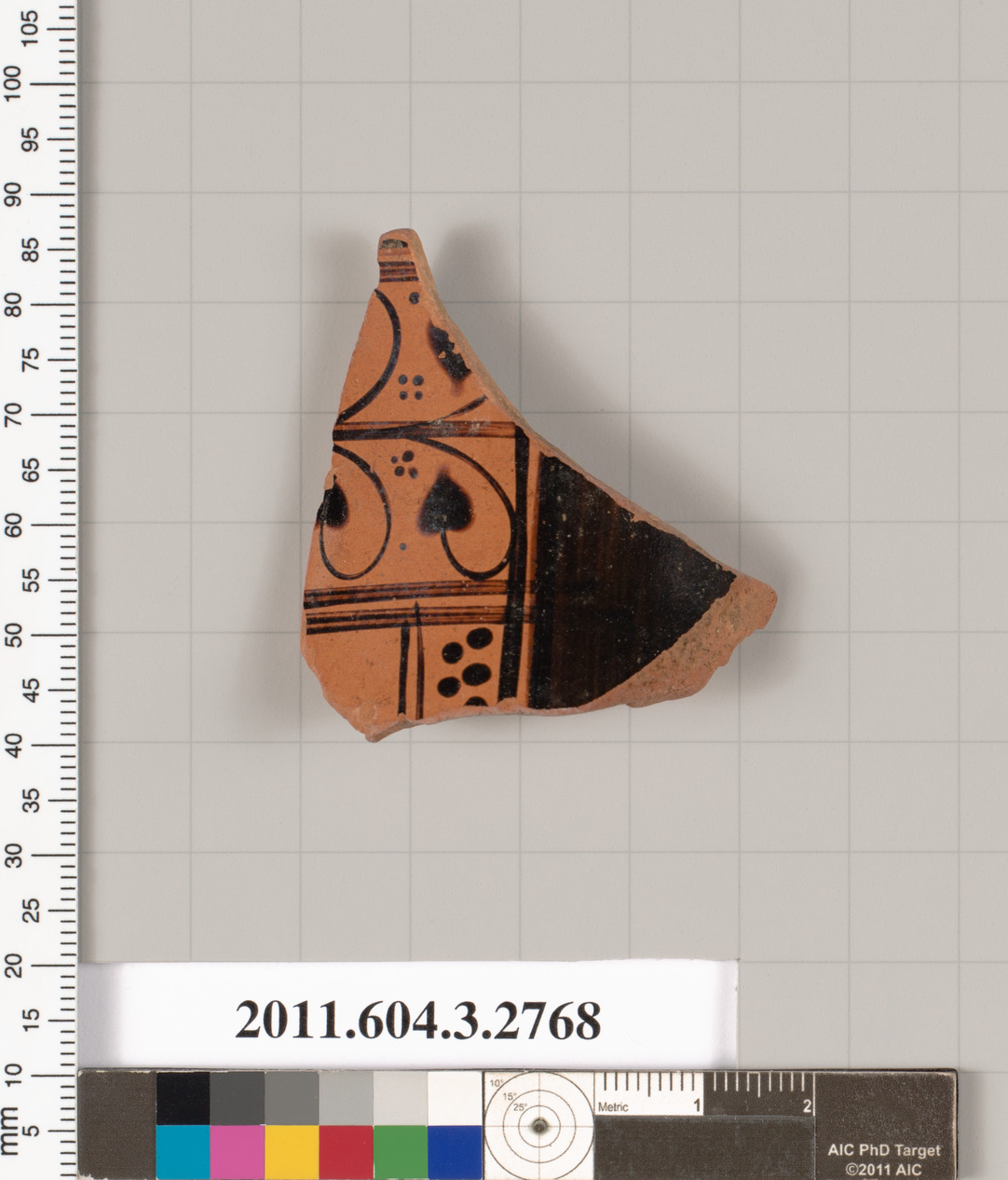
The Ceramic Lineage of Restraint: How an Attic Terracotta Fragment Informs the 2026 Old Money Silhouette
The Lauren Fashion Heritage Lab’s internal genetic code, which juxtaposes a Delftware bowl’s serene geometry against the turbulent symbolism of *The Temptation of Saint Anthony*, reveals a fundamental dialectic in aesthetic philosophy: the contained versus the expansive, the harmonious versus the agonistic. Yet, when we turn to the museum artifact—a terracotta fragment of an Attic olpe (jug), c. 6th century BCE—we encounter a third term in this aesthetic equation: the *architectural*. This shard of fired clay, with its residual black-figure decoration and broken rim, is not a vessel of wild nature nor a canvas of spiritual torment. It is a fragment of *civilization* itself. For the 2026 Old Money silhouette, this artifact offers a profound lesson in how materiality, proportion, and the deliberate embrace of imperfection can forge a sartorial language of enduring power—one that speaks not of fleeting trends but of a lineage of taste that is, like the olpe, both broken and whole.
From Ceramic Fragment to Sartorial Structure: The Logic of the Vessel
The Attic olpe was a utilitarian object—a jug for pouring wine or water—yet its form was never merely functional. Its slender neck, swelling body, and carefully articulated handle were governed by a logic of *proportion* that the ancient Greeks called *symmetria*. This is not symmetry in the modern sense of mirroring, but a dynamic balance of parts that creates a sense of organic unity. The terracotta fragment, even in its broken state, retains this logic: the curve of the shoulder, the precise angle of the handle attachment, the rhythmic spacing of the decorative band. For the 2026 Old Money silhouette, this translates into a renewed emphasis on *structure* as the foundation of elegance. The season’s defining garments—a single-breasted overcoat in charcoal wool, a double-pleated trouser in cavalry twill, a silk crepe de chine blouse with a mandarin collar—all share a common ancestor in the vessel’s logic. The shoulder line is not padded but *shaped*, following the natural architecture of the body like the olpe’s handle follows its curve. The waist is not cinched but *suggested*, through the subtle taper of a jacket or the drape of a skirt. The silhouette is, in essence, a *vessel for the body*—a container that does not constrict but defines, much as the olpe’s walls contain the wine without imprisoning it.
The Imperfect Surface: Patina as the New Luxury
The Delftware bowl’s appeal lies in its pristine, icy blue—a surface that captures nature in a state of arrested perfection. The *Temptation* painting revels in the grotesque, the deliberately distorted. The terracotta fragment, however, offers a third surface condition: *patina*. The clay is worn, the black glaze is chipped, the surface bears the tactile memory of centuries of handling, of being held, poured from, and eventually broken and buried. This is not decay but *accumulation*—a physical record of use that transforms an object into a relic. For the 2026 Old Money silhouette, this concept of patina becomes the ultimate signifier of authenticity. The season’s fabrics are not merely new; they are *treated* to evoke age. Cashmere is brushed to a soft, hazy nap that suggests years of wear. Wool is woven with a subtle slub or nep, mimicking the irregularities of hand-spun yarn. Leather is tumbled or waxed to develop a surface that will, over time, acquire the unique creases and color shifts of its owner’s life. The color palette itself draws from the terracotta’s earth tones: burnt sienna, ochre, deep umber, and the black of the fired clay. These are not colors that shout; they are colors that *have been*—the hues of archaeological sites, of ancient pottery shards, of the very ground from which civilization emerged.
The Fragment as a Whole: The Aesthetic of the Incomplete
Perhaps the most radical lesson from the Attic olpe fragment is its *incompleteness*. It is a broken object, yet it is displayed as a complete artifact. The museum does not attempt to reconstruct the missing handle or restore the lost section of the body. Instead, the fragment stands as a synecdoche—a part that stands for the whole, a ruin that evokes the original. This is the aesthetic of the *suggested* rather than the *stated*. For the 2026 Old Money silhouette, this translates into a deliberate embrace of the unfinished. A jacket might be left unlined, revealing the raw edge of the canvas and the hand-stitched seams. A trouser hem might be left uncut, the fabric folded and basted, awaiting the wearer’s final decision. A shirt might be worn with the collar unbuttoned, the top buttonhole left empty. These are not signs of neglect but of *confidence*—the confidence of a wearer who understands that true luxury lies not in perfection but in the *potential* for completion. The silhouette is, in this sense, a *work in progress*, a living artifact that evolves with its owner. It echoes the Delftware bowl’s “limited infinity”—the sense that within a finite form, infinite possibility resides. But it does so not through the bowl’s serene harmony, but through the fragment’s honest admission of time’s passage.
The Architecture of Restraint: A New Old Money Ethos
The 2026 Old Money silhouette, as informed by the terracotta fragment, is ultimately an exercise in *restraint*—not the restraint of austerity, but the restraint of *intention*. Every line, every seam, every surface is the result of a deliberate choice to *subtract* rather than add. The silhouette is lean without being skinny, structured without being stiff, aged without being shabby. It is a silhouette that understands that the most powerful statement is often the one left unsaid. In this, it finds its deepest resonance with the Delftware bowl’s “way of the vessel”—the idea that the container is not the message, but the *condition* for the message. The bowl’s ducks and waves are not the point; the *space* they inhabit is. Similarly, the 2026 Old Money silhouette is not about the garment itself, but about the *person* within it. The garment is the vessel; the wearer is the wine. And like the Attic olpe, which was made to be held, to be poured from, to be passed from hand to hand, this silhouette is made to be *lived in*—to acquire the patina of a life well-lived, to become, over time, a fragment of its own history.
In the end, the terracotta fragment teaches us that the most enduring luxury is not the new, the perfect, or the complete. It is the *authentic*—the object that bears the marks of its making and its use, that speaks of a lineage of craft and a history of care. For the 2026 Old Money silhouette, this is the ultimate inheritance: not a garment, but an *ethos*. An ethos of structure, of patina, of the fragment as a whole. An ethos that, like the ancient olpe, is both broken and enduring, both of its time and timeless.
Heritage Lab Insight
Genetic Bridge: Archive node focusing on Heritage-Black craftsmanship.