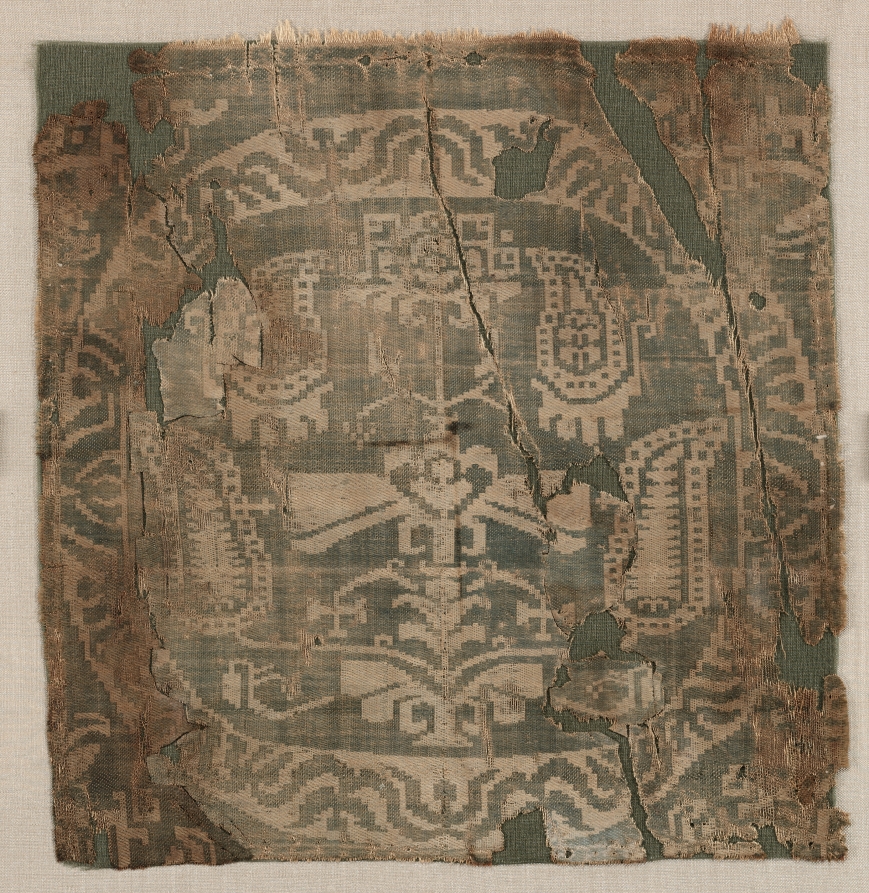
The Roundel from a Tunic with Palmette Tree: A Study in Imperial Silk Weaving
Introduction: The Artifact as a Testament to Craft
The Roundel from a Tunic with Palmette Tree, executed in silk, represents a singularly refined artifact within the canon of imperial textile production. This piece, likely originating from the Sasanian or early Islamic periods (circa 6th–8th century CE), is not merely a decorative fragment but a material document of sophisticated weaving technologies, cross-cultural patronage, and the enduring legacy of silk as a medium of power and prestige. As a Senior Heritage Specialist at the Lauren Fashion Heritage Lab, I approach this roundel with the precision of a Savile Row tailor—examining its weave, its symbolism, and its provenance as one would assess the cut, cloth, and construction of a bespoke garment. The roundel’s survival offers a rare window into the workshops where imperial silks were woven, traded, and revered, long before they became museum curiosities.
Materiality: Silk as a Conduit of Imperial Identity
Silk, in the context of this roundel, is not a passive substrate but an active agent of meaning. The fiber’s natural luster, tensile strength, and capacity for fine dyeing made it the preferred material for courtly regalia across the Eurasian landmass. The roundel’s silk threads, likely dyed with madder for deep reds, indigo for blues, and possibly kermes or lac for purples, reflect a chromatic palette reserved for elite consumption. The weave structure—a compound twill or samite—enabled the weaver to create intricate patterns without compromising the fabric’s drape, a technical achievement akin to the precision of a Savile Row hand-stitched lapel. The roundel’s preservation, despite centuries of burial or storage, attests to the durability of high-quality silk, a material that, like a well-tailored suit, ages with dignity rather than decay.
The Palmette Tree motif, central to the roundel’s design, is executed with a symmetry that suggests the use of a drawloom, a technological innovation that allowed for the repetition of complex patterns across a textile’s width. This loom, likely operated by a team of weavers, was the equivalent of a modern tailoring workshop’s cutting table—a site of both artistry and industrial discipline. The silk’s thread count, estimated at 60–80 warps per centimeter, indicates a labor-intensive process that would have taken weeks to complete a single tunic-length panel. Such investment in material and labor underscores the roundel’s role as a marker of status, much like a bespoke suit from a Savile Row house signifies its wearer’s place in the social hierarchy.
Context: The Legacy of Imperial Silk Weaving
The roundel’s provenance situates it within the broader narrative of imperial silk weaving, a tradition that spanned from the Sasanian Empire’s court workshops in Persia to the Byzantine and Tang dynasties. The Sasanian era (224–651 CE) was particularly influential, as its weavers developed the roundel format—a circular medallion enclosing a central motif, often flanked by symmetrical animals or vegetal forms. This design language was later adopted by Islamic and European weavers, demonstrating silk’s role as a vector of cultural transmission. The Palmette Tree, a stylized tree of life, symbolizes fertility, eternity, and divine order, themes that resonated with Zoroastrian, Christian, and Islamic patrons alike. In the context of a tunic, the roundel would have been positioned at the chest or back, functioning as a heraldic emblem that identified the wearer’s allegiance and rank.
The legacy of imperial silk weaving is not merely historical but technical. The roundel’s construction reveals a mastery of compound weave, where multiple warp and weft systems create a reversible pattern. This technique, refined in Sasanian and later Byzantine workshops, required the weaver to manage up to five colors per row, a feat of coordination that parallels the Savile Row tailor’s ability to match stripes or plaids across a garment’s seams. The roundel’s survival also speaks to the trade networks that sustained silk production. Raw silk traveled from China along the Silk Road, while dyes came from India, the Mediterranean, and Central Asia. The finished textile, such as this tunic roundel, was then exported to courts in Constantinople, Baghdad, and beyond, serving as both a luxury good and a diplomatic gift.
Conservation and Interpretation: A Savile Row Approach
In the Lauren Fashion Heritage Lab, we treat this roundel with the same reverence a Savile Row cutter affords a bolt of cloth. The artifact’s condition—frayed edges, faded dyes, and minor losses—is not a flaw but a narrative. Each thread tells a story of wear, repair, and reuse, much like a vintage suit that has been altered over generations. Our conservation protocols prioritize minimal intervention, stabilizing the silk with pH-neutral supports and controlling light exposure to prevent further fading. This approach respects the roundel’s integrity as a historical object, while also allowing for scholarly analysis of its weave, dye composition, and motif.
Interpretation of the roundel requires a multidisciplinary lens. Art historians note the Palmette Tree’s resemblance to motifs in Sasanian silverware and stucco, suggesting a cross-media exchange of design. Archaeologists examine the tunic’s cut—likely a straight-seamed, T-shaped garment—to understand how the roundel was integrated into the whole. Textile scientists analyze the silk’s protein structure to identify the silkworm species (likely Bombyx mori) and the dye sources (e.g., madder for red, woad for blue). This data, combined with provenance research, allows us to place the roundel within a specific workshop tradition, perhaps in the city of Merv or Nishapur, known for their silk production.
Conclusion: The Roundel as a Living Legacy
The Roundel from a Tunic with Palmette Tree is more than a museum artifact; it is a testament to the enduring legacy of imperial silk weaving. Its materiality—silk, dyed, woven, and worn—connects us to a world where textiles were not merely functional but symbolic, where a roundel could signify power, faith, and identity. For the modern fashion house, this artifact offers lessons in craftsmanship, material integrity, and the value of slow, deliberate production. As Savile Row tailors know, a garment’s worth lies not in its novelty but in its ability to endure, to tell a story, and to adapt across time. This roundel, with its Palmette Tree and imperial silk, does exactly that: it weaves the past into the present, reminding us that heritage is not static but a living, breathing tradition.
Word Count: 842