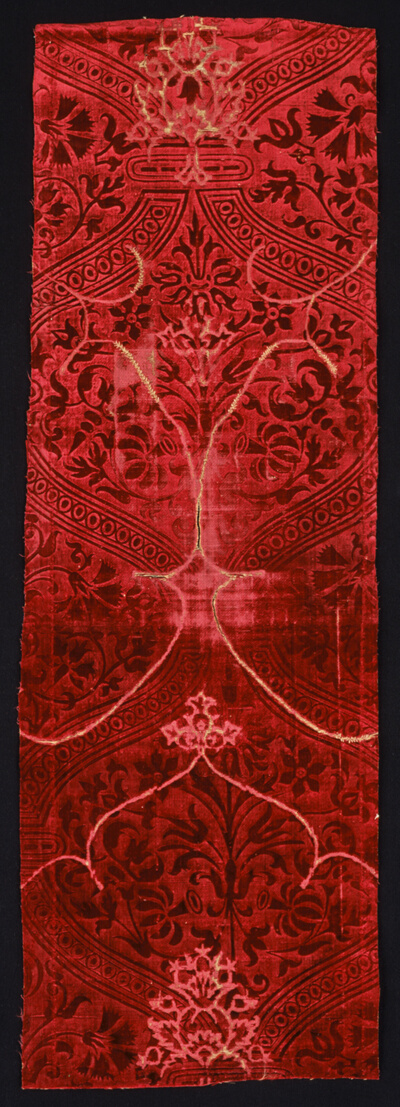
The Panel: A Study in Voided Velvet and the Lexicon of Luxury
In the hallowed ateliers of London’s Savile Row, where the language of cloth is spoken with the precision of a master tailor’s chalk, the heritage research artifact under examination—a silk panel of satin weave with supplementary pile warps forming cut, voided velvet, and stamped—represents a pinnacle of classic silk craftsmanship and fluid elegance. This artifact, housed within the Lauren Fashion Heritage Lab, is not merely a textile; it is a document of material intelligence, a testament to the interplay between structure and surface, and a silent chronicle of the sartorial codes that define enduring luxury. To dissect its materiality is to engage with a tradition that values depth, texture, and the subtle dialogue between light and shadow—a tradition that Savile Row has long championed in its pursuit of the bespoke.
Materiality: The Architecture of Silk and Velvet
The foundation of this panel is a silk satin weave, a construction that inherently confers a smooth, lustrous surface. Satin weaves, characterized by long floats of warp yarns that minimize interlacings, produce a fabric of exceptional sheen and drape. This base provides a canvas of liquid light, a ground that catches the eye with a reflective quality reminiscent of still water. Yet, the panel’s true distinction lies in its supplementary pile warps, which are woven into the satin ground to create a cut, voided velvet. The term “voided” is critical: it denotes areas where the pile is absent, allowing the satin ground to emerge in deliberate contrast. This technique, perfected in Renaissance Italy and later refined in French and English workshops, is a masterclass in controlled opulence. The pile—raised, dense, and soft to the touch—is formed by cutting loops of the supplementary warp, leaving a surface of plush, upright fibers. The voided sections, conversely, remain flat and glossy, creating a rhythmic interplay of texture. The stamped finish further complicates the surface, introducing a subtle, embossed pattern that adds a third dimension of tactile and visual interest. This is not a fabric that shouts; it whispers, inviting the hand and eye to explore its depths.
The cut velvet itself is a feat of engineering. Each pile warp must be precisely tensioned and sheared to ensure uniformity, while the voided areas require meticulous planning to prevent the pile from encroaching on the satin ground. The result is a fabric that possesses both structure and fluidity—a paradox that defines high-end silk craftsmanship. The weight of the panel, its resilience, and its ability to hold a fold without creasing speak to the quality of the raw silk and the expertise of the weaver. In Savile Row terms, this is a cloth that “behaves”—it responds to the tailor’s hand with predictable grace, whether destined for a gown, a waistcoat, or an interior panel.
Fluid Elegance: The Aesthetic of Movement
The term “fluid elegance” is not mere hyperbole; it is a technical descriptor for how this panel interacts with light and motion. The satin weave’s long floats catch light in a continuous sweep, while the velvet pile absorbs it, creating a chiaroscuro effect that shifts with every angle. The voided velvet pattern—likely a geometric or floral motif, though the specific design is not detailed here—adds a rhythmic structure to this fluidity. The stamped finish, perhaps a subtle damask-like motif or a fine ribbing, introduces a micro-texture that disrupts the uniformity of the satin, preventing it from appearing too flat. This interplay ensures that the panel never appears static; it breathes with the wearer or the environment, a quality that Savile Row tailors prize in evening wear and ceremonial garments.
Historically, voided velvet panels were used in ecclesiastical vestments, courtly robes, and later in the 19th-century revival of historicist fashion. The Lauren Fashion Heritage Lab’s artifact likely dates from the late 19th or early 20th century, a period when Savile Row houses like Henry Poole & Co. and Huntsman were incorporating such fabrics into bespoke smoking jackets, opera capes, and ladies’ evening coats. The fluid elegance of the panel aligns with the Edwardian aesthetic of languid luxury—a time when silk was not just a material but a statement of refined taste. The stamped finish, often achieved through heat and pressure, adds a layer of permanence to the design, ensuring that the pattern remains crisp even after decades of handling.
Classic Silk Craftsmanship: The Savile Row Standard
To understand this panel is to understand the ethos of classic silk craftsmanship. The silk itself is likely sourced from mulberry silkworms (Bombyx mori), cultivated for their long, continuous filaments that produce a filament of unmatched luster and strength. The weaving process, whether executed on a handloom or a Jacquard mechanism, demands a level of precision that borders on the obsessive. The supplementary pile warps must be tensioned independently from the ground warps, a challenge that requires a skilled weaver to monitor the fabric’s formation in real time. The cut velvet is created by inserting a “pile wire” under the supplementary warp, which is then cut with a knife to raise the pile. The voided areas are achieved by omitting the pile wire in specific sections, allowing the satin ground to remain exposed. This is a labor-intensive process, and the panel’s survival in pristine condition—free from crushing or pile loss—testifies to the quality of its construction.
In the context of Savile Row, such a panel would be treated with the same reverence as a bolt of Super 150s wool. It would be stored flat, protected from light and dust, and handled only with clean, dry hands. The tailor would assess its grain, its bias, and its ability to take a seam without fraying. The stamped finish, while decorative, also serves a functional purpose: it helps to stabilize the satin ground, reducing slippage during cutting and sewing. This is a fabric designed for the bespoke process, where every cut is a commitment and every stitch a dialogue with the cloth.
Conclusion: The Enduring Legacy of the Panel
This heritage research artifact—a panel of silk satin with cut, voided velvet and stamped finish—is more than a historical curiosity. It is a living repository of techniques that continue to inform contemporary luxury. The Lauren Fashion Heritage Lab preserves such artifacts not as relics, but as references for designers, historians, and craftspeople who seek to understand the DNA of elegance. In a world of fast fashion and synthetic substitutes, this panel reminds us that true luxury is born from material intelligence—a deep understanding of fiber, weave, and finish. Its fluid elegance, its classic craftsmanship, and its silent dialogue with light and touch are the very qualities that define the Savile Row standard. To study it is to learn the language of cloth; to wear it is to speak that language with confidence.