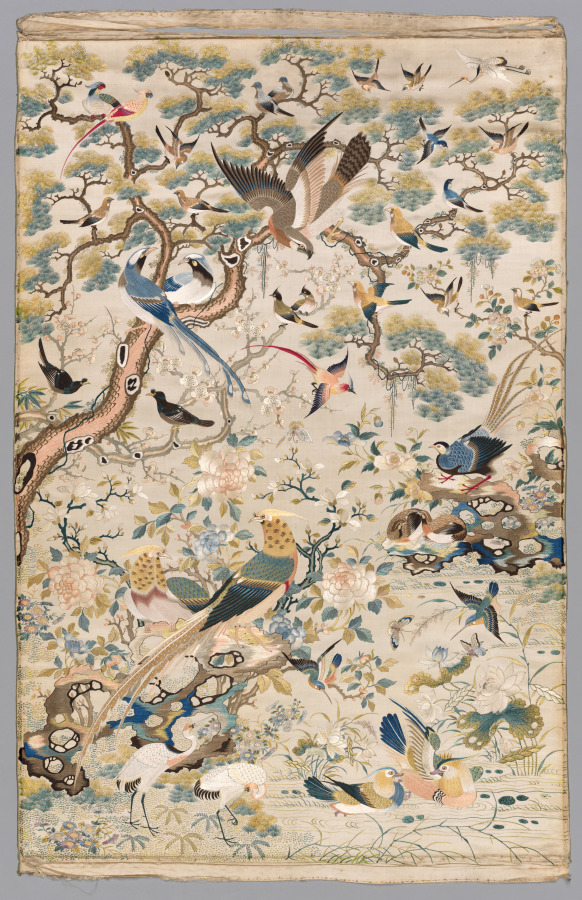
A Myriad of Birds: An Aviary Woven in Imperial Silk
To consider the subject of ‘A Myriad of Birds’ rendered in silk is to engage with one of the most demanding and eloquent chapters in the annals of textile heritage. It is not merely a decorative motif; it is a profound statement of technical mastery, cosmological understanding, and imperial authority, executed in a fibre that has, for millennia, defined civilisation itself. The legacy of imperial silk weaving presents a canon of craftsmanship against which all subsequent endeavours in patterned cloth are, whether tacitly or explicitly, measured. Here, we examine this artifact not as a relic, but as a peerless exemplar of material intelligence.
The Ground: A Foundation of Absolute Authority
First, one must appreciate the ground upon which this aviary takes flight. Imperial silk, particularly that emanating from the zenith of Chinese loom technology, established a foundational principle: the ground cloth is not a passive canvas. It is an engineered entity, a manifestation of order. The dense, luminous warp and weft of the finest huangjin or later, impeccable satin weaves, provide a surface of profound depth and subtle lustre. This is the woven equivalent of a Savile Row’s super 150s worsted—a base of such impeccable, understated perfection that it communicates luxury through its intrinsic quality long before a single decorative thread is introduced. It establishes a silent, regal discipline, a controlled environment in which the ensuing spectacle of life and colour will be displayed.
The Aviary: Iconography and Hierarchy in Flight
The subject matter—a myriad, a teeming multitude of avian forms—is where imperial ideology and artistic ambition converge. This is no casual scattering of bird motifs. It is a meticulously composed hierarchy, a feathered court captured in floss and filament. The phoenix (fenghuang), sovereign of all birds, would command the central axis, its sweeping tail feathers and elegant crown rendered in complex supplementary wefts, often of gilt paper wrapped in silk, causing it to literally gleam with a different light than its subjects. Surrounding it, a structured yet fluid society: mandarin ducks denoting conjugal fidelity, cranes symbolising longevity, parrots for clever discourse, and swallows for the arrival of auspicious seasons.
Each species is not merely depicted but articulated, with precise, economical lines that capture the turn of a head, the splay of a claw, the distinctive barring of a wing. The drawing, translated into the binary language of warp and weft by the unseen master weaver operating the draw-loom, must be faultless. A single mis-tie in the thousands of patterning cords would repeat its error across the entire length of the bolt, ruining the composition. The risk was total, the precision required, absolute.
Materiality and Technique: The Alchemy of Loom and Hand
The true heritage here resides in the alchemy of technique. To achieve the polychrome brilliance and painterly detail of a myriad of birds required a formidable arsenal of silk technologies. One observes the use of kesi (slit-tapestry) for areas of pictorial realism, allowing for colour changes and delicate shading as if by brushstroke. For larger, luminous fields of colour—a lapis lazuli sky, an emerald branch—satin damasks would be employed, their patterns visible through a play of light on texture rather than colour contrast.
Most sophisticated is the integration of jin silk, or polychrome patterned weaves, often incorporating gold and silver threads. Here, the birds become multidimensional. The weft threads, of multiple colours and metals, are not simply carried across the width but are selectively interwoven, creating intricate, discontinuous patterns that float upon the foundational ground. The material cost is extraordinary: kilometres of hand-reeled silk, precious metal, and years of a master weaver’s life, all invested into a single length of cloth. This is bespoke in its most extreme, imperial sense—the client is the state, the purpose is the projection of celestial mandate and cultural supremacy.
Legacy and Resonance: A Canon for the Connoisseur
The legacy of this imperial silk weaving establishes a permanent canon. It sets the parameters for ambition in textile design: the integrity of the ground, the narrative depth of the iconography, the fearless synthesis of complex techniques, and the unwavering commitment to the finest possible material expression. It speaks of a culture that understood cloth as a primary medium for communicating power, philosophy, and aesthetic philosophy.
For the modern connoisseur of heritage, this artifact—this ‘Myriad of Birds’—serves as an enduring benchmark. It reminds us that true luxury in textiles is not defined by ostentation alone, but by the seamless, often invisible, integration of profound material knowledge, narrative intelligence, and technical audacity. The silence of the silk, the language of the birds, the authority of the weave: these are the threads of a legacy that continues to inform the highest aspirations in craftsmanship. It is a testament to the fact that the most sophisticated stories are often those told not in pages, but in patterns, woven with patience, skill, and sovereign intent.