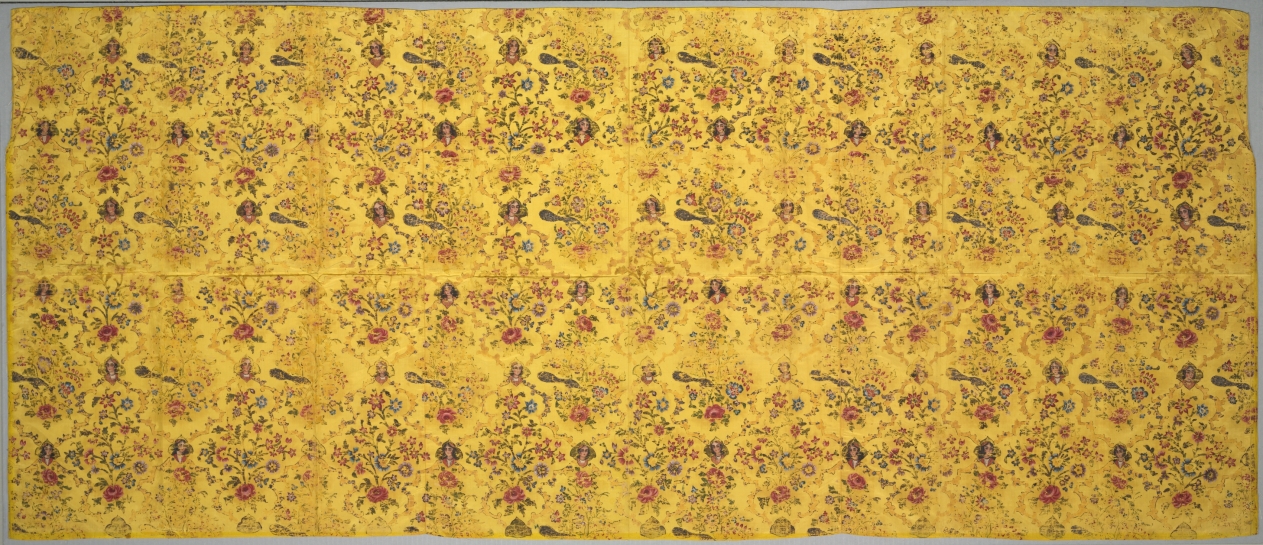
The Peacock and the Portrait: A Silk Wall Covering as Imperial Legacy
In the hushed, wood-paneled ateliers of London’s Savile Row, where the cut of a jacket is a matter of honor and the weight of a cloth is a testament to centuries of craft, we speak of provenance not merely as a date or a name, but as a living thread. The artifact before us—a wall covering of woven silk, bearing a complex tableau of flora, peacocks, and portrait medallions—is not simply a decorative object. It is a document of imperial ambition, a masterclass in materiality, and a poignant relic of a weaving tradition that once clothed empires and now informs the quiet authority of bespoke tailoring.
Materiality and the Language of Silk
Silk is the protagonist here. Its materiality is not incidental; it is the very grammar of the narrative. The wall covering, likely dating from the late 19th or early 20th century, is woven from filament silk—a continuous protein fiber harvested from the cocoon of the Bombyx mori silkworm. This is not the raw, textured silk of rustic looms, but the lustrous, high-twist thread of imperial manufactories. The warp and weft are so finely calibrated that the surface catches light with a liquid sheen, shifting from deep indigo to verdant green as the viewer moves. This optical effect, known as shot silk or changeant, was a hallmark of the finest European and Asian workshops, a deliberate demonstration of technical mastery.
The weave structure itself is a compound satin, likely a lampas weave, where a pattern is created by an additional weft thread that floats over the ground weave. This allows for the intricate, multi-colored design—the peacock’s iridescent tail feathers, the delicate petals of chrysanthemums and peonies, and the gilded frames of the portrait medallions—to be rendered with a painterly precision. The density of the weave, approximately 120 to 160 threads per centimeter, is a testament to the loom’s complexity and the weaver’s patience. Each square inch required hundreds of passes of the shuttle, a process that could take weeks for a single yard of cloth. This is not a fabric for the hurried; it is a fabric for the discerning, for those who understand that time, like silk, is a luxury that cannot be replicated.
Iconography: Peacocks, Flora, and the Imperial Gaze
The iconographic program of this wall covering is a deliberate lexicon of power and prestige. The peacock, a motif ubiquitous in both Mughal and European decorative arts, is not merely an ornamental bird. In the context of imperial silk weaving, it symbolizes immortality, renewal, and the all-seeing eye of divine authority. The peacock’s tail, with its ocelli (eye-like spots), was a favorite of the Safavid and Ottoman courts, and later adopted by European manufacturers such as the Manufacture des Gobelins in Paris and the Spitalfields weavers in London. Here, the peacock stands amidst a profusion of flora—chrysanthemums (a symbol of longevity in East Asian art), peonies (wealth and honor), and stylized lotuses (purity). This botanical abundance is not random; it is a coded language of prosperity and dynastic continuity.
The inclusion of portrait medallions elevates the piece from mere decoration to political statement. These medallions, woven with a precision that suggests the use of a Jacquard loom (invented in 1801, but perfected for silk by the mid-19th century), likely depict idealized figures—perhaps a monarch, a patron, or allegorical representations of the arts and sciences. The medallions are framed by acanthus leaves and scrolling vines, a classical motif that roots the design in the Greco-Roman tradition of imperial portraiture. This fusion of Eastern and Western iconography—the peacock and the portrait, the lotus and the acanthus—is the hallmark of the Chinoiserie and Orientalism that dominated European luxury markets from the 17th century onward. It is a visual declaration of global reach, a tapestry of conquest and commerce woven into the very fabric of the wall.
The Legacy of Imperial Silk Weaving
To understand this wall covering is to understand the legacy of imperial silk weaving—a tradition that spans from the Silk Road caravanserais to the royal manufactories of Europe. The silk trade was the lifeblood of empires: the Byzantine Empire guarded the secret of sericulture for centuries; the Mongol Empire facilitated its spread; and the Italian city-states, particularly Lucca and Venice, perfected the art of figured silk weaving in the Renaissance. By the 18th century, France had become the epicenter of luxury silk production, with Lyon supplying the courts of Versailles, Vienna, and St. Petersburg. The Grande Fabrique of Lyon, under royal patronage, produced silks of such complexity that they were considered the pinnacle of European craftsmanship.
This wall covering, however, bears the hallmarks of a later, more globalized phase of this legacy. The use of portrait medallions and the specific floral motifs suggest a date after the Great Exhibition of 1851, when international trade fairs spurred a revival of historicist and exotic designs. The piece may have been woven in a European workshop—perhaps in Lyon, Krefeld, or even a bespoke London studio—but the influence of Mughal and Persian silk weaving is unmistakable. The peacock, after all, is the national bird of India, and the Mughal emperors were renowned patrons of silk workshops that produced pashmina and kinkhab (brocade) for their courts. The British Empire, in turn, absorbed these motifs into its own decorative lexicon, using silk wall coverings to adorn the grand reception rooms of colonial administrators and industrial magnates.
From Wall to Wardrobe: The Savile Row Connection
Why does this artifact matter to Savile Row? Because the same principles that governed the weaving of this wall covering—the selection of the finest raw materials, the precision of the weave, the narrative encoded in the pattern—are the principles that govern the creation of a bespoke suit. The silk weaver and the tailor are kin in their devotion to craftsmanship and material integrity. The wall covering is a reminder that silk is not merely a fabric; it is a repository of history, a medium for power, and a testament to human ingenuity.
In the context of Lauren Fashion Heritage Lab, this artifact serves as a research tool for understanding how imperial silk weaving shaped the aesthetics of luxury fashion. The peacock motif, for instance, appears in the embroidered jackets of the 1920s, the printed scarves of the 1950s, and the contemporary runway collections of houses like Gucci and Alexander McQueen. The portrait medallion, meanwhile, prefigures the cameo brooches and monogrammed linings that define personalization in high fashion. By studying this wall covering, we trace the lineage of these motifs from the imperial loom to the modern wardrobe.
To handle this silk is to feel the weight of history. It is a fabric that has witnessed the rise and fall of empires, the ebb and flow of trade routes, and the quiet persistence of craft in an age of mass production. For the discerning client of Savile Row, it is a reminder that true luxury is not about novelty, but about continuity—the unbroken thread that connects the peacock’s feather to the tailor’s needle. This wall covering is not just an artifact; it is a legacy, woven in silk, for the ages.