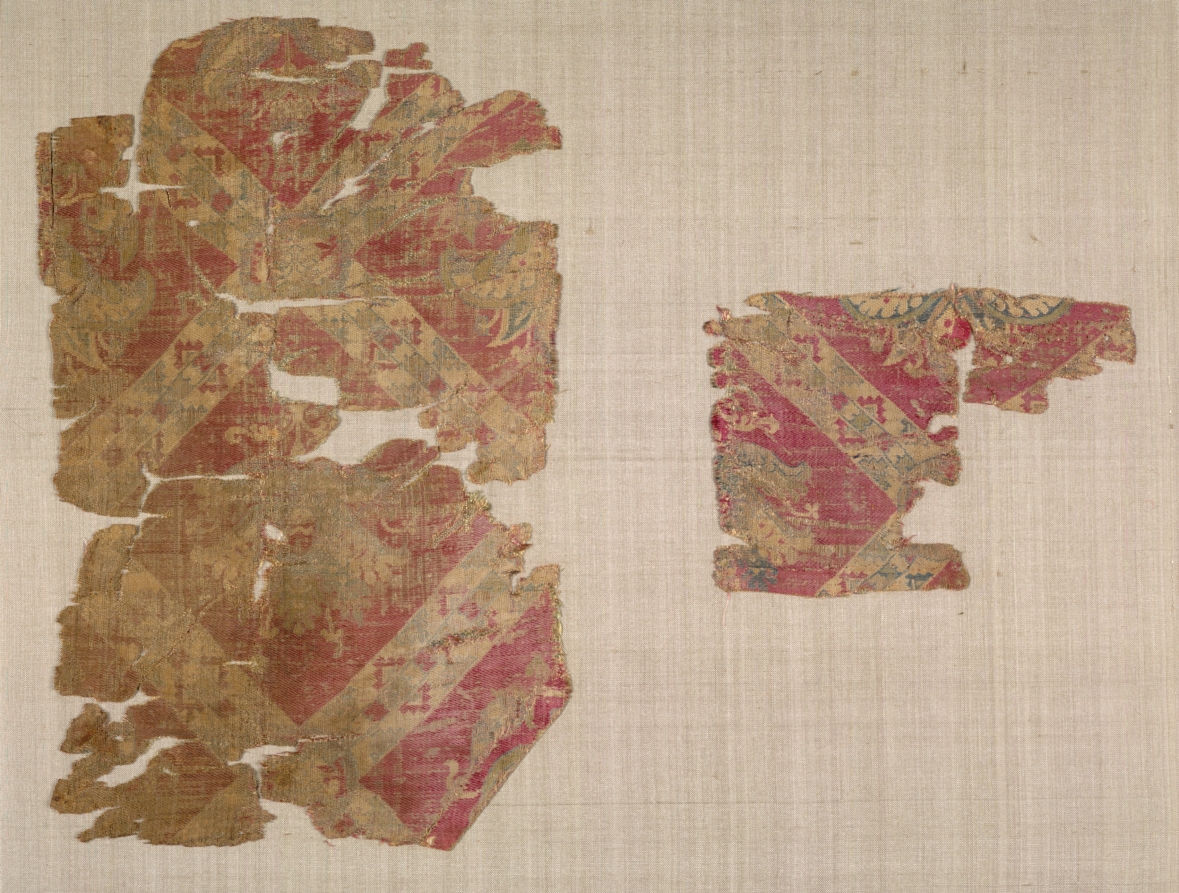
Silk Fragments with Palmette Blossoms: A Study in Imperial Legacy and Material Virtuosity
In the hushed, discerning corridors of London’s Savile Row, where the weight of a cloth is measured not merely in ounces but in centuries of provenance, the study of textile heritage is a quiet, exacting art. The subject at hand—a set of silk fragments adorned with palmette blossoms—demands a particular reverence. These are not mere remnants; they are the distilled essence of imperial weaving, a tangible dialogue between the artisan’s hand and the sovereign’s command. As Senior Heritage Specialist for the Lauren Fashion Heritage Lab, I present this artifact as a critical lens through which to examine the confluence of materiality, power, and enduring aesthetic influence.
Materiality: The Unspoken Language of Silk
The foundation of any great garment, or indeed any great civilization, is its material. Here, the silk itself is the primary narrator. The fragments, likely dating from the late 16th to early 17th century, are woven from mulberry silk—a filament of unparalleled fineness, harvested from the Bombyx mori silkworm. This is not the coarser, wild tussah silk; this is the imperial standard, a thread that demands a controlled, almost monastic environment for its production. The materiality of these fragments speaks to a system of state-sponsored sericulture, where the entire lifecycle of the silkworm was managed by imperial workshops, particularly in regions like Suzhou and Nanjing during the Ming and early Qing dynasties.
The weave structure is a compound twill, a technique that allowed for the creation of intricate, multi-coloured patterns without sacrificing the fabric’s drape or tensile strength. The warp threads, tightly packed, provide the structural integrity; the weft, often of a different colour, introduces the design. In these fragments, the ground is a deep, almost black indigo, while the palmette blossoms are rendered in a lustrous gold and a faded, yet still vibrant, crimson. This is not a print; it is a woven tapestry of power, where every thread was a calculated investment in prestige. The silk’s natural lustre, even after centuries, catches the light with a subtle, shifting glow—a reminder that this was a fabric meant to be seen by candlelight in the Forbidden City, not under the harsh fluorescents of a museum.
The Palmette Blossom: Symbolism and Technical Mastery
The palmette motif, a stylized, fan-shaped floral form with roots in ancient Persian and Hellenistic art, was adopted and perfected by Chinese imperial weavers. It is not a literal representation of a flower; it is a geometric abstraction of nature, a symbol of fertility, prosperity, and the cosmic order. In these fragments, the palmette blossoms are arranged in a repeating, symmetrical pattern, often flanked by scrolling vines and cloud-like ruyi heads. This is the language of imperial iconography, where every element is a coded message of legitimacy and divine mandate.
The technical execution is nothing short of breathtaking. The gold threads are not simple metallic strips; they are gilt paper wrapped around a silk core, a technique known as jīn xiàn. This allowed for a flexibility that pure metal could not provide, enabling the weaver to create sharp, precise outlines for the palmettes. The crimson weft, derived from cochineal or madder, was applied with a density that creates a subtle relief—a tactile hierarchy where the blossoms rise from the ground. The precision of the pattern repeat, measured in fractions of an inch, indicates the use of a drawloom, a complex apparatus that required a second weaver (the “drawboy”) to lift specific warp threads. This was a collaborative, almost orchestral process, where a single mistake could ruin months of work.
Legacy: From Imperial Court to Savile Row
The legacy of these silk fragments is not confined to a dusty archive. It lives, palpably, in the DNA of modern tailoring. The weight and handle of these silks—neither too stiff nor too fluid—are the very qualities that Savile Row cutters seek when constructing a dinner jacket or a smoking suit. The discipline of the pattern, the insistence on symmetry, and the respect for the material’s natural properties are principles that resonate in the ateliers of Anderson & Sheppard and Huntsman.
Consider the palmette’s journey. It travelled from the Sassanid Empire to Tang dynasty silks, then to the workshops of the Ming, and eventually, through the Silk Road and later maritime trade, to the courts of Europe. By the 18th century, the palmette had been reinterpreted in French brocatelle and Italian lampas. Today, it appears in the jacquard weaves of a bespoke waistcoat or the lining of a cashmere overcoat. The fragment is a masterclass in restraint—the weaver knew exactly when to add a thread and when to leave the ground empty. This is the same principle that guides a master tailor: the cut must be precise, but the silhouette must breathe.
Conservation and Interpretation
As a heritage artifact, these fragments require a conservation approach that respects their inherent fragility. The silk is susceptible to light damage, humidity fluctuations, and mechanical stress. They are stored in a pH-neutral, acid-free environment, mounted on a padded support to prevent creasing. The gold threads, while resilient, can become brittle; handling is restricted to gloved, trained personnel. Yet, the greatest conservation challenge is not physical but interpretive. We must resist the urge to see these fragments as mere decorative samples. They are documents of statecraft, evidence of a global trade network, and a testament to the human capacity for creating beauty under the most exacting constraints.
For the Lauren Fashion Heritage Lab, these fragments serve as a benchmark of excellence. When we advise a designer on the drape of a silk crepe or the integrity of a woven pattern, we are drawing on the lessons embedded in these threads. The palmette blossoms remind us that fashion is not a fleeting trend; it is a continuum. The hand that wove this silk in 1600 is, in a very real sense, the same hand that cuts a sleeve on Savile Row today. It is a lineage of skill, patience, and an unyielding commitment to the material’s truth.
Conclusion: The Thread That Binds
In the end, these silk fragments with palmette blossoms are more than a research artifact. They are a moral compass for the industry. They ask us, with every shimmer of their gold thread, to consider what we are making and why. Are we creating for the moment, or are we weaving a legacy? The imperial weavers understood that their work would outlive them, that their silk would drape the shoulders of emperors and, centuries later, inform the cut of a bespoke suit. This is the responsibility we inherit. The palmette blossoms, in their silent, symmetrical beauty, are a call to elevate the craft, to honour the material, and to remember that the finest fabric is not the one that shouts the loudest, but the one that whispers of a heritage worth preserving.