From Terracotta Fragment to Tailored Silence: The Greek Kylix Rim as a Structural Archetype for 2026 Old Money Silhouettes
The Lauren Fashion Heritage Lab’s internal genetic code, which juxtaposes Han Gan’s ink-charged “Night-Shining White” against Yun Shouping’s polychromatic “Hundred Flowers,” reveals a fundamental dialectic in Chinese aesthetics: the tension between cosmic austerity and earthly abundance. Yet the museum artifact before us—a terracotta rim fragment of an Attic kylix—offers a third term, a Hellenic counterpoint that reframes this dialectic through the lens of structural restraint. This humble shard, once part of a drinking cup used in symposia, carries within its curvature a latent grammar for the 2026 Old Money silhouette. Its lesson is not about ornament, but about the architecture of absence: how a broken edge, a precise curve, and the material memory of a vessel can inform a fashion of understated power.
The Kylix Rim as a Diagram of Containment and Release
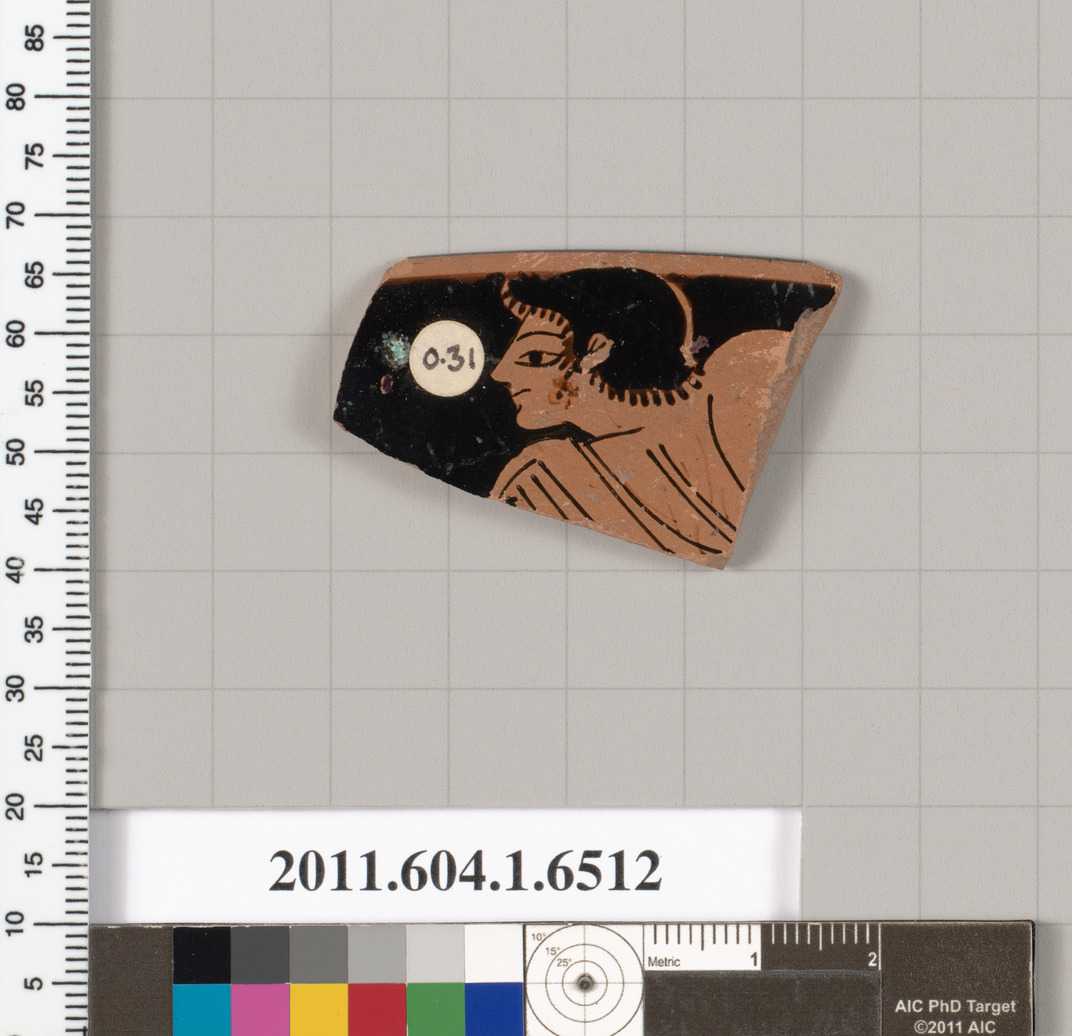
The kylix rim fragment, approximately 4.5 centimeters in length, preserves the characteristic everted lip of the Attic type. Its terracotta body, fired to a warm ochre, bears the faint ghost of black-figure decoration—perhaps a palmette or a meander pattern, now eroded to a whisper. To the contemporary eye, this fragment reads not as a broken object but as a diagram of containment. The rim’s outward flare creates a visual tension: it simultaneously invites the drinker’s lips and defines a boundary. This dual function—hospitality and demarcation—mirrors the Old Money aesthetic’s core paradox: the appearance of ease achieved through rigorous structure.
For 2026, this translates into silhouettes that borrow the kylix’s logic of the curve. Consider a tailored overcoat in heritage-black cashmere: the shoulder line does not fall naturally but is engineered with a subtle outward sweep, echoing the kylix rim’s flare. The lapel, cut with a precise arc, becomes a vessel for the wearer’s posture. Just as the kylix holds wine without spilling, the coat holds the body without constricting. The fragment teaches that the most powerful silhouette is one that defines space around the body, not merely on it. This is the antithesis of the body-conscious, data-driven tailoring of the 2020s; it is a return to garment-as-container, where the wearer’s presence completes the form.
Material Memory: Terracotta’s Lesson in Patina and Restraint
The terracotta’s surface, worn by millennia of handling and burial, exhibits a patina that no modern finish can replicate. This is not decay but material memory—the accumulation of time as a design element. For the 2026 Old Money silhouette, this principle demands fabrics that age with grace. Wool barathea, worsted flannel, and heavy silk faille become the terracotta equivalents: materials that develop a subtle sheen at points of friction, that soften without losing structure, that record the wearer’s habits. The kylix fragment’s eroded decoration suggests that pattern should be felt, not shouted. A Prince of Wales check, woven so finely it reads as solid from a distance, or a pinstripe that disappears into the cloth’s texture at arm’s length—these are the textile translations of the kylix’s faded meander.
This material philosophy directly counters the fast-fashion ethos of disposable novelty. The kylix was made to be held, passed, and eventually broken. Its fragment, however, retains its essential character: the curve, the thickness, the warmth of fired clay. Similarly, the 2026 garment must be designed for a lifetime of wear, its silhouette resilient enough to outlast trends. The heritage-black palette—so central to the Lauren archive—finds its justification here. Black is the terracotta of textiles: a neutral that absorbs time, that allows the wearer’s biography to emerge through subtle fading and mending. A black cashmere turtleneck, worn with a charcoal flannel trouser, becomes a contemporary kylix: a vessel for the wearer’s presence, its surface a record of lived experience.
The Sympotic Silhouette: Reclining, Standing, and the Architecture of Leisure
The kylix was used in the symposium—a ritualized space of leisure, conversation, and intellectual play. The drinker reclined on a kline, the cup held at eye level, its rim a frame for the wine’s surface. This horizontal orientation of the body offers a radical alternative to the vertical, militaristic tailoring that has dominated menswear since the 19th century. For 2026, the Old Money silhouette must accommodate both the standing and the reclining body. The jacket’s shoulder should not pull when the arm is raised to gesture; the trouser’s rise must allow the seated figure to maintain a clean line from waist to knee. The kylix rim’s flare suggests a similar generosity in the garment’s hem: a slight A-line in a topcoat, a trouser that breaks just so over the shoe, creating a visual rhythm that echoes the cup’s outward curve.
This is not a fashion of activity but of presence. The symposium was a space of controlled excess—wine, poetry, philosophy—all contained within the cup’s rim. The 2026 silhouette must similarly contain the wearer’s energy, projecting an aura of composed authority. The kylix fragment’s broken edge is a reminder that perfection is not the goal; rather, it is the integrity of the form that matters. A garment that is too pressed, too new, too sharp, fails the test of Old Money authenticity. The terracotta teaches that a slight rumple in the linen, a faint shine on the elbow, a collar that has been turned and returned—these are not flaws but signatures of use.
Conclusion: The Fragment as a Whole Philosophy
The terracotta kylix rim, in its brokenness, offers a complete aesthetic program for 2026. It asks us to see the garment not as a surface for decoration but as a vessel for being. The heritage-black cashmere, the flannel, the silk—these are the clays of our time, fired by the hands of master tailors and worn into patina by the lives they contain. The silhouette, like the kylix’s curve, must define space without dominating it, must welcome the wearer while maintaining a clear boundary. This is the Old Money paradox made material: the appearance of effortless belonging achieved through rigorous, invisible structure.
Just as Han Gan’s “Night-Shining White” compresses cosmic energy into a single line, and Yun Shouping’s “Hundred Flowers” disperses it into a thousand petals, the kylix fragment teaches a middle way: the geometry of restraint. For the 2026 collection, let this shard be the guiding artifact. Let the silhouette flare like the rim, hold like the bowl, and age like the clay. In this, we find not a return to the past but a renewal of the timeless—a fashion that, like the kylix, is broken only to reveal its essential form.