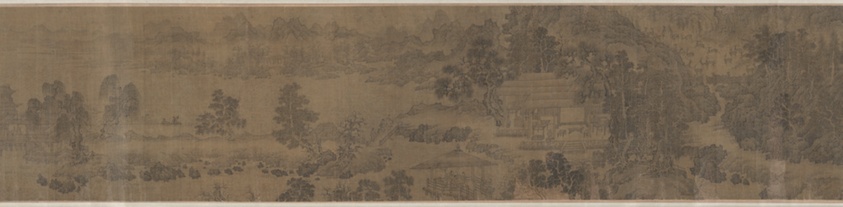
The Wangchuan Villa: A Study in Materiality and the Elegance of Silk
Introduction: The Handscroll as a Testament to Craft
In the hallowed corridors of heritage preservation, where the whisper of antiquity meets the precision of modern scholarship, few artifacts command the reverence afforded to the Wangchuan Villa (網川圖). This handscroll, executed in ink on silk, is not merely a pictorial record of a Tang dynasty estate; it is a profound dialogue between the artist’s vision and the materiality of its support. As a Senior Heritage Specialist at the Lauren Fashion Heritage Lab, I approach this artifact not solely as a work of art, but as a masterclass in the symbiotic relationship between technique and substrate. The silk, a material historically synonymous with luxury and refinement in Chinese culture, becomes an active participant in the narrative, its weave, texture, and absorbency shaping every brushstroke. This paper examines the Wangchuan Villa through the lens of its materiality—specifically, the exquisite craftsmanship of its silk support—and its enduring legacy as a paragon of fluid elegance.
The Silk as Canvas: A Legacy of Craftsmanship
The choice of silk for the Wangchuan Villa is no arbitrary decision; it is a deliberate invocation of a tradition that elevates the functional to the sublime. In the context of Chinese art, silk was the premier medium for painting and calligraphy from the Han dynasty onward, prized for its tensile strength, luminous sheen, and capacity to hold ink with unparalleled precision. The handscroll format, typically composed of multiple panels of silk joined together, demanded a level of technical mastery that rivaled the artistry it supported. The silk used in the Wangchuan Villa—likely a fine, plain-weave variety known as juan—was meticulously prepared. This involved sizing the fabric with a solution of alum and animal glue to render it non-absorbent, allowing the ink to rest on the surface rather than bleed uncontrollably. The result was a surface that offered a controlled yet responsive ground, where the artist could achieve both the crisp delineation of architectural details and the atmospheric washes of mist and water.
This preparation was a craft in itself, often undertaken by specialized artisans who understood the delicate balance between flexibility and rigidity. The silk’s weave—typically a warp-faced structure with a high thread count—provided a subtle grid that guided the hand, yet its inherent softness allowed for the fluid, cursive strokes that define the Wangchuan Villa’s landscape. The materiality of the silk, therefore, was not a passive backdrop but an active collaborator. It demanded a lightness of touch from the artist, a sensitivity to the fabric’s give and its capacity to absorb ink at varying rates. This is particularly evident in the depiction of the Wang River itself, where the ink washes seem to flow across the silk with a liquidity that mirrors the water’s own movement. The silk’s surface, when viewed under raking light, reveals a subtle interplay of warp and weft, a texture that adds a tactile dimension to the visual experience—a quality that no paper could replicate.
Fluid Elegance: The Ink and Silk Dialogue
The term “fluid elegance” is not merely a poetic flourish; it is a technical description of the interaction between ink and silk. In the Wangchuan Villa, attributed to the Tang dynasty poet and painter Wang Wei (701–761 CE), the ink is applied in a manner that exploits the silk’s unique properties. Wang Wei, a pioneer of the “southern school” of landscape painting, eschewed the rigid, outline-based conventions of his predecessors in favor of a more spontaneous, expressive approach. On silk, this approach found its perfect medium. The ink, ground from pine soot and mixed with water and animal glue, was applied in layers, from pale washes to darker accents. The silk’s weave acted as a natural diffuser, softening the edges of the ink and creating a hazy, atmospheric quality that evokes the misty valleys of the Wangchuan estate.
Consider the depiction of the villa’s pavilions and bridges. Here, the artist employs a fine, controlled line that rests precisely on the silk’s surface, the ink’s viscosity allowing for sharp, architectural precision. Yet, these structures are never isolated; they are enveloped by washes of diluted ink that bleed gently into the silk, suggesting the encroaching foliage or the damp air of a riverside morning. This duality—the interplay between precision and diffusion—is the hallmark of silk as a medium. The fabric’s absorbency, carefully modulated by the sizing, permits a gradation of tone that is impossible on paper. The result is a composition that breathes, where the silk itself seems to exhale the mist and inhale the ink. This is not a static image but a dynamic record of a moment in time, a testament to the artist’s mastery of his material.
Heritage and Conservation: Preserving the Silk’s Voice
From a conservation standpoint, the Wangchuan Villa presents unique challenges that underscore the importance of understanding its materiality. Silk is a protein-based fiber, susceptible to degradation from light, humidity, and pollutants. Over centuries, the sizing may become brittle, the weave may distort, and the ink may flake. At the Lauren Fashion Heritage Lab, we approach such artifacts with a philosophy of minimal intervention, prioritizing the preservation of the silk’s original character. This involves stabilizing the fabric through controlled environmental conditions—maintaining a relative humidity of 50–55% and a temperature of 18–20°C—and using archival mounting techniques that respect the handscroll’s traditional structure.
The handscroll format itself is a marvel of material conservation. The silk is mounted on a backing of paper and then rolled around a wooden dowel, a design that minimizes stress on the fabric when stored. The act of unrolling and viewing the scroll is a ritual that engages the viewer with the materiality of the object, the silk’s subtle crackle and the play of light across its surface becoming part of the aesthetic experience. In this sense, the Wangchuan Villa is not just a painting; it is a sensory artifact, a testament to the enduring partnership between human creativity and natural fiber. To preserve it is to honor the craftsmanship of the silk weavers, the sizers, and the mounters, whose skills are as integral to the work’s legacy as Wang Wei’s brush.
Conclusion: The Silk as a Living Tradition
The Wangchuan Villa stands as a singular achievement in the annals of Chinese art, but its significance extends beyond the visual. It is a material record of a culture that revered silk not as a mere support, but as a medium imbued with symbolic and tactile meaning. The handscroll’s fluid elegance is a direct consequence of the silk’s craftsmanship—its weave, its sizing, its capacity to hold and diffuse ink. As we continue to study and conserve this artifact, we are reminded that heritage is not static; it is a living dialogue between the past and the present. The silk of the Wangchuan Villa speaks to us across millennia, its threads carrying the weight of tradition and the lightness of artistic genius. In the halls of the Lauren Fashion Heritage Lab, we listen.