The Metallurgic Silhouette: Forging Old Money Aesthetics from Armory to Atelier
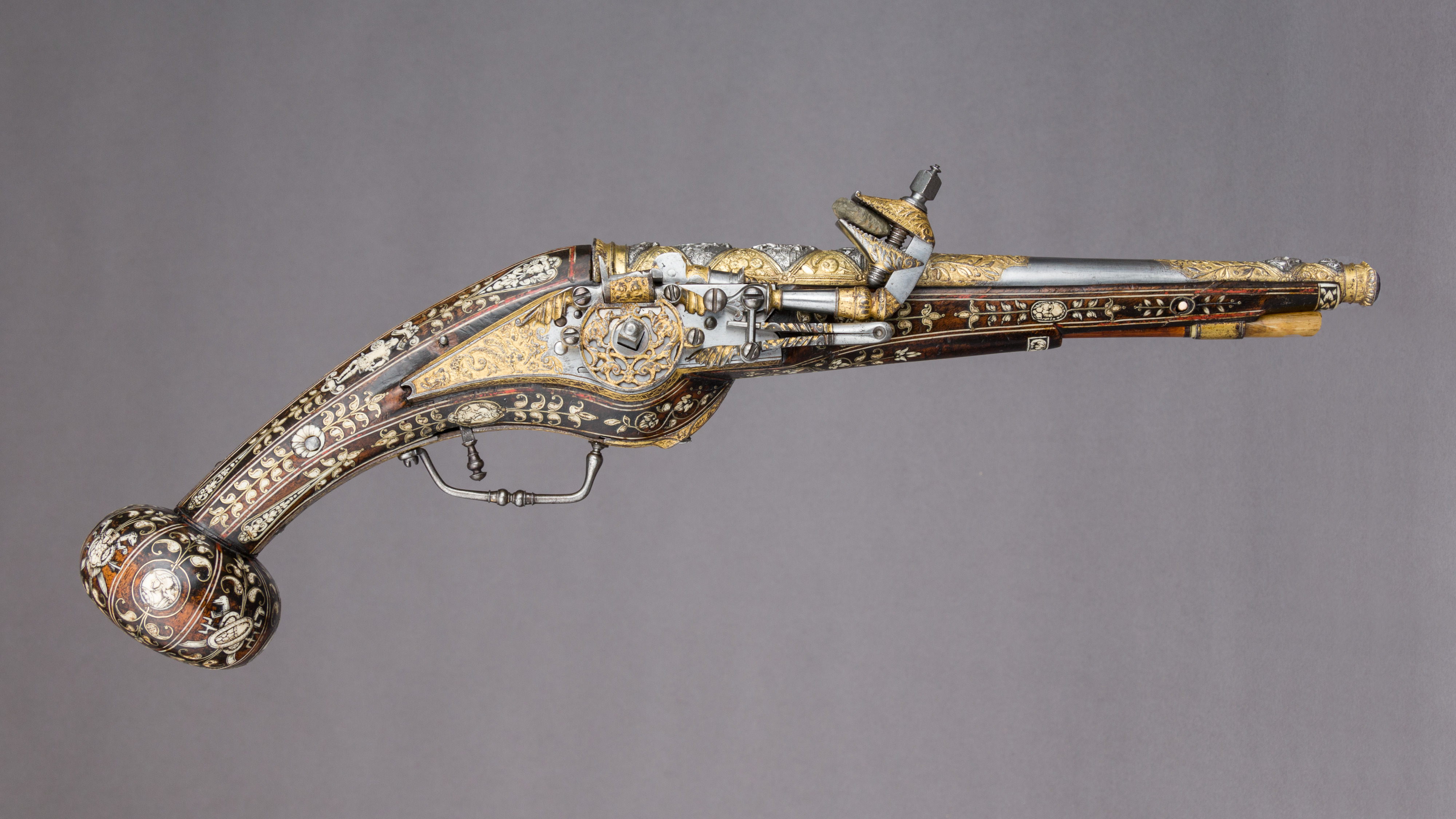
The conceptual dialogue between the Mirror with Split-Leaf Palmette Design Inlaid with Gold and the Sarcophagus Panel establishes a profound heritage framework for Lauren Fashion: the transformation of the ephemeral into the eternal through masterful craft, where surface becomes a site of profound narrative. This philosophical stance finds an unexpected yet potent material counterpart in the Pair of Wheellock Pistols (French, c. 1600-1620). These artifacts, instruments of decisive force, are paradoxically repositories of the highest decorative arts. Their synthesis of steel, gold, silver, brass, walnut, staghorn, and pigment does not merely inform the 2026 Old Money silhouette; it provides its foundational metallurgic grammar, translating the quiet, assured power of hereditary legacy into a modern sartorial language.
The Armature of Elegance: Steel, Structure, and the Unyielding Silhouette
The core of the wheellock pistol is its steel mechanism—complex, functional, and lethally precise. This translates directly to the 2026 Old Money silhouette as an underlying armature of impeccable structure. The Old Money ethos rejects fleeting trends for enduring form. Thus, tailoring becomes paramount, not as ostentation but as an invisible assertion of quality. Imagine a woman’s blazer where the shoulder line is engineered with the exacting precision of a lock-plate, creating a sharp, authoritative profile that never crumples. Or a man’s overcoat where the drape is achieved through internal construction as complex and considered as the pistol’s internal works, resulting in a silhouette that is both imposing and effortless. The steel informs a philosophy: true luxury is structural integrity, a form of sartorial ballistics where the cut must hit its mark with silent accuracy.
Precious Inlay: Gold, Silver, and the Semaphore of Restrained Opulence
Upon this steel foundation lies exquisite inlay: gold and silver scrolling foliage, mythological scenes, and geometric borders. This is not gaudy overlay but integrated ornamentation, a coded language of wealth and cultivation. For 2026, this manifests as the strategic and semantic use of precious embellishment. The "gold" here is metaphorical—a perfectly placed, gilded button engraved with a familial monogram; a slender belt buckle in brushed silver with an abstracted palmette motif; a delicate chain-stitch embroidery tracing a vine pattern along a cuff or placket, visible only upon close inspection. Like the pistol’s decoration, which speaks to the owner’s taste and status without impeding function, these elements are semaphores of legacy. They are heirlooms already embedded into the garment, following the principle from the heritage mirror: ornamentation as a declaration of “the permanent and the eternal” set against the base fabric of time.
The Organic Grip: Walnut, Staghorn, and the Patina of Provenance
Contrasting the cold brilliance of metal are the organic materials of the grip: walnut and staghorn. These materials warm to the touch, age with character, and bear the unique markings of their natural origin. They introduce the vital Old Money concept of the patina of provenance. For 2026 silhouettes, this translates to rich, textural fabrics that gain character with wear—luxurious brushed wools, supple cordovan leathers, and dense cashmeres that develop a personal gloss. The staghorn, with its tactile, variegated surface, inspires accessories and fastenings: horn buttons, a belt with a textured buckle, a bag clasp of polished organic material. These elements connect the wearer to a world of landed estates, hunting lodges, and inherited libraries, grounding the metallic precision in a narrative of natural, weathered authenticity. It is the sarcophagus panel’s lesson: the cold stone (steel structure) is given life and narrative through the carved, organic story (natural materials) upon it.
The Unified Composition: Pigment and the Discipline of a Limited Palette
Finally, the use of pigment on the pistols—often to highlight engraved lines or tint certain elements—reminds us that color is applied with discipline. The overall palette of such an object is restrained: the gray of steel, the warmth of gold, the cool of silver, the brown of walnut. This discipline directly shapes the 2026 Old Money color story: Heritage-Black as the new foundational steel, alongside a spectrum of "metallic" neutrals (gunmetal gray, parchment, dove), earthy "organic" tones (hunting green, russet, deep walnut), and only occasional, calculated flashes of "vermeil" or gold. Color is not used for trend-driven expression but for compositional harmony and legible signaling, much like the heraldic devices sometimes etched into the pistol’s barrel.
Therefore, the 2026 Old Money silhouette, as informed by the Pair of Wheellock Pistols, is a study in contrasted yet unified integrity. It pairs the severe, architectural lines derived from steel mechanism with the warm, patinated textures of organic materials. It embeds precious, symbolic detail within a framework of absolute functional clarity. It speaks not of new wealth’s loud proclamation, but of old wealth’s quiet, assured potency—a power so inherent it can be holstered in a tailored coat or carried in the line of a skirt. It is the wardrobe equivalent of a master-crafted artifact: lethal in its elegance, timeless in its construction, and eternally resonant with the narrative of its own making. In this seamless fusion of armory and atelier, Lauren Fashion forges a new legacy, one where the wearer is both the protected heirloom and the steadfast guardian of an unbroken line.