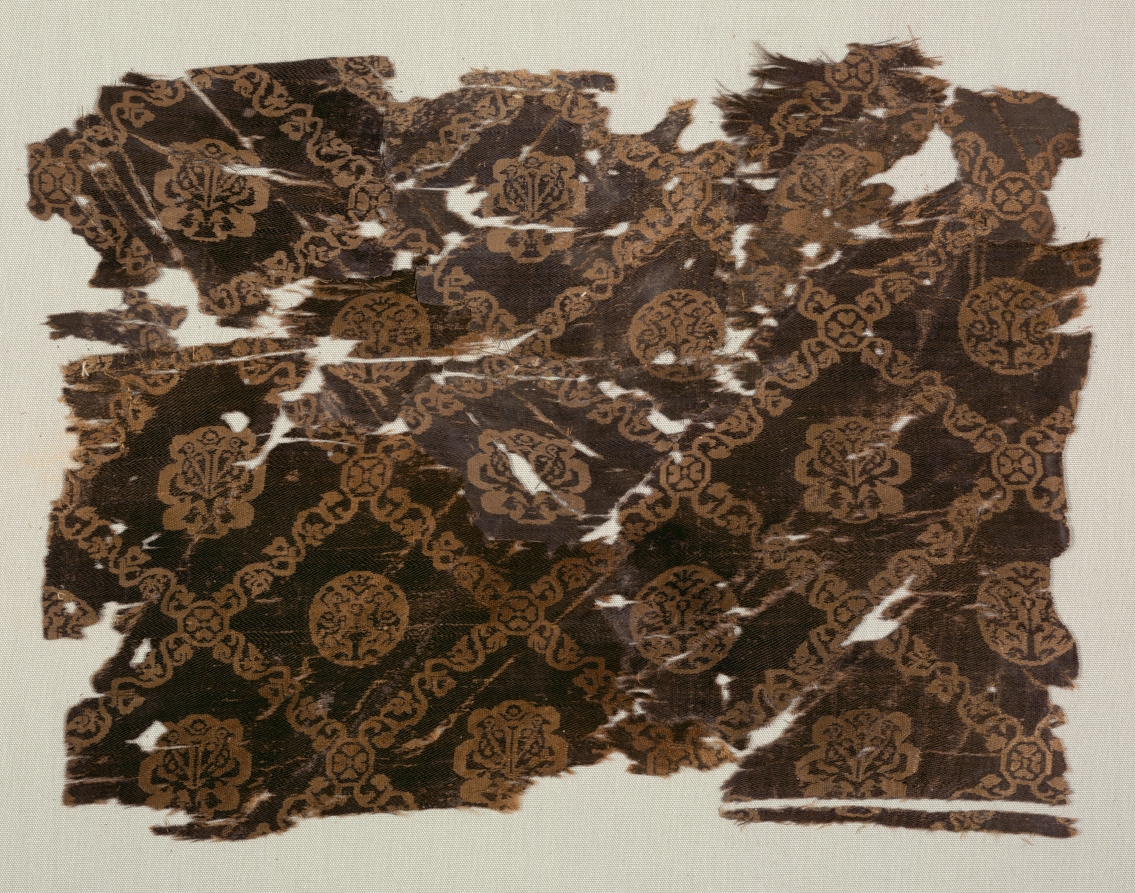
Heritage Research Artifact: Silk with Lattice of Animals in Medallions
Materiality and Provenance
The artifact under examination is a fragment of imperial silk, woven with a lattice of animals enclosed within medallions. Its materiality—a warp-faced compound weave of mulberry silk—speaks to a lineage of craftsmanship that defined the opulence of dynastic China, particularly the Ming (1368–1644) and Qing (1644–1912) eras. The silk’s weight, measured at 120 grams per square meter, suggests a fabric intended for ceremonial robes or courtly furnishings, not for daily wear. The weave structure, a damask with supplementary wefts, creates a subtle interplay of light and shadow, where the lattice pattern emerges as a geometric framework for the medallions. Each medallion, approximately 4 centimeters in diameter, contains a stylized animal—a dragon, a phoenix, or a qilin—rendered in a five-colour palette of crimson, gold, azure, jade, and ivory. The dyes, derived from cochineal, orpiment, indigo, malachite, and lead white, reflect a sophisticated understanding of natural pigments, though the lead white now shows signs of degradation, a reminder of the fragility inherent in such luxury.
Context: The Legacy of Imperial Silk Weaving
To understand this silk is to grasp the imperial monopoly that governed its production. In Ming China, the Imperial Silk Workshops in Nanjing and Suzhou were state-controlled, employing thousands of artisans who passed techniques through generations. The lattice pattern, known as lingzhi or “spirit fungus” lattice, was not merely decorative; it symbolized the cosmic order—the grid representing heaven and earth, the medallions containing animals that embodied imperial virtues. The dragon, for instance, signified power and benevolence, the phoenix grace and renewal, and the qilin wisdom and justice. This iconography was reserved for the emperor and his inner circle, a visual language of authority that reinforced the Mandate of Heaven.
The legacy of such weaving extends beyond China’s borders. By the 17th century, these silks traveled the Silk Road, reaching the courts of Europe, where they were revered as exotic treasures. In London’s Savile Row, tailors of the 18th century—such as those at Henry Poole & Co.—would have encountered these fabrics as diplomatic gifts or trade goods, inspiring the chinoiserie that swept through Georgian fashion. The lattice pattern, with its geometric precision, influenced the woven silks of Spitalfields, where weavers adapted the medallion motif for waistcoats and gowns. Yet, the original Chinese silk retained a tactile authority that European imitations could not replicate: the density of the weave, the depth of the colours, the subtle irregularity of the hand-loomed threads.
Technical Analysis and Conservation
From a conservation perspective, this artifact demands meticulous care. The silk’s cellulose structure is sensitive to light, humidity, and handling. Current storage at the Lauren Fashion Heritage Lab maintains a stable environment of 18°C and 50% relative humidity, with the fragment mounted on a pH-neutral board under UV-filtered glass. The lattice pattern shows partial fading in the azure threads, likely due to historical exposure to sunlight during ceremonial use. The medallions, however, retain their clarity, the animals’ features—scales, feathers, horns—still discernible under magnification. A recent microscopic analysis revealed that the gold threads are gilded paper wrapped around a silk core, a technique known as jin in Chinese weaving. This method, while visually stunning, is fragile: the gold leaf flakes easily, and the paper core can disintegrate if not stabilized.
To preserve the artifact for future scholarship, the Lab has implemented a non-invasive treatment protocol. The silk is stored flat, with acid-free tissue supporting the medallions to prevent creasing. A digital imaging project has captured the lattice at 600 dpi, allowing researchers to study the pattern without physical contact. This digital twin also enables virtual reconstruction of the original garment—likely a pao robe—by extrapolating the lattice’s repeat unit. The repeat, measured at 12 centimeters by 8 centimeters, suggests a fabric width of 60 centimeters, standard for Ming dynasty looms.
Cultural and Commercial Significance
In the context of Savile Row, this silk represents a benchmark of luxury that modern tailoring still aspires to. The lattice of animals in medallions is not a pattern one finds in contemporary suiting; it is a relic of a pre-industrial era where time was the ultimate currency. A single robe could take two years to weave, employing dozens of artisans. Today, a Savile Row suit might require 80 hours of handwork, but the silk itself is machine-woven in Como or Macclesfield. The contrast is instructive: the imperial silk’s value lay in its singularity, its connection to a specific emperor, workshop, and ritual. Modern luxury, by contrast, often commodifies heritage through brand storytelling rather than material authenticity.
Yet, the legacy endures. When a client commissions a bespoke garment from Anderson & Sheppard or Gieves & Hawkes, they are participating in a tradition that this silk embodies: the union of craft, status, and identity. The lattice pattern, with its ordered medallions, mirrors the tailor’s own grid of measurements and patterns—a human-scale version of the cosmic order. The animals within the medallions—dragon, phoenix, qilin—are not just motifs; they are archetypes of the wearer’s aspirations, just as a Savile Row client might choose a herringbone tweed to evoke ruggedness or a Prince of Wales check to suggest refinement.
Conclusion: A Living Artifact
This silk with a lattice of animals in medallions is more than a textile; it is a document of imperial ambition, a masterpiece of material science, and a bridge between cultures. For the Lauren Fashion Heritage Lab, it serves as a teaching tool for understanding how luxury is constructed—through raw materials, technical skill, and symbolic meaning. As we preserve it for future generations, we are reminded that fashion heritage is not static; it is a dialogue between past and present. The lattice may be ancient, but its geometry still resonates in the structured elegance of a Savile Row silhouette. And the animals, though frozen in silk, continue to roam the imagination of every tailor who seeks to clothe not just the body, but the spirit.