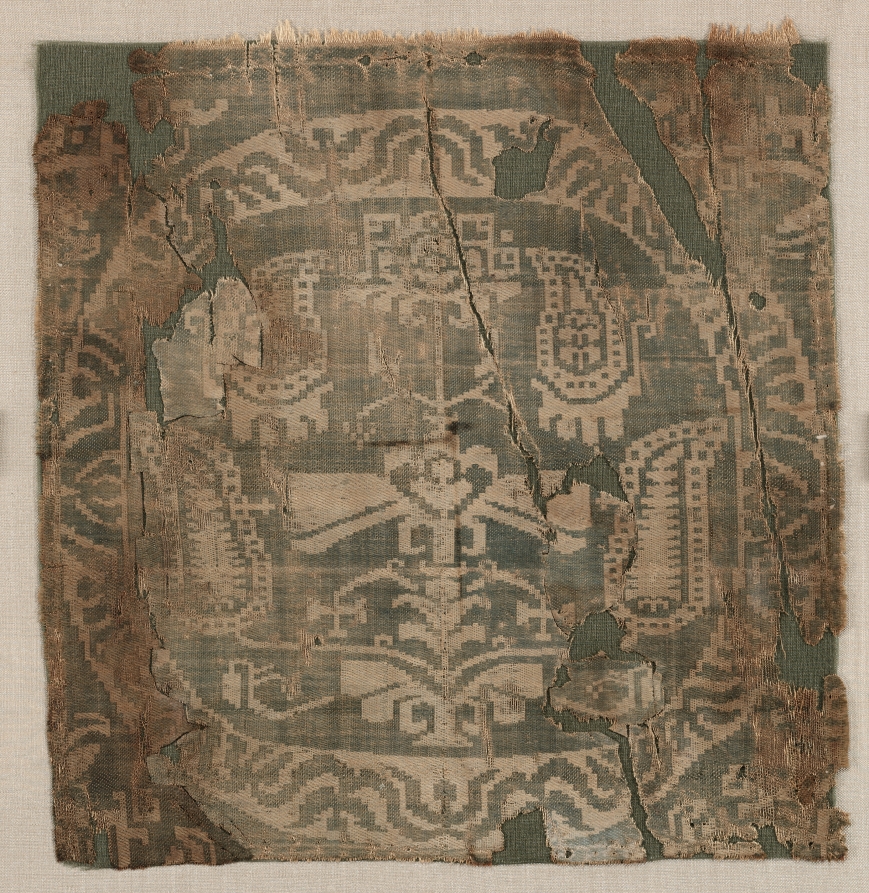
The Roundel from a Tunic with Palmette Tree: A Study in Imperial Silk Weaving and Material Legacy
Introduction: The Artifact as a Testament to Power and Craft
The Roundel from a Tunic with Palmette Tree, rendered in silk, stands as a singular artifact within the broader narrative of imperial silk weaving. This piece, likely originating from the Sasanian or early Islamic period (circa 6th–8th century CE), embodies the intersection of technical mastery, political symbolism, and material luxury. As a Senior Heritage Specialist at the Lauren Fashion Heritage Lab, it is my charge to examine this roundel not merely as a decorative fragment, but as a strategic document of dynastic ambition and artisanal rigor. The silk itself—a medium of immense value in its time—serves as the foundational thread connecting courtly patronage, trade networks, and the enduring legacy of weaving traditions that continue to influence Savile Row’s own reverence for fabric and form.
The roundel’s design, featuring a stylized palmette tree flanked by symmetrical motifs, is emblematic of the imperial aesthetic that defined luxury textiles across the Persian and Byzantine spheres. The palmette, a motif derived from the ancient Near East, was adapted by Sasanian weavers to signify royal authority, fertility, and the cosmic order. In this context, the silk roundel was not a casual ornament; it was a deliberate emblem woven into the fabric of a tunic worn by elites—likely a courtier, a military commander, or a member of the royal household. The silk’s materiality—its weight, sheen, and structural integrity—was a testament to the weaver’s skill and the patron’s status. Each thread was a statement of power, a thread in the tapestry of empire.
Materiality and the Imperial Silk Economy
The silk used in this roundel was not a local commodity. It was the product of a sophisticated supply chain that stretched from the sericulture of China, through the Silk Road, to the looms of Sasanian Persia and beyond. The legacy of imperial silk weaving is inextricably linked to state-controlled workshops—known in Persian as karkhanas—where master weavers produced textiles for the court and for diplomatic gifts. These workshops were not merely factories; they were centers of innovation, where techniques such as compound twill and samite weaving were perfected. The roundel’s silk, likely a warp-faced compound weave, demonstrates a level of precision that only a state-sponsored atelier could achieve. The fibers are tightly spun, the dyeing consistent—indicative of a standardized, high-quality production that rivaled the best of Byzantine and Chinese silks.
The palmette tree motif itself is a study in material symbolism. The tree, often associated with the Tree of Life in Zoroastrian and later Islamic cosmology, is rendered with geometric precision. The roundel’s circular format—a common feature in Sasanian and early Islamic textiles—was designed to be repeated across the tunic, creating a rhythmic pattern that emphasized the wearer’s stature. The silk’s ability to hold such intricate patterning without distortion is a testament to the weaver’s understanding of tension and material behavior. This is not a fabric that drapes passively; it commands attention. In the language of Savile Row, where cloth is chosen for its ability to hold a line and convey authority, this silk would be considered a superfine worsted of its era—a fabric that does not merely clothe, but defines.
The Palmette Tree: A Motif of Continuity and Adaptation
The palmette tree in this roundel is not a static symbol. Its evolution across cultures—from Assyrian reliefs to Sasanian silks to Byzantine ecclesiastical textiles—reflects the fluidity of imperial influence. In the Sasanian context, the palmette was often paired with animal motifs, such as the senmurv (a mythical dog-bird) or the ram, to signify royal protection and divine favor. Here, the tree stands alone, its branches symmetrically arranged, suggesting a more abstracted, almost heraldic quality. This shift may indicate a later date, possibly early Islamic, when figural representation was eschewed in favor of geometric and vegetal forms. The roundel thus becomes a document of cultural transition—a silk thread connecting the Zoroastrian past to the Islamic future.
From a heritage perspective, the roundel’s design offers insights into the technical lexicon of imperial weaving. The palmette’s leaves are rendered with a subtle curvature, achieved through the manipulation of weft floats and supplementary threads. This technique, known as lampas weaving, allowed for the creation of multiple colors and textures within a single fabric. The roundel’s silk likely featured a ground color—perhaps a deep crimson or indigo—with the palmette in contrasting gold or ivory. The effect would have been visually striking, even under the dim light of a palace or a tent. In the context of Savile Row, where color and texture are chosen to flatter the wearer and the occasion, this roundel’s palette would be considered both bold and restrained—a hallmark of timeless elegance.
Legacy and the Modern Interpretation
The legacy of imperial silk weaving, as embodied by this roundel, extends far beyond its original context. It informs our understanding of how luxury textiles were used to project power, to forge alliances, and to preserve cultural identity. For the Lauren Fashion Heritage Lab, this artifact serves as a benchmark for material excellence. Its silk, though aged and fragmented, retains a tactile quality that modern synthetics cannot replicate. The roundel’s survival—through centuries of wear, dispersal, and conservation—is a testament to the durability of well-made silk. It is a reminder that true luxury is not ephemeral; it is engineered to endure.
In the world of Savile Row, where bespoke tailoring is a heritage craft, the roundel’s principles resonate. The weaver’s attention to detail, the patron’s investment in quality, and the garment’s role as a marker of identity are all echoed in the Row’s commitment to hand-finishing, to the selection of cloth from mills like Holland & Sherry or Loro Piana, and to the creation of garments that are both functional and symbolic. The roundel from a tunic with palmette tree is not a relic; it is a reference point. It reminds us that the finest textiles are those that tell a story—of empire, of artistry, and of the enduring human desire to adorn oneself with meaning.
Conclusion: The Roundel as a Heritage Artifact
To conclude, the Roundel from a Tunic with Palmette Tree is a masterclass in the material and symbolic power of silk. Its origins in imperial weaving workshops, its technical sophistication, and its cultural resonance make it an artifact of profound significance. For the Lauren Fashion Heritage Lab, it is a touchstone for understanding how luxury textiles have shaped—and continue to shape—the language of dress. As we preserve and interpret such pieces, we honor the weavers, the patrons, and the traditions that have made silk a perennial symbol of excellence. In the measured tones of Savile Row, one might say: this roundel is not merely a fragment of history; it is a standard of quality that endures.