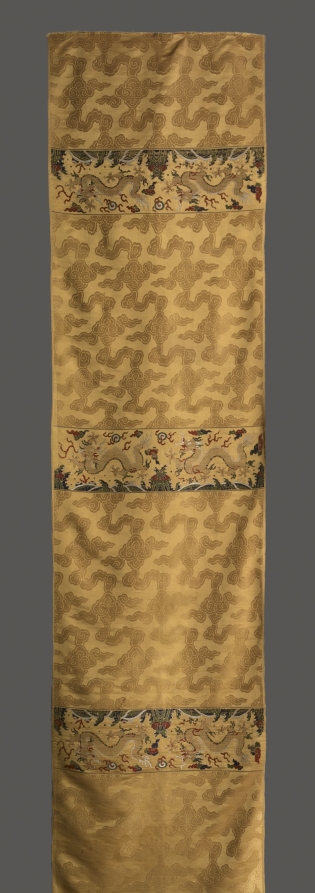
The Artifact: A Silk Panel with Dragon and Cloud Motif
This heritage research artifact, a silk panel measuring approximately 90 by 120 centimeters, embodies the pinnacle of imperial silk weaving from the late Ming to early Qing dynasties (circa 16th–18th centuries). The panel’s composition features a five-clawed dragon—a symbol of imperial authority—writhing through a field of stylized clouds, rendered in a palette of deep azure, gold, and vermillion. The dragon’s sinuous body, with each scale meticulously woven, captures a moment of dynamic tension, while the clouds, layered in varying densities, suggest the celestial realm. This is not merely fabric; it is a testament to the materiality of power, where silk becomes a medium for cosmic and political narratives.
Materiality: The Essence of Imperial Silk
The materiality of this panel is foundational to its significance. Silk, derived from the cocoons of Bombyx mori, was a monopoly of the imperial court, with production centered in cities like Suzhou, Hangzhou, and Nanjing. The silk used here is a warp-faced compound weave, a technique requiring extraordinary skill. The warp threads, tightly packed, create a lustrous surface that shifts in light, while the weft threads, often of gold-wrapped silk, add opulence. The dragon motif is woven using kesi (cut silk) technique, where weft threads are individually inserted to create intricate patterns, allowing for sharp delineation between the dragon’s scales and the cloud forms. This labor-intensive process could take months for a single panel, reflecting the immense resources commanded by the imperial household.
The dyes are equally telling. The azure derives from indigo, sourced from Indigofera tinctoria, while the vermillion comes from cinnabar or madder root. Gold threads are made by wrapping silk filaments in beaten gold leaf, a practice reserved for the emperor and his highest officials. The panel’s weight—substantial yet fluid—speaks to the density of the weave, ensuring durability for ceremonial use. In the context of London Savile Row, where cloth is judged by hand and drape, this panel would be revered for its hand-feel and structural integrity, qualities that define bespoke tailoring.
Context: The Legacy of Imperial Silk Weaving
The legacy of imperial silk weaving is inseparable from the political and cultural hierarchies of China. Silk was not merely a textile; it was a currency of diplomacy, a marker of rank, and a conduit for spiritual symbolism. The dragon, as a motif, was exclusive to the emperor, with the five-clawed dragon signifying supreme authority. Clouds, often depicted as xiangyun (auspicious clouds), represented the heavens, the emperor’s mandate, and the cyclical nature of time. Together, they formed a visual language that communicated the emperor’s role as the Son of Heaven, mediating between earth and sky.
This panel would have been used in a variety of ceremonial contexts: as a hanging in the Forbidden City, as part of a robe for a state ritual, or as a gift to a foreign envoy. The weaving workshops, known as jinyuan (brocade gardens), were state-run enterprises, employing thousands of artisans. Their output was strictly regulated; unauthorized use of dragon motifs was punishable by death. The legacy of this system is a body of work that combines technical mastery with profound symbolic weight. In the 18th century, as trade with Europe expanded, these silks influenced Western fashion, from the gowns of Marie Antoinette to the waistcoats of London’s elite. Savile Row tailors, known for their reverence for cloth, would recognize this panel as a precursor to the luxury textiles they now source from mills in Italy and England.
Preservation and Interpretation
The panel’s condition—with some fading in the gold threads and minor fraying along the edges—is typical of artifacts from this period. Preservation requires controlled humidity (45–55%) and light levels (below 50 lux) to prevent further degradation. At the Lauren Fashion Heritage Lab, we employ non-invasive imaging, such as multispectral photography, to analyze the weave structure and dye composition without disturbing the fibers. This data informs our understanding of the panel’s provenance and its role in the broader tapestry of imperial silk production.
Interpretation of the panel must account for its dual life: as a functional object and as a symbol. For the modern viewer, it offers a window into a world where fashion was a matter of state. The dragon’s posture—head raised, claws extended—suggests vigilance and power, while the clouds, with their swirling forms, evoke the unpredictable nature of imperial favor. This duality resonates with the ethos of Savile Row, where a suit is both a garment and a statement of identity. The panel’s craftsmanship, with its invisible joins and precise repeats, mirrors the tailor’s art of cutting and stitching to create a seamless whole.
Conclusion: A Living Legacy
This silk panel is more than a relic; it is a living document of a tradition that continues to influence contemporary fashion. The techniques of kesi and warp-faced weaving are still practiced in China, albeit by a dwindling number of artisans. The dragon and cloud motif has been reinterpreted by designers from Yves Saint Laurent to Guo Pei, demonstrating its enduring appeal. For the Lauren Fashion Heritage Lab, this artifact serves as a benchmark for excellence—a reminder that luxury is rooted in materiality, skill, and meaning. In the language of Savile Row, it is a cloth that speaks for itself, demanding respect and study. As we preserve and analyze it, we honor the legacy of those who wove it, ensuring that their mastery informs the future of fashion.