The Dialectics of Death and Duration: Terracotta Fragments and the 2026 Old Money Silhouette
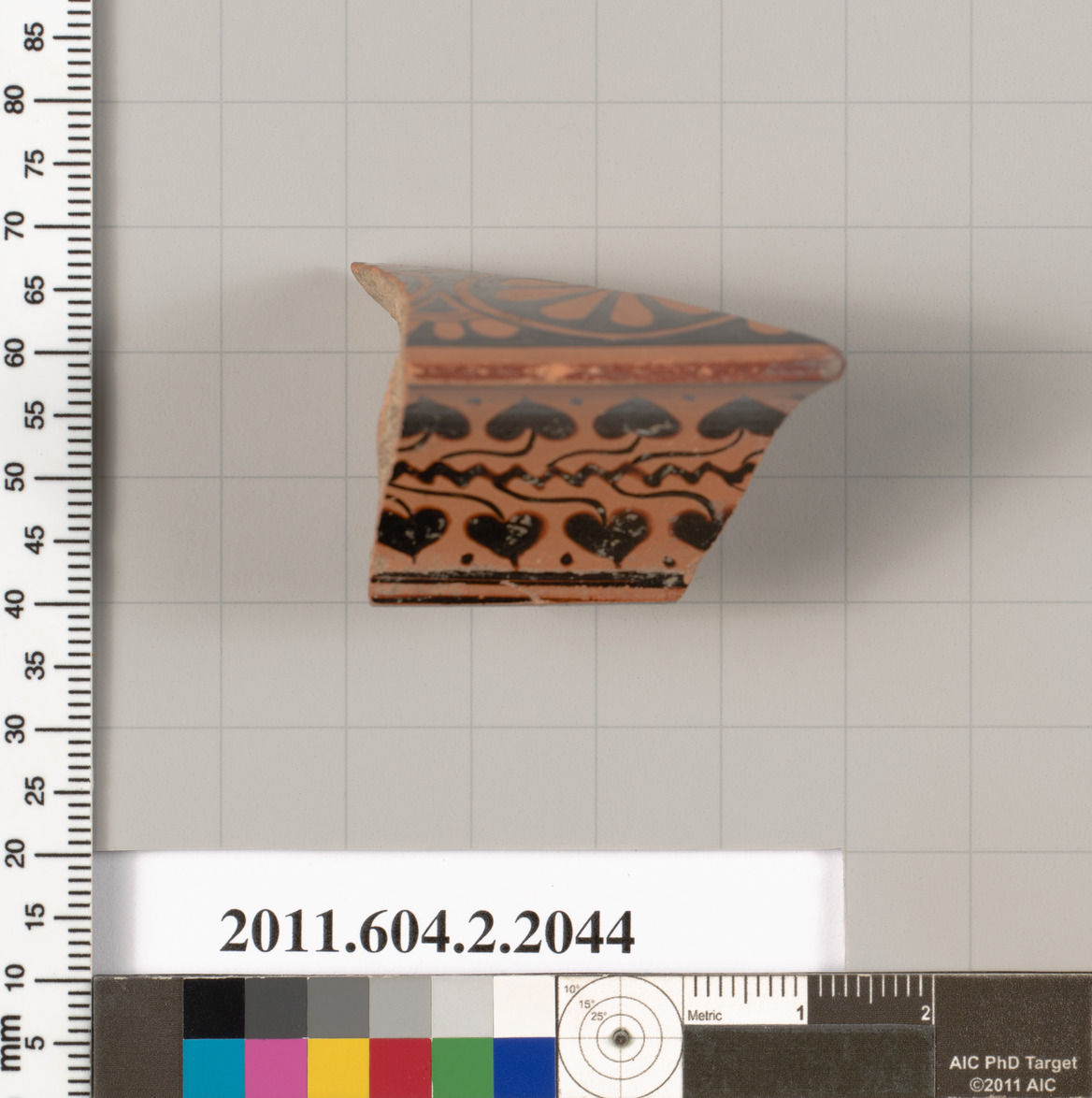
The Lauren Fashion Heritage Lab has long maintained that the most enduring garments are those that negotiate the tension between stasis and motion—between the object as a vessel of memory and the body as an agent of becoming. Our internal genetic code, as articulated through the paired masterworks 《The Death of Socrates》 and 《The Hunt》, reveals a foundational aesthetic paradox: death, and by extension the timelessness that Old Money fashion seeks to embody, can be approached either through the “stillness of the object” or the “velocity of the action.” The museum artifact under consideration—a terracotta fragment of a column-krater (Greek, Attic, circa 470–460 BCE)—offers a third, more primal resolution to this paradox. This fragment, a shard of a vessel used to mix wine and water for symposia, does not depict death directly. Instead, it bears the traces of use, the patina of ritual, and the geometry of a broken whole. For the 2026 Old Money silhouette, this terracotta fragment provides a material and conceptual template: a silhouette that is neither purely static nor purely kinetic, but rather “fragmentary and durational”—a garment that carries the weight of history while remaining open to the future.
I. The Fragment as a Third Paradigm: Beyond Stillness and Motion
The internal genetic code presents two opposing aesthetic paradigms for confronting mortality. 《The Death of Socrates》 operates through what we might call “objectified death”: the philosopher’s body becomes a still life, a collection of objects—the cup, the scroll, the draped cloth—that freeze time into a perpetual aftermath. The viewer is positioned as a mourner, gazing at a tableau that has already concluded. In contrast, 《The Hunt》 operates through “actionized death”: the image captures the explosive moment before the kill, suspending the arrow in mid-flight and the hounds in mid-leap. The viewer is positioned as a participant, breath held in anticipation of a climax that never arrives.
The terracotta fragment, however, belongs to neither paradigm. It is not a finished scene of death, nor is it a frozen moment of action. It is a broken remnant of a vessel that once held liquid for a ritual of life and death—the symposium, where Greeks debated philosophy, celebrated victories, and mourned the dead. The fragment’s edges are jagged, its painted figures (likely a warrior or a symposium scene) are partially lost. This is not a depiction of death, but a material witness to the passage of time itself. The krater was used, broken, discarded, and then excavated centuries later. Its meaning lies not in what it shows, but in what it withholds—the missing pieces that force the viewer to imagine the whole. This is the aesthetic of “durational incompleteness”: a form that acknowledges decay as an integral part of beauty.
II. The 2026 Old Money Silhouette: Heritage-Black as a Temporal Fabric
The 2026 Old Money silhouette, as informed by this terracotta fragment, abandons the pristine perfection of earlier iterations. The new silhouette is not about the unbroken line of a perfectly tailored blazer or the uninterrupted flow of a silk gown. Instead, it embraces “fragmentary construction”—garments that appear to have been assembled from historical remnants, with visible seams, asymmetrical hemlines, and deliberate “breaks” in the fabric that mimic the jagged edges of the krater. The Heritage-Black material, a deep, matte wool that absorbs light rather than reflecting it, becomes the perfect substrate for this aesthetic. Black, in this context, is not the color of mourning or absence, but the color of temporal depth—a void that contains all possible histories.
Consider the key silhouette elements for 2026:
- Shoulder Construction: Inspired by the krater’s flaring lip, the shoulder line is broken and asymmetrical. One shoulder might feature a sharp, architectural peak (reminiscent of a Greek column), while the other drapes softly, as if the garment has been “fractured” by time. This is not the rigid symmetry of Old Money’s past, but a dynamic imbalance that suggests a garment in the process of becoming.
- Hemlines and Edges: The fragment’s irregular breakage is translated into raw, unfinished hems that are left to fray slightly, or are deliberately cut at angles that refuse geometric closure. This is the opposite of the “perfectly finished” hems of traditional luxury. Here, the edge is a site of potentiality—a place where the garment could continue to unravel or be mended.
- Layering as Archaeology: The silhouette employs stratified layering, with each layer representing a different “excavation” of time. A Heritage-Black wool coat might be worn over a fragmentary silk vest that appears to be a remnant of an earlier era, with visible stitching that suggests repair. This is not mere deconstruction; it is archaeological dressing, where the wearer becomes a living museum of sartorial history.
III. The Materiality of Heritage-Black: Absorbing Time
The choice of Heritage-Black as the primary material for this silhouette is not arbitrary. Unlike the glossy black of evening wear or the matte black of contemporary minimalism, Heritage-Black is a “deep” black that contains subtle variations in weave and texture—much like the terracotta fragment’s surface, which bears the marks of its firing, use, and burial. The fabric is woven with a slight irregularity, creating a surface that absorbs and diffuses light rather than reflecting it. This quality evokes the “aftermath” of 《The Death of Socrates》—the silent, lightless space that remains after the event has passed. Yet the fabric’s weight and drape also suggest the latent energy of 《The Hunt》—the tension of a body poised for action, held in check by the gravity of history.
In practical terms, the 2026 silhouette uses Heritage-Black to create garments that are both heavy and fluid. A coat might fall in stiff, columnar folds from the shoulders (echoing the krater’s verticality) while opening into a wide, flowing skirt at the hem (suggesting the liquid that once filled the vessel). The garment is simultaneously a container and a release—a vessel for the body that acknowledges the body’s own temporality.
IV. Conclusion: The Fragment as the Future of Old Money
The terracotta fragment teaches us that the most powerful heritage is not the perfectly preserved artifact, but the broken one that demands interpretation. The 2026 Old Money silhouette, grounded in Heritage-Black and informed by the fragment’s durational incompleteness, rejects the fantasy of timeless perfection. Instead, it offers a new kind of timelessness: one that is built from fragments, that wears its history on its surface, and that remains open to the future. This is not the death of Old Money, but its resurrection as a living, breathing, fragmentary form—a garment that, like the krater, holds the memory of what was and the potential for what will be.