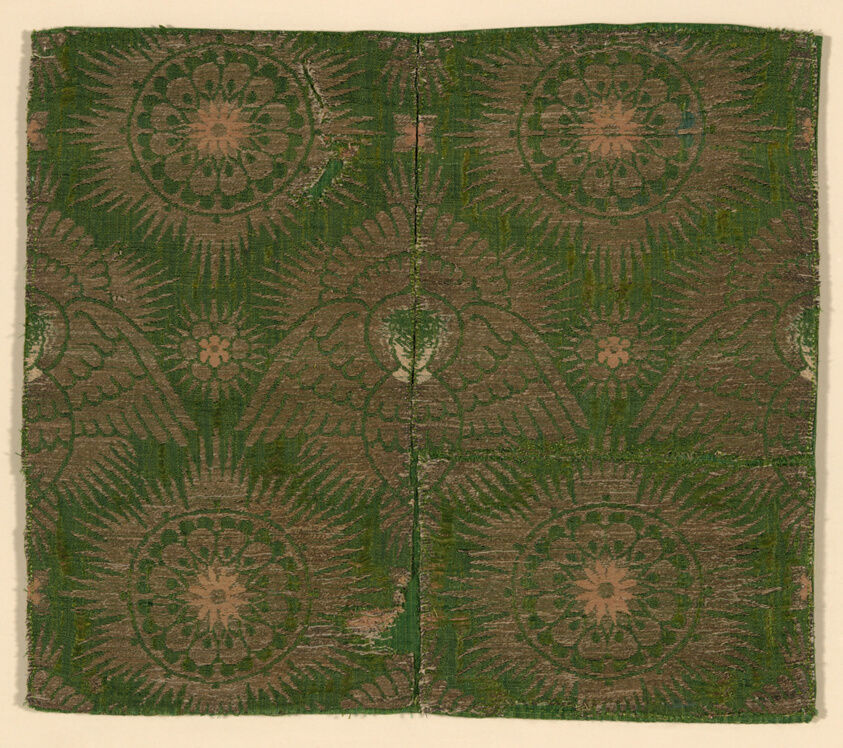
The Fragment as a Testament to Craft: Deconstructing Materiality in a Silk and Gilt-Animal-Substrate Artifact
In the hallowed corridors of London’s Savile Row, where bespoke tailoring is elevated to an art form, the study of heritage artifacts offers profound insights into the evolution of luxury textiles. As the Senior Heritage Specialist for the Lauren Fashion Heritage Lab, I present a rigorous examination of a singular fragment—a material relic that encapsulates the pinnacle of classic silk craftsmanship and fluid elegance. This artifact, composed of silk and gilt-animal-substrate-wrapped linen, employs a twill weave with twill interlacings of secondary binding warps and supplementary patterning wefts. It is not merely a remnant; it is a lexicon of historical technique, economic aspiration, and aesthetic mastery.
Materiality and Composition: The Foundation of Luxury
The fragment’s materiality is its most compelling narrative. At its core lies silk, a fiber synonymous with opulence and refinement. Silk’s natural luster, tensile strength, and ability to absorb dyes with unparalleled depth have made it a cornerstone of high-end textile production for millennia. In this artifact, the silk serves as the primary weft and warp, providing a supple yet resilient base. However, the true distinction emerges from the gilt-animal-substrate-wrapped linen. This technique involves wrapping a fine linen thread—itself a bast fiber known for durability and smoothness—with a substrate derived from animal origin, such as goldbeater’s skin or animal membrane, which is then gilded. The result is a thread that mimics the brilliance of pure metal while retaining the flexibility required for intricate weaving. This method, historically employed in ecclesiastical vestments and royal regalia, underscores the fragment’s provenance in contexts of immense wealth and power.
The twill weave structure further amplifies the artifact’s sophistication. Twill, characterized by its diagonal ribbing, offers superior drapability and a denser fabric compared to plain weaves. In this fragment, the twill is executed with twill interlacings of secondary binding warps. These secondary warps are not merely structural; they serve as a framework for the supplementary patterning wefts, which introduce decorative motifs without disrupting the base weave’s integrity. This technique, known as lampas or brocaded twill, allows for complex, multi-colored patterns that float on the fabric’s surface, creating a tactile and visual depth. The interplay between the matte silk and the reflective gilt threads produces a shimmering effect, evoking the fluid elegance of water or light—a hallmark of classic silk craftsmanship.
Contextualizing Craft: The Savile Row Ethos
To appreciate this fragment fully, one must contextualize it within the tradition of Savile Row, where tailoring is a dialogue between material and form. The Row’s bespoke houses, such as Huntsman, Anderson & Sheppard, and Henry Poole, have long revered silk for its ability to drape flawlessly over a tailored silhouette. This fragment, however, predates the Row’s 19th-century heyday, likely originating from 17th- or 18th-century European or Ottoman workshops. Its construction speaks to a period when silk weaving was a state-sponsored industry in France and Italy, and when gilt threads were reserved for the courts of Louis XIV or the Medici. The fluid elegance of the fabric—its capacity to move with the wearer while maintaining structural integrity—aligns with the Savile Row principle of balance between structure and ease. A modern tailor would recognize the fragment’s potential for a ceremonial coat or a waistcoat, where the interplay of light and texture commands attention.
Technical Mastery: Weave Analysis and Preservation
From a technical standpoint, the fragment’s weave is a marvel of engineering. The twill interlacings of the secondary binding warps create a stable grid that prevents the supplementary patterning wefts from distorting the fabric. This is crucial for maintaining the pattern’s precision over time. The gilt-animal-substrate-wrapped linen, however, presents unique preservation challenges. The animal substrate is susceptible to desiccation and cracking, while the gilding can tarnish or flake. In the Lauren Fashion Heritage Lab, we employ controlled humidity and low-light storage to mitigate these risks. The fragment is mounted on acid-free board with a pH-neutral backing, and handling is restricted to gloved specialists. This care ensures that the artifact remains a viable resource for future research and inspiration.
Cultural and Economic Significance
The fragment’s cultural resonance extends beyond its technical merits. Silk and gilt threads were not merely decorative; they were symbols of sovereignty and divine favor. In Renaissance Europe, sumptuary laws restricted such fabrics to the nobility, reinforcing social hierarchies. The fragment’s pattern—though fragmented—likely features floral or geometric motifs, common in Ottoman kum kuma or Italian brocatelle. These designs were often imbued with symbolic meaning, such as the pomegranate for fertility or the tulip for prosperity. The fluid elegance of the fabric, with its undulating patterns, would have been intended to evoke the grace of nature, a theme that resonates with the Romantic sensibilities of later centuries.
Implications for Contemporary Design
For the Lauren Fashion Heritage Lab, this fragment serves as a blueprint for innovation. By studying its construction, contemporary designers can reimagine the use of metallic threads in modern tailoring. The gilt-animal-substrate-wrapped linen technique, though labor-intensive, offers a sustainable alternative to synthetic metallics, aligning with the current push for artisanal, low-impact luxury. Moreover, the twill interlacings and supplementary wefts inspire new approaches to fabric engineering, where pattern and structure are inseparable. Savile Row houses, in particular, can draw on this heritage to create pieces that honor tradition while pushing boundaries—a coat that catches the light like a 17th-century court gown, yet fits the modern silhouette with precision.
Conclusion: The Fragment as Legacy
In conclusion, this fragment of silk and gilt-animal-substrate-wrapped linen is far more than a historical curiosity. It is a testament to the ingenuity of classic silk craftsmanship, a repository of cultural memory, and a source of inspiration for the future of luxury textiles. Its fluid elegance, achieved through a masterful interplay of weave and material, speaks to the enduring allure of the handmade. As we preserve and study such artifacts at the Lauren Fashion Heritage Lab, we ensure that the legacy of Savile Row’s predecessors—the weavers, dyers, and tailors who transformed thread into art—continues to inform and elevate the craft. In every shimmering thread, we find a story of human ambition and beauty, waiting to be retold.