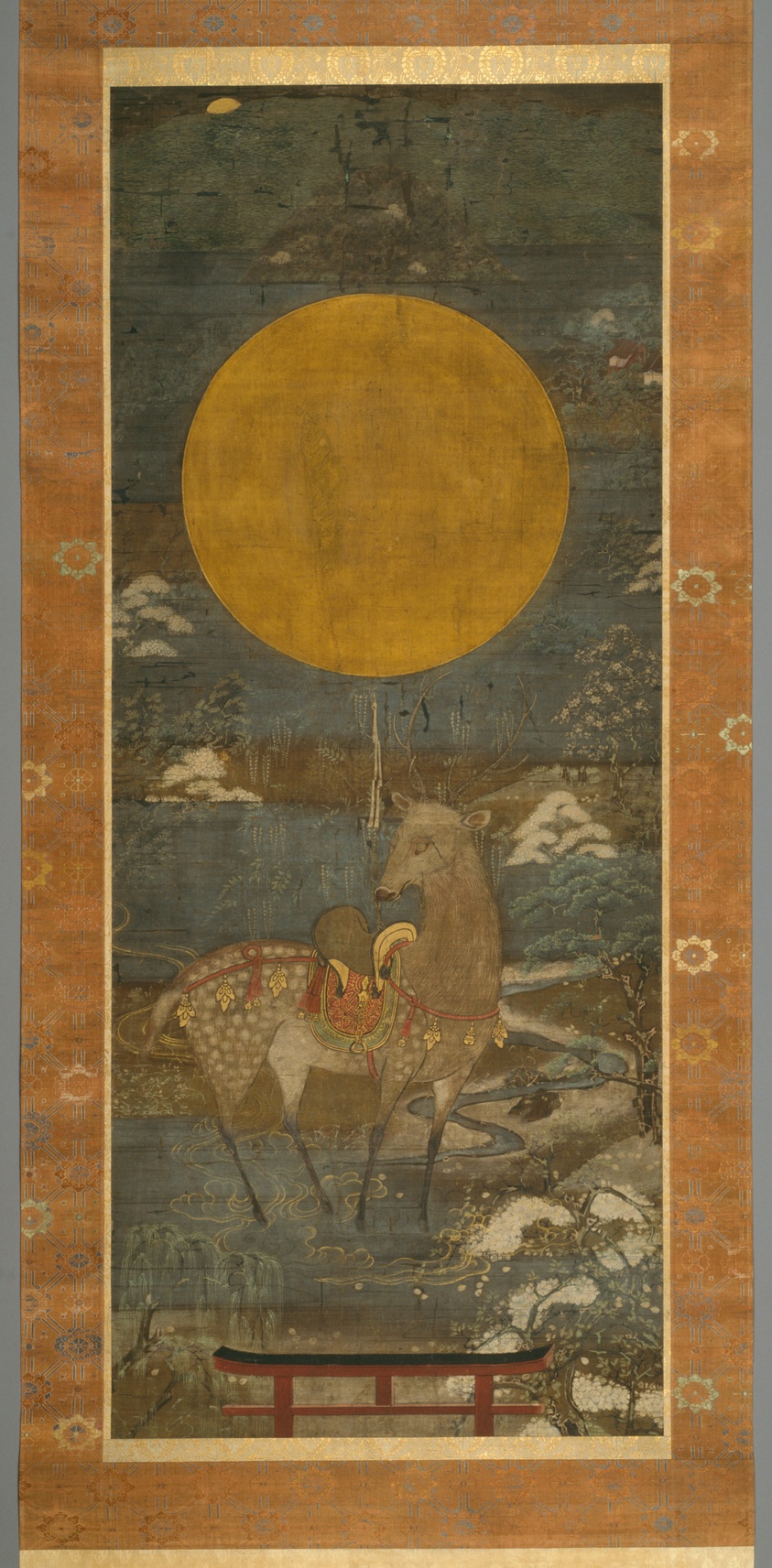
An Examination of the Kasuga Deer Mandala: Propriety in Pigment and Thread
To engage with the Kasuga Deer Mandala is not merely to observe an artefact of religious iconography; it is to be granted an audience with a consummate exercise in disciplined artistry, where every element—from the foundational support to the most ethereal application of gold—adheres to a silent, exacting protocol. The subject, drawn from the sacred precincts of Nara’s Kasuga Grand Shrine, presents a vision of a divine deer, a messenger of the gods, rendered not as a creature of mere flesh and bone, but as an emblem of celestial order. Its execution, however, is where the true dialogue between heritage and mastery occurs. The material specification—ink, colours, and gold on silk—is not a casual list of mediums. It is, in the most precise terms, the bill of materials for a solemn sartorial covenant.
The Foundation: A Bespoke Canvas
One must first appreciate the silk. This is not a generic ground. In the manner of a Savile Row front cloth, selected for its specific weight, weave, and propensity to accept shape, the silk used in such a mandala is chosen with a profound understanding of its behaviour. It provides a surface that is at once resilient and receptive, offering a slight, deliberate tooth to secure the mineral pigments, while possessing a latent luminosity that will, in time, collaborate with the overlying elements to produce a depth of field quite unattainable on paper or panel. The silk is the foundational garment upon which the vision is tailored. Its preparation—sizing, stretching, priming—is a ritual as critical as the cutting of a pattern, ensuring a flawless, stable plane for the lifetime application of sacred narrative.
The Drafting: Line as Unbreakable Thread
The initial drawing in ink is the equivalent of the chalk stripe on a length of Holland & Sherry cloth—it is the absolute, authoritative blueprint. There is no room for equivocation. The line defining the deer’s elegant form, the curve of its antlers which echo sacred tree branches, the flow of the celestial ribbons adorning its body, must be rendered with a confidence that is both fluid and immovable. This ink line is the skeleton; it establishes proportion, posture, and sacred geometry. Its unwavering certainty speaks of an artisan who has internalised the form through countless repetitions, achieving a state where the hand does not hesitate, much like the master cutter whose shears glide through superfine wool without a second thought. This is the armature of faith, executed with technical purity.
The Commission of Colour: A Mineral Wardrobe
Upon this assured draft, the palette is commissioned. The colours—derived from malachite, azurite, cinnabar, and other finely ground minerals—are not merely applied; they are dressed onto the silk. Each pigment possesses its own character, its own method of adhesion and interaction with the binding medium. The application is built up in layers, from thin washes to dense, saturated planes, creating a richness that vibrates with internal light. The verdant landscape from which the divine deer emerges, the rich tones of its symbolic trappings, are rendered with a clarity that refuses to muddy. This is colour with integrity. It does not seek to imitate the transient effects of nature in a literal sense, but to present an idealised, eternal nature—a landscape tailored to its purpose, much as the cloth of a city suit presents an idealised, authoritative silhouette, divorced from the casual drape of everyday attire.
The Final Appointment: Gold as Ultimate Bespoke Detail
Then, the gold. If the silk is the cloth, the ink the pattern, and the colours the main tailoring, then the gold is the hand-stitched buttonhole, the pick-stitching along the lapel, the discreet silk lining—the details that transcend utility and announce uncompromising provenance. Applied as delicate leaf or as a suspension of fine particles in solution (kindei), the gold is not a mere highlight. It is the materialisation of the sacred. It illuminates divine halos, traces the celestial patterns on the deer’s form, and suggests an atmosphere suffused with spiritual radiance. Its application demands a serene hand and a breathless precision; a misplacement would be as glaring as a flawed line of stitching on a peak lapel. The gold provides the final, luminous structure, lifting the entire composition from the realm of the beautifully pictorial into the sphere of the numinous and the ceremonially complete.
Conclusion: A Legacy of Fluid Elegance
The resultant artifact, this Kasuga Deer Mandala, stands as a testament to a heritage philosophy that finds direct parallel in the world of classic craftsmanship. Its fluid elegance is not an accident of style, but the direct consequence of rigorous material intelligence and hierarchical technique. Every component knows its place and fulfills its duty: the silk supports, the ink defines, the colour robes, and the gold sanctifies. It is a system of creation where respect for material and process yields an object of timeless authority and serene power. To study it is to understand that true heritage, whether in Nara or on Savile Row, is never ostentatious. It is the quiet, profound confidence that comes from the perfect execution of a sacred canon, stitch by meticulous stitch, brushstroke by deliberate brushstroke.