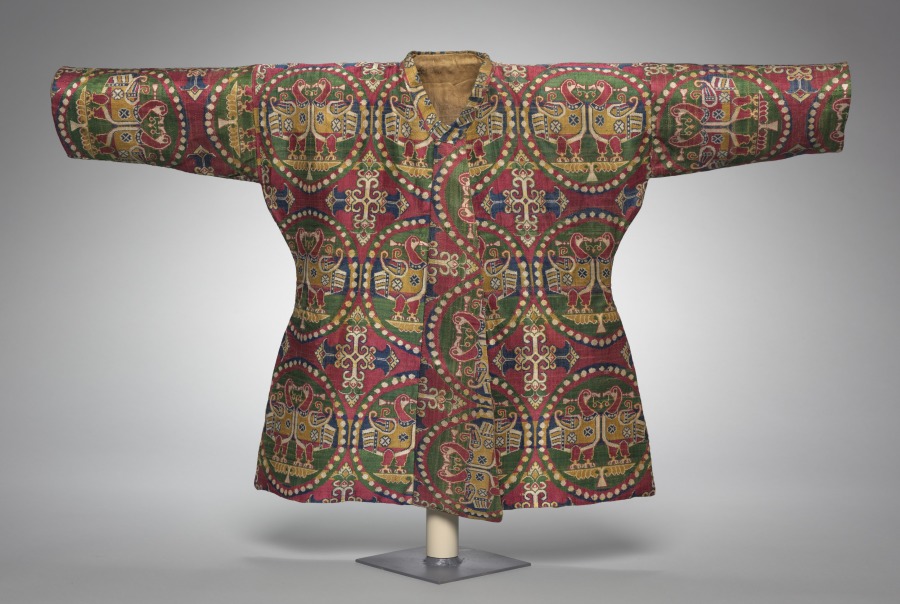
The Child’s Coat with Ducks in Pearl Medallions: A Study in Imperial Silk Weaving and the Legacy of Craft
Introduction: The Artifact as a Testament to Heritage
The Child’s Coat with Ducks in Pearl Medallions, rendered in lustrous silk, stands as a singular artifact within the Lauren Fashion Heritage Lab. It is not merely a garment; it is a document of material culture, a whisper from the ateliers of imperial silk weaving, and a poignant narrative of childhood, status, and the meticulous artistry that defined an era. This coat, with its delicate interplay of motifs and its sumptuous fabric, invites a rigorous examination of the legacy of silk—a legacy that bridges the opulence of dynastic courts with the refined sensibilities of modern luxury. In the tradition of London’s Savile Row, where precision and provenance are paramount, we must approach this piece with a tailor’s eye and a historian’s reverence.
Materiality: The Silk and Its Imperial Roots
The foundation of this coat is its materiality: a silk of exceptional quality, likely woven from the finest mulberry silkworm cocoons. The fabric’s weight, drape, and sheen suggest a damask or brocade construction, techniques perfected in the imperial workshops of China and later emulated in European centers like Lyon and Spitalfields. The silk’s hand—smooth, cool, and resilient—speaks to a weaving process that demanded both time and expertise. In imperial contexts, silk was not merely a textile; it was a currency of power, a medium for conveying rank, and a repository of symbolic meaning. The coat’s silk, with its subtle iridescence, reflects the legacy of the Silk Road, where threads of commerce and culture intertwined. This is not a fabric for the everyday; it is a material reserved for ceremony, for the marking of important transitions, such as the childhood of a scion of a noble house.
Design and Motif: The Ducks in Pearl Medallions
The design of the coat is a masterclass in symbolic storytelling. The central motif—ducks in pearl medallions—is rich with layered meaning. In both Eastern and Western iconography, ducks represent fidelity, prosperity, and the harmonious passage of seasons. The pearl medallions that encircle them are equally significant: pearls, in their natural luster, evoke purity, wisdom, and the moon. The medallions themselves, likely rendered in a contrasting weave or with metallic thread, create a rhythmic pattern that draws the eye across the coat’s surface. This is not decoration for its own sake; it is a deliberate composition, a visual language that communicates the family’s values and aspirations. The child who wore this coat was not just clothed; they were adorned with a narrative of heritage, a promise of continuity.
The placement of the medallions is equally telling. They are arranged in a symmetrical grid, a nod to the order and discipline of imperial design. Yet, the ducks within them are rendered with a naturalistic grace—their beaks slightly open, their wings poised as if in mid-flight. This tension between structure and life mirrors the duality of childhood itself: the need for guidance and the impulse for freedom. The coat’s cut, with its rounded collar and fitted sleeves, is tailored for a young body, but the motifs elevate it beyond mere utility. It is a garment that anticipates the child’s future role, a sartorial primer for the responsibilities of adulthood.
Context: The Legacy of Imperial Silk Weaving
To fully appreciate this coat, one must situate it within the broader legacy of imperial silk weaving. In China, the imperial workshops of the Ming and Qing dynasties produced silks of unparalleled complexity, using techniques such as kesi (silk tapestry) and jin (brocade) to create fabrics for the emperor and his court. These workshops were state-controlled, their artisans bound by tradition and secrecy. The motifs they wove—dragons, phoenixes, clouds, and waves—were not arbitrary; they were governed by sumptuary laws that dictated who could wear what. The duck, while less overtly imperial than the dragon, was a symbol of scholarly achievement and domestic harmony, making it appropriate for a child’s garment.
As silk weaving spread westward, it was adapted to European tastes. By the 18th and 19th centuries, London’s Spitalfields weavers were producing silks that rivaled those of the East, often incorporating chinoiserie motifs like the ducks seen here. The coat’s design may reflect this cross-cultural exchange, a fusion of Eastern symbolism and Western tailoring. The pearl medallions, for instance, recall the “paisley” or boteh motifs that traveled from Persia to Europe, but they are rendered with a precision that suggests a master weaver’s hand. This coat is thus a product of globalization, a tangible link between the imperial workshops of the East and the bespoke ateliers of the West.
Preservation and Provenance: The Role of the Heritage Lab
The coat’s survival into the present is a testament to its quality and the care it received. Silk, while durable, is vulnerable to light, humidity, and pests. The fact that the ducks in pearl medallions remain vivid—their threads intact, their colors unfaded—speaks to a lineage of stewardship. The Lauren Fashion Heritage Lab’s role is to ensure that this stewardship continues, through climate-controlled storage, careful handling, and scholarly documentation. The coat’s provenance, though incomplete, points to a private collection, likely from a family with ties to the textile trade. Each stitch, each thread, is a clue to be preserved for future generations.
Conclusion: The Coat as a Living Legacy
The Child’s Coat with Ducks in Pearl Medallions is more than a historical curiosity; it is a living legacy. It reminds us that silk is not just a fabric but a repository of memory, a medium through which cultures communicate across time. For the child who wore it, it was a promise of heritage. For us, it is a call to preserve that heritage with the same precision and reverence that the original weavers brought to their looms. In the spirit of Savile Row, where every garment is a bespoke creation, this coat demands that we honor its craftsmanship, its symbolism, and its story. It is, in the truest sense, a masterpiece of material culture.