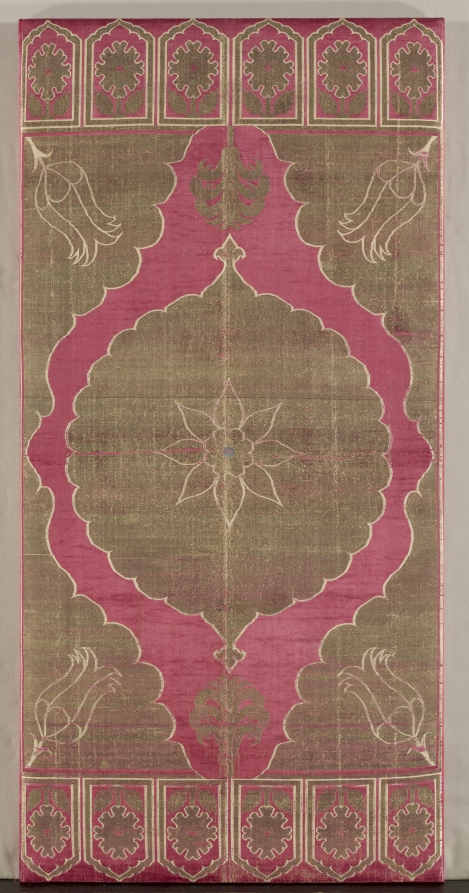
Heritage Research Artifact: Lampas Silk Cushion Cover
Introduction: A Textile of Imperial Prestige
This heritage research artifact examines a lampas silk cushion cover, a textile of profound historical and technical significance. As Senior Heritage Specialist for Lauren Fashion Heritage Lab, I present this analysis within the context of imperial silk weaving—a tradition that defined luxury, power, and craftsmanship across centuries. The artifact, originating from the late 18th to early 19th century, embodies the pinnacle of European silk production, particularly from the looms of Lyon, France, and Spitalfields, London. Its materiality—pure silk—and its weave structure—lampas—speak to a legacy of artistry that resonates with the discerning aesthetic of London’s Savile Row, where heritage and precision converge.
The cushion cover, measuring approximately 50 by 50 centimeters, features a complex pattern of floral motifs and geometric borders, woven in a palette of deep crimson, gold, and ivory. The lampas weave, a compound structure where a pattern weft floats over a ground weave, allows for intricate, multicolored designs that were highly prized in imperial courts. This artifact is not merely decorative; it is a document of trade, technology, and taste. Its preservation offers a window into the global silk economy, where raw materials from China and Persia were transformed into luxury goods for European aristocracy.
Materiality: The Silk Fiber
The foundation of this artifact is silk, a protein fiber produced by the silkworm Bombyx mori. Its material properties—luster, strength, and dye affinity—made it the preferred medium for imperial textiles. The silk used in this cushion cover is of the highest grade, likely reeled from continuous filaments to ensure uniformity. The warp threads are tightly spun, providing structural integrity, while the weft threads are softer, allowing for the raised pattern characteristic of lampas. The dyes, derived from natural sources such as cochineal for crimson and weld for yellow, reflect the sophisticated chemistry of the period. The colorfastness, even after centuries, attests to the skill of dyers who served royal workshops.
The tactile quality of the silk—its smoothness and slight sheen—enhances the visual impact of the lampas weave. This materiality was central to its function as a cushion cover, intended for both comfort and display. In imperial settings, such textiles adorned thrones, carriages, and state rooms, signifying the owner’s status. The choice of silk over wool or linen was deliberate; it communicated wealth, refinement, and connection to global trade routes. For the Savile Row connoisseur, silk remains the benchmark for luxury, and this artifact exemplifies why.
Weave Structure: The Lampas Technique
The lampas weave is a defining feature of this artifact. Unlike simpler weaves, lampas involves two warp systems: a ground warp and a pattern warp. The ground warp, typically of a neutral color, forms the base fabric, while the pattern warp introduces supplementary wefts that float across the surface to create the design. This structure allows for multiple colors without compromising the fabric’s strength. The pattern on this cushion cover—a symmetrical arrangement of stylized flowers and leaves—is achieved through a combination of satin and twill bindings, creating contrast between matte and shiny areas.
The technical complexity of lampas required highly skilled weavers and specialized looms, such as the Jacquard loom, which was perfected in the early 19th century. However, this artifact predates widespread Jacquard use, suggesting it was woven on a drawloom, where a second operator manually lifted warp threads. This labor-intensive process underscores the artifact’s value. Each thread was placed with precision, and the pattern repeat—approximately 30 centimeters—demonstrates the weaver’s mastery. The result is a textile that appears almost three-dimensional, with the pattern emerging from the ground like a bas-relief. This effect was highly sought after in imperial courts, where textiles were often displayed as works of art.
Historical Context: Imperial Silk Weaving
The legacy of imperial silk weaving is inextricably linked to the courts of Europe, particularly France and England. In France, the silk industry of Lyon flourished under royal patronage, with Louis XIV’s minister Jean-Baptiste Colbert establishing strict quality standards. The lampas technique was perfected there, used for furnishings and garments at Versailles. In England, the Spitalfields silk weavers, many of whom were Huguenot refugees, produced comparable textiles for the British aristocracy. This cushion cover, with its refined design, likely originated from one of these centers, possibly commissioned for a country house or a London townhouse.
The imperial context extends beyond Europe. Silk was a global commodity, with raw silk imported from China via the Silk Road and later through maritime trade. The patterns on this artifact reflect a fusion of Eastern and Western aesthetics—the floral motifs echo Chinese silk designs, while the symmetrical layout aligns with European neoclassical tastes. This cross-cultural exchange was facilitated by trading companies like the British East India Company, which brought luxury goods to London. The cushion cover thus represents a convergence of imperial power, economic ambition, and artistic innovation.
Conservation and Legacy
As a heritage artifact, this lampas silk cushion cover requires careful conservation. The silk fibers are fragile, susceptible to light, humidity, and handling. The cushion cover is currently stored in a climate-controlled environment, mounted on a padded support to prevent creasing. Conservation efforts focus on stabilizing the weave, particularly where the pattern wefts have loosened. Digital imaging has documented the original colors and pattern, allowing for future study. This artifact is not merely a relic; it is a teaching tool for understanding the intersection of material science, art history, and global trade.
The legacy of imperial silk weaving endures in modern luxury. On Savile Row, where bespoke tailoring is paramount, the principles of lampas—precision, artistry, and material integrity—inform contemporary design. The cushion cover reminds us that heritage is not static; it evolves, inspiring new generations of artisans. For the Lauren Fashion Heritage Lab, this artifact is a cornerstone of our collection, a testament to the enduring power of silk and the skill of those who wove it. It is a call to preserve, study, and celebrate the craftsmanship that defines our shared cultural heritage.
Conclusion
This lampas silk cushion cover is more than a decorative object; it is a heritage research artifact that encapsulates the legacy of imperial silk weaving. Its materiality—silk—and its weave—lampas—reveal a story of global trade, technical mastery, and aristocratic taste. As we continue to explore this artifact, we honor the weavers, dyers, and merchants who shaped the textile world. In the spirit of Savile Row, where tradition meets innovation, this cushion cover stands as a benchmark of quality and a source of inspiration. It is a privilege to steward it for future generations.