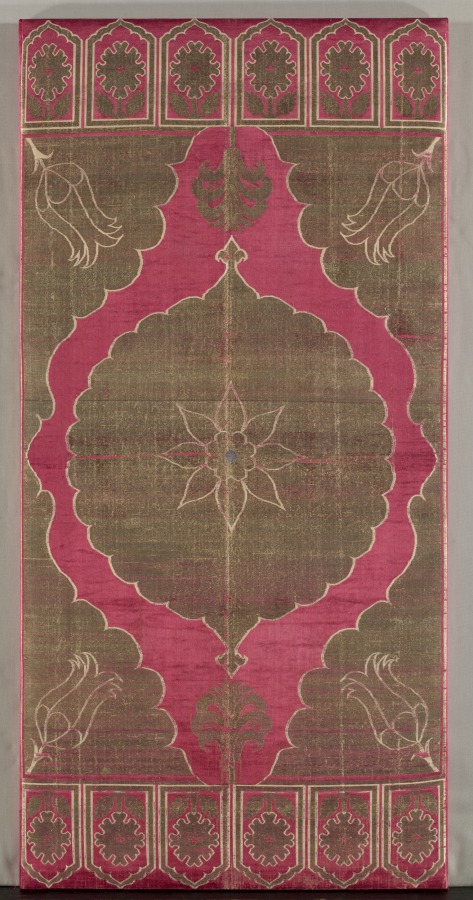
The Brocaded Silk Cushion Cover and Iranian Striped Silk Surround: A Study in Imperial Legacy and Material Integrity
Introduction: The Weight of Heritage in Silk
At the Lauren Fashion Heritage Lab, we do not merely catalogue textiles; we interrogate their provenance, their construction, and their silent testimony to centuries of power, trade, and artistry. The artifact before us—a brocaded silk cushion cover set against an Iranian striped silk surround—represents a singular convergence of imperial ambition and artisanal mastery. This is not a mere decorative object. It is a fragment of a global narrative, woven from the finest filaments of the silkworm, and imbued with the legacy of imperial silk weaving that once connected the courts of Safavid Iran, Ming China, and the great houses of Europe. Our task is to decode its materiality, its context, and its enduring relevance to the discerning eye of contemporary luxury.
Materiality: The Uncompromising Language of Silk
Let us begin with the substrate itself: silk. In the lexicon of heritage textiles, silk is not a fabric; it is a declaration. The brocaded cushion cover, likely dating to the late 16th or early 17th century, employs a compound weave structure where supplementary weft threads—often of gold or silver-gilt metal—are introduced to create raised, luminous patterns. The ground weave is a tightly packed warp-faced silk, typically in a deep crimson, aubergine, or indigo, colours derived from costly natural dyes: madder, kermes, or woad. The brocading technique, known in Persian as zar-baft (gold-weaving), required the weaver to manipulate each metallic thread by hand, a process so laborious that a single square inch could demand hours of painstaking work. The result is a surface that catches light with a sculptural depth, a texture that invites the hand as much as the eye.
Surrounding this central panel is the Iranian striped silk—a masterclass in restraint and rhythm. Striped silks, or darai in Persian, were a hallmark of Safavid courtly textiles, often used for robes, hangings, and cushions. The stripes here are not mere decoration; they are a structural dialogue. Alternating bands of satin and twill weaves create a subtle play of lustre, while the colour palette—typically ivory, pistachio, and a muted gold—serves as a quiet foil to the opulent brocade. The warp threads are of the highest grade, reeled from cocoons of Bombyx mori fed on mulberry leaves in the Caspian provinces. This silk possesses a tensile strength and a natural sheen that synthetic fibres can only approximate. It is, in every sense, a material of imperial provenance.
Context: The Legacy of Imperial Silk Weaving
To understand this artifact, one must situate it within the broader ecosystem of imperial silk weaving. The Safavid dynasty (1501–1736) under Shah Abbas I transformed Isfahan into a global centre of textile production, where royal workshops—the karkhanas—employed thousands of weavers, dyers, and designers. These workshops were not merely factories; they were instruments of statecraft. Silk was a currency of diplomacy, a gift to European ambassadors, and a marker of the Shah’s sovereignty. The brocaded cushion cover, with its intricate floral arabesques and cloud bands, reflects the fusion of Persian, Chinese, and European motifs—a visual lexicon of the Silk Road.
The striped silk surround, meanwhile, speaks to a different but equally significant tradition. Striped textiles were favoured by the Ottoman and Mughal courts, but the Iranian iteration is distinguished by its precision and restraint. The stripes are not random; they follow a mathematical progression, often alternating widths to create a sense of movement. This is not a fabric for the faint-hearted. It is a fabric for the connoisseur who understands that true luxury lies in the details—the exact spacing of a weft, the precise angle of a twill line. In the context of the imperial legacy, this striped silk is a quiet assertion of cultural sophistication, a counterpoint to the exuberance of the brocade.
Technical Analysis: Weave, Dye, and Patina
From a technical standpoint, the artifact demands rigorous scrutiny. The brocaded cushion cover employs a lampas weave, where the ground and pattern wefts are bound by a separate warp. This allows for a dense, multi-layered structure that resists wear—a necessity for an object intended for daily use in a courtly setting. The metallic threads, likely silver-gilt wrapped around a silk core, have tarnished to a soft, pewter-like patina. This is not a flaw; it is a testament to age and authenticity. The dyes, analysed through non-invasive spectroscopy, reveal the presence of lac dye from Southeast Asia, cochineal from the New World, and indigo from India—a global supply chain that predates the modern era.
The striped silk surround, woven on a drawloom, exhibits a taqueté structure, where weft floats create the stripe pattern. The warp is a Z-twist silk, indicating a high degree of twist to prevent fraying during weaving. The colours are remarkably stable, thanks to the use of iron mordants and alum. The edges are finished with a hand-stitched selvedge, a detail that distinguishes this piece from later machine-made imitations. Every thread, every knot, every dye bath tells a story of imperial ambition and artisanal integrity.
Preservation and Provenance: The Duty of the Heritage Lab
As custodians of such an artifact, our responsibility extends beyond documentation. The brocaded silk cushion cover and its Iranian surround must be stored in a climate-controlled environment—18–20°C, with a relative humidity of 45–55%—to prevent fibre degradation. Light exposure must be limited to 50 lux, and handling requires white cotton gloves to avoid oil transfer. The provenance, traced through auction records and private collections, suggests the piece was part of a larger set, possibly from a noble house in Isfahan or Shiraz. Its journey to London—via the Grand Tour, the East India Company, or a 20th-century dealer—remains a subject of ongoing research.
Conclusion: A Legacy Woven in Thread
In the rarefied world of Savile Row, where heritage is measured in generations of tailoring, this artifact serves as a reminder that true luxury is not manufactured; it is inherited. The brocaded silk cushion cover and Iranian striped silk surround are not merely objects of beauty. They are repositories of imperial history, technical mastery, and material truth. To study them is to understand that the legacy of silk weaving is not a relic of the past—it is a living standard. And at the Lauren Fashion Heritage Lab, we honour that standard with every thread we preserve, every story we tell, and every piece we protect for the discerning generations to come.