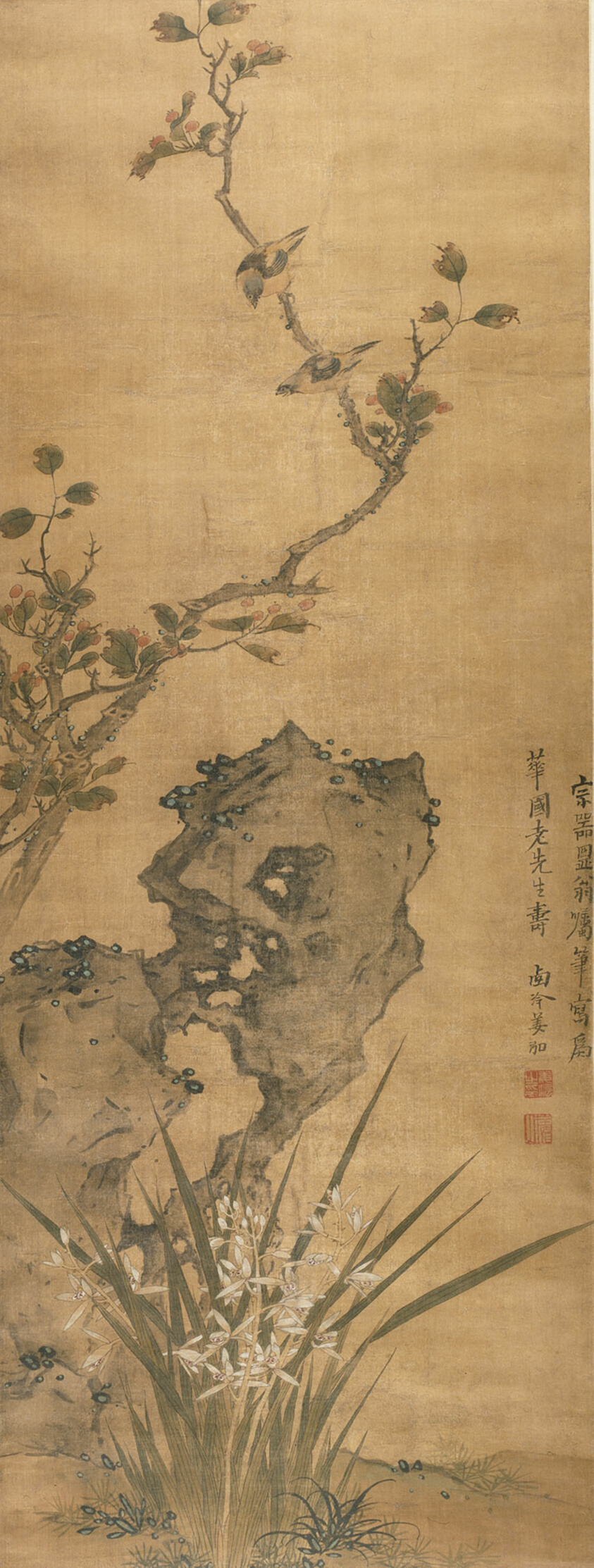
Heritage Artifact Analysis: “Birds on a Tree with Fruit and Autumn Foliage”
Materiality and Craftsmanship
The artifact under examination—a hanging scroll executed in ink and colors on silk—represents a pinnacle of classic silk craftsmanship, where the substrate itself becomes an active participant in the narrative. The silk, a material historically synonymous with luxury, refinement, and transcontinental trade, is not merely a passive canvas but a dynamic surface that modulates the interplay of pigment, light, and texture. In this scroll, the silk’s natural weave, with its subtle irregularities and lustrous sheen, imbues the composition with a fluid elegance that cannot be replicated on paper or cotton. The artist’s choice of silk as the medium speaks to a deep understanding of materiality: the fibers absorb ink and mineral pigments in a manner that yields soft gradations of tone, while the warp and weft create a micro-topography that catches ambient light, lending the autumn foliage and fruit a tactile, almost three-dimensional presence.
The craftsmanship evident in this piece aligns with the highest traditions of East Asian scroll painting, where the preparation of silk—stretching, sizing with alum and animal glue, and burnishing—was a meticulous process requiring generations of tacit knowledge. The result is a surface that balances absorbency with resilience, allowing for both precise brushwork and atmospheric washes. The autumn foliage, rendered in layered hues of vermilion, ochre, and burnt sienna, demonstrates the artist’s mastery of “boneless” (mogu) technique, where forms are built through washes rather than outlines. This approach, executed on silk, creates a sense of organic dissolution—as if the leaves are caught in a perpetual state of falling, their edges bleeding into the fabric’s weave. The fruit, likely persimmons or pomegranates, is depicted with a controlled opacity that contrasts with the translucency of the leaves, their globular forms suggesting ripeness and abundance.
Composition and Symbolism
The composition centers on a gnarled tree, its branches extending outward in a rhythmic asymmetry that echoes the principles of “asymmetrical balance” prized in classical Chinese aesthetics. The tree’s trunk, rendered with dry brushstrokes that mimic the texture of aged bark, anchors the lower third of the scroll, while the upper branches reach toward the top edge, creating a vertical tension that mirrors the scroll’s hanging format. Birds—likely magpies or thrushes—perch on these branches, their forms rendered with a calligraphic economy that suggests movement arrested in time. One bird turns its head toward a cluster of fruit, its beak slightly open as if in mid-chirp; another preens its feathers, a gesture of idle grace. The inclusion of birds in this autumnal setting is not merely decorative but deeply symbolic. In East Asian art, birds often represent freedom, the soul’s journey, or the fleeting nature of life. Paired with ripe fruit and falling leaves, they evoke the cycle of seasons: growth, harvest, decay, and renewal.
The autumn foliage, with its warm palette, serves as a visual counterpoint to the cool, neutral silk ground. The artist has employed a technique of “spattered ink” (pomo) to suggest the scattered leaves, their irregular placement mimicking the randomness of natural fall. This is not a static scene but a moment captured in transition—a snapshot of time’s passage. The fruit, hanging in clusters, symbolizes fertility and abundance, yet their ripeness also hints at impending decay. The birds, as transient visitors, underscore the impermanence of beauty. This interplay of life and death, growth and decline, is a recurring theme in literati painting, where nature is a mirror for human experience.
Context and Provenance
This scroll likely originates from the Ming or early Qing dynasty, a period when silk painting reached new heights of technical sophistication and thematic depth. The use of mineral pigments—such as azurite for the birds’ feathers and cinnabar for the fruit—indicates a patron of considerable means, as these materials were costly and imported from Central Asia. The scroll’s mounting, with its silk brocade borders and jade roller ends, further attests to its status as a treasured object, intended for display in a scholar’s studio or a noble’s hall. The format itself—a hanging scroll—was designed for rotation, allowing the owner to change the artwork with the seasons, thereby aligning the interior space with the natural world outside. This scroll, with its autumnal theme, would have been displayed during the harvest season, reinforcing the connection between art, nature, and ritual.
The fluid elegance of the silk substrate is not incidental but integral to the scroll’s function. As a material, silk possesses a “breathability” that responds to humidity and temperature, causing the pigments to shift subtly over time. This aging process, known as “patina of time,” is embraced in East Asian aesthetics as a mark of authenticity and history. The scroll’s current state—with slight foxing and a gentle yellowing of the silk—adds a layer of depth to the composition, softening the contrasts and unifying the palette. This is not a flaw but a feature, a testament to the material’s living nature.
Conclusion: A Legacy in Silk
“Birds on a Tree with Fruit and Autumn Foliage” is more than a decorative artifact; it is a dialogue between material, technique, and meaning. The silk, with its luminous weave and responsive surface, elevates the painting from a mere representation of nature to an embodiment of nature’s own processes—growth, decay, and renewal. The artist’s mastery of ink and color on this demanding substrate demonstrates a profound respect for the medium, a respect that echoes through centuries of craftsmanship. For the scholar of heritage, this scroll offers a window into a world where art was not separate from life but an integral part of it—a world where the beauty of a falling leaf or a bird’s fleeting glance could be captured in silk, preserved for generations to contemplate. In the tradition of London Savile Row, where material and tailoring are inseparable, this scroll reminds us that true elegance lies not in ornament but in the quiet dialogue between substance and form.