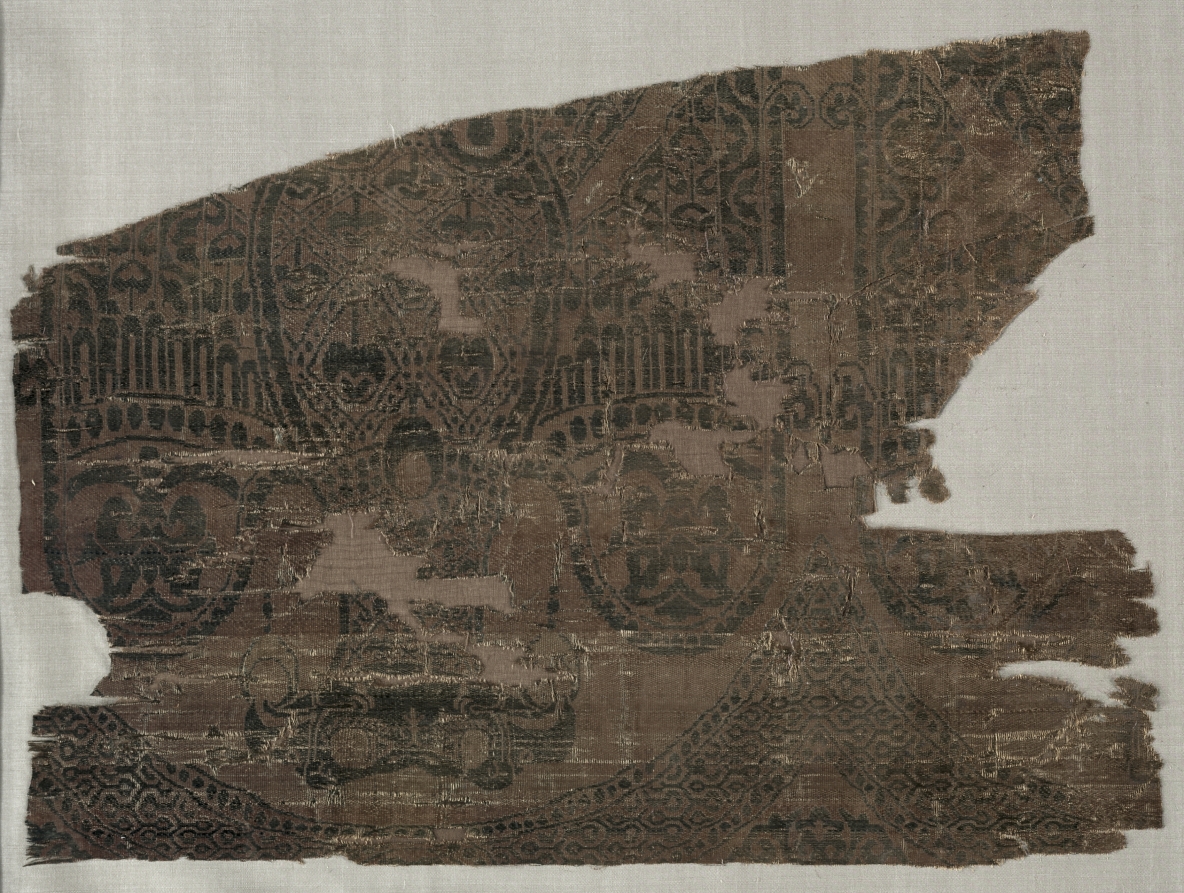
A Discreet Assertion of Epochs: Samite Fragments from the Tomb of Saint Bernard Calvo
To consider these fragments—these remnants of samite, heavy with the dust of sanctity and the weight of empires—is to engage in a most particular form of connoisseurship. It is not merely an appraisal of textile, but an evaluation of legacy, of a narrative woven with the same deliberate intricacy as the double-headed eagles that stare, even now, from their crimson ground. They were discovered, as such things often are, not in a treasury but in a tomb: the final resting place of Saint Bernard Calvo, the thirteenth-century Bishop of Vich. Their presence there is the first, and perhaps most profound, statement of their character. This was not a garment for daily wear, but a vestment of ultimate authority, a final, silent accompaniment for a prince of the church who navigated the temporal and spiritual thrones of his age. The material itself, silk, dictates the terms of our understanding. It is the non-negotiable foundation upon which all subsequent meaning is constructed.
The Fabric of Empire: A Material Provenance
One must first appreciate the provenance inherent in the fibre. In the medieval world, silk was not a mere commodity; it was the physical manifestation of geopolitical reach and technical supremacy. Its journey from the mulberry groves of the East to the loom, and ultimately to a Pyrenean tomb, traces a map of old power. The very fact that these fragments are samite—a weft-faced compound twill, dense, lustrous, and capable of supporting complex pattern repeats—places their origin within the highest echelons of the Byzantine or Islamic imperial workshops. This was a fabric reserved for coronations, for altar cloths, for shrouding relics and saints. Its hand, even now, would communicate a substantial weight, a dignified drape that confers status upon the wearer and the occasion alike. The material, therefore, is the first and most unassailable claim to importance; everything else is elaboration upon this most luxurious of canvases.
The Heraldry of the Heavens: The Double-Headed Eagle
Upon this ground of imperial silk, we encounter the emblematic motif: the double-headed eagle. Its execution in gold and silver thread, now tarnished but still suggestive of its original blinding splendour, is a masterclass in symbolic audacity. The motif is an ancient one, a Byzantine inheritance speaking of a sovereignty that looks unflinchingly both East and West, governing the secular and the sacred. Its adoption by the Holy Roman Empire and other European potentates was never mere imitation; it was a deliberate sartorial claim to a translatio imperii, a transfer of that universal authority.
To find it here, in the context of a bishop’s tomb, is to witness a sublime piece of sartorial diplomacy. The bishop, clad in or covered by this silk, becomes a living—and in death, an eternal—nexus of powers. He is a vessel of divine authority (the Church), yet wrapped in the symbol of supreme terrestrial dominion (the Empire). The silk samite is the only medium capable of bearing such a conflated message without diminishing either aspect; its cost, its rarity, and its regal association lend equal validity to both claims. The eagle is not embroidered upon the surface; it is woven into the very structure of the cloth, making the assertion inseparable from its substance. This is not adornment; it is constitutional architecture in thread.
A Legacy Cut from Time's Bolt: The Fragment as Testament
Their present state as fragments is, paradoxically, what renders them so eloquent. A complete chasuble or cope would be a museum piece, a static relic of a bygone liturgy. These remnants, however, invite a more forensic appreciation. The cut of the edges, the alignment of the pattern repeat, the way the eagle’s wing is severed by time’s depredations—all these speak to the garment’s original construction and its subsequent veneration. They have been handled, perhaps kissed as relics, certainly preserved with a care that acknowledges their dual nature as sacred object and masterpiece of weaving.
The legacy of imperial silk weaving is precisely this: the creation of a material so potent that it could survive the dissolution of the empires that spawned it, the decay of the body it shrouded, and the fading of the specific political alliances it once signified, yet retain its formidable aura. The techniques—the complex loom technology, the dye mastery to achieve that enduring crimson, the manipulation of metallic threads—were the guarded secrets of state workshops. Their output was a soft, shimmering tool of statecraft, as strategic as any treaty.
In conclusion, the samite fragments from the tomb of Saint Bernard Calvo present a case study in the unspoken language of supreme authority. They represent a confluence where material rarity, technical virtuosity, and profound iconography are fused into a single, devastatingly effective statement. They whisper of Constantinople and Palermo, of emperors and bishops, of a world where power required a suitable raiment. To examine them is to understand that the true legacy of imperial silk weaving is not merely aesthetic; it is the demonstration that the most enduring politics are often those woven into the very fabric of culture, destined to outlast stone and decree, resting in quiet, fragmented splendour, waiting for the discerning eye to piece the story back together.