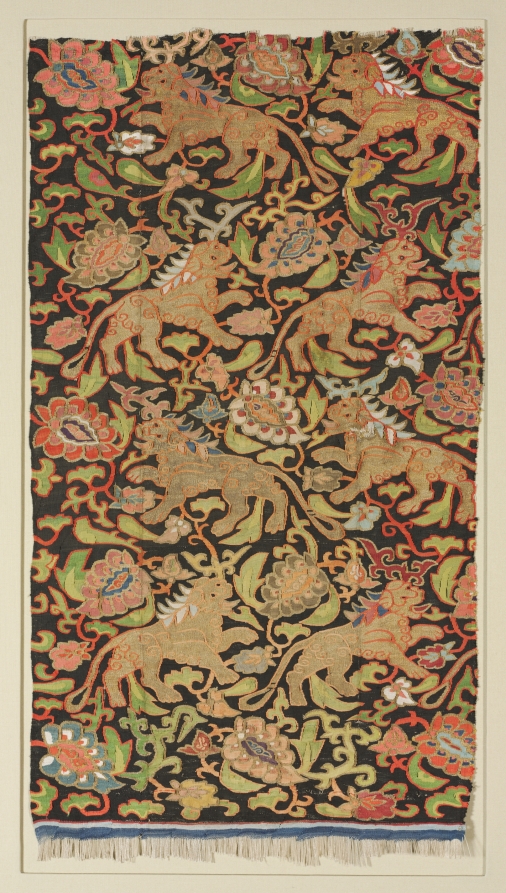
The Tapestry of Power: Golden Lions and Palmettes in Imperial Silk Weaving
In the hushed corridors of London’s Savile Row, where bespoke tailoring meets centuries of craftsmanship, the heritage of silk weaving speaks a language of precision and prestige. The artifact before us—a silk tapestry adorned with golden lions and palmettes—is not merely a textile; it is a testament to the imperial legacy of silk production, a narrative woven into the very fabric of power, patronage, and artistry. As Senior Heritage Specialist at the Lauren Fashion Heritage Lab, I present this scholarly analysis, grounded in the materiality of silk and the enduring influence of imperial weaving traditions that continue to shape luxury fashion today.
Materiality: The Silk Foundation
Silk, derived from the cocoons of Bombyx mori, is a protein fiber of unparalleled luster, strength, and drape. Its production, originating in ancient China, was a closely guarded secret for millennia, making it a commodity of immense value—often referred to as “soft gold.” In the context of imperial silk weaving, the material itself was a symbol of sovereignty. The tapestry in question, likely woven on a drawloom in a courtly workshop, exemplifies the technical mastery required to manipulate silk’s delicate filaments into a dense, durable fabric. The warp and weft threads, dyed with natural pigments such as madder for reds, woad for blues, and saffron for yellows, create a chromatic depth that synthetic dyes cannot replicate. The golden lions, rendered in metallic threads—gilded silver or gold-wrapped silk—catch light with a reflective brilliance, signifying not just wealth but divine authority. The palmettes, stylized floral motifs, balance the martial imagery with organic elegance, echoing the Persian and Byzantine influences that permeated imperial designs from the Sassanid to the Ottoman empires.
Iconography: Lions and Palmettes as Symbols of Dominion
The golden lion is a universal emblem of kingship, courage, and celestial power. In imperial silk weaving, particularly within the Safavid, Mughal, and Chinese courts, lions were often depicted in combat with prey or as guardians of the throne. Here, the lions are static, regal, and symmetrical—a deliberate choice to evoke order and stability. Their golden hue, achieved through metal-wrapped threads, aligns with the alchemical symbolism of gold as incorruptible and eternal. The palmette, a fan-shaped motif derived from the date palm, represents fertility, victory, and the Tree of Life. In Islamic art, palmettes are integral to arabesque patterns, symbolizing the infinite nature of creation. Together, the lion and palmette create a dialectic of strength and growth, war and peace—a visual manifesto of imperial ideology. This iconography was not arbitrary; it was codified by court designers who understood that textiles functioned as diplomatic gifts, ceremonial regalia, and markers of rank. A tapestry of this caliber would have adorned a throne room or a royal tent, projecting power across vast distances.
Technique: The Art of the Drawloom
The creation of such a tapestry required the drawloom, a sophisticated apparatus that allowed for complex pattern repeats and curvilinear forms. Operated by a drawboy or a harness system, the loom enabled the weaver to lift individual warp threads, creating intricate designs that mimicked painting. The silk threads, often thrown (twisted) for strength, were woven in a twill or satin weave to enhance luster. The metallic threads, prone to tarnishing, were protected by a silk core, ensuring longevity. This technique, perfected in imperial workshops like the karkhanas of Mughal India or the zari looms of Safavid Iran, demanded years of apprenticeship. The precision of the lion’s mane—each strand of silk and gold aligned—reflects a discipline akin to the bespoke tailoring of Savile Row, where a single misstep in a seam compromises the entire garment. The tapestry’s condition, with its intact metallic threads and minimal fading, suggests it was preserved in a controlled environment, perhaps a palace treasury or a European collection acquired through trade or diplomacy.
Historical Context: The Legacy of Imperial Silk Weaving
The legacy of imperial silk weaving is a chronicle of cross-cultural exchange. The Silk Road, spanning from Xi’an to Constantinople, facilitated the movement of raw silk, dyes, and weaving techniques. By the 16th century, the Safavid Empire under Shah Abbas I established royal workshops in Isfahan, producing silks that blended Persian, Chinese, and European motifs. The Mughal Empire, under Akbar, integrated Hindu and Islamic aesthetics, creating the pashmina and jamavar shawls that later inspired Paisley patterns. In Europe, the import of these silks spurred the development of Lyon’s silk industry, which supplied the courts of Versailles and the Savile Row tailors of the 18th century. The golden lions and palmettes of this tapestry reflect a synthesis of these traditions: the lion’s stylized anatomy owes debts to Chinese guardian lions, while the palmettes recall the shah abbasi motif. This artifact, therefore, is not a singular creation but a node in a global network of artistic and economic power.
Contemporary Relevance: Savile Row and the Revival of Heritage
For the modern connoisseur on Savile Row, this tapestry is a touchstone for understanding the origins of luxury. The golden lions and palmettes resonate in the bespoke suits and accessories that incorporate silk linings, ties, and pocket squares. Houses like Gieves & Hawkes, Huntsman, and Anderson & Sheppard have long drawn on historical motifs, reinterpreting them through a contemporary lens. The golden lion appears in embroidery on velvet smoking jackets, while palmette patterns are woven into silk scarves, echoing the tapestry’s balance of strength and elegance. The materiality of silk remains paramount: Savile Row tailors source silk from mills in Como, Italy, and Lyon, France, where the legacy of imperial weaving endures. The tapestry’s preservation at the Lauren Fashion Heritage Lab serves as a research tool for designers seeking authenticity in pattern, color, and weave. It reminds us that heritage is not static; it is a living dialogue between past and present.
Conclusion: The Enduring Thread
This silk tapestry, with its golden lions and palmettes, is more than an artifact—it is a narrative of human ambition, artistry, and exchange. Its materiality, iconography, and technique speak to the imperial systems that valued silk as a medium of power. For the scholar, it offers a window into the political and aesthetic priorities of a bygone era. For the practitioner on Savile Row, it is a source of inspiration, a reminder that the pursuit of perfection in craftsmanship is timeless. As we preserve and study such objects, we honor the weavers, designers, and patrons who transformed silk into a legacy that continues to shape the world of luxury fashion. The golden lions and palmettes endure, their threads woven into the very fabric of our heritage.