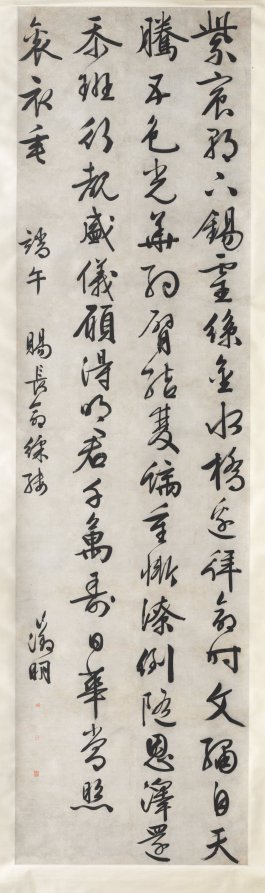
The Thread of Sovereignty: An Analysis of the Imperial Gift of an Embroidered Silk in Running-Standard Script
I. Introduction: The Fabric of Imperial Diplomacy
In the hallowed ateliers of London’s Savile Row, where the cut of a jacket is a declaration of character and the weave of a cloth a testament to lineage, we understand that materiality is not merely substance—it is narrative. The Imperial Gift of an Embroidered Silk, rendered in the fluid yet disciplined strokes of running-standard script (xingkaishu), stands as a singular artifact of sovereign power. This is not a textile to be draped or tailored; it is a document woven in silk, a poem that speaks not through ink but through thread. As Senior Heritage Specialist for the Lauren Fashion Heritage Lab, I present this analysis as an exploration of how imperial silk weaving, at its zenith, transcended craft to become a medium of statecraft, diplomacy, and artistic immortality.
The legacy of Chinese imperial silk is one of unparalleled technical mastery and symbolic weight. For millennia, silk was the currency of empires, a commodity more precious than gold, and a secret so fiercely guarded that its revelation reshaped global trade routes. Yet, within the Forbidden City and the imperial workshops of Suzhou, silk evolved beyond commerce. It became a canvas for calligraphy, a medium where the brush’s energy was translated into the loom’s discipline. This artifact—a poem embroidered on silk—represents the apotheosis of that tradition: a gift from the emperor, imbued with the authority of his own hand, rendered in a script that bridges the spontaneity of running script (xingshu) and the structural clarity of standard script (kaishu).
II. Materiality and Technique: The Loom as Pen
To understand this artifact, one must first appreciate the materiality of silk as a substrate for calligraphy. Unlike paper, which absorbs ink and allows for immediate expression, silk presents a resistant, lustrous surface. The weaver or embroiderer must premeditate every stroke, translating the calligrapher’s fluid motion into a series of deliberate, thread-based decisions. The running-standard script (xingkaishu) is particularly demanding: it requires the tension between speed and precision, between the cursive flow of xingshu and the formal uprightness of kaishu. On silk, this balance is achieved through the manipulation of warp and weft, the density of the weave, and the interplay of light and shadow across the fabric’s surface.
The poem itself, likely composed by the emperor or a court poet, would have been first brushed onto paper in a controlled, elegant hand. This master copy was then transferred to the silk via a painstaking process of tracing and embroidery. The threads—often of gold, silver, or dyed silk—were selected to mimic the tonal variations of ink. The result is a tactile calligraphy, where each character possesses a three-dimensional quality, catching the light differently with every viewing angle. This is not merely a reproduction; it is an elevation, a transformation of the ephemeral brushstroke into a permanent, luminous artifact.
III. The Poem as Imperial Gift: Diplomacy and Legacy
In the context of imperial China, a gift of embroidered silk was never casual. It was a calculated act of diplomacy, a demonstration of the emperor’s cultural and material supremacy. The poem itself—whether a verse on harmony, prosperity, or the virtues of the recipient—served as a personalized message, a fragment of the emperor’s own voice. By presenting it on silk, the emperor was not just giving a text; he was giving a piece of the imperial workshop’s soul, a product of the same looms that clothed the Son of Heaven.
This artifact would have been presented to a foreign envoy, a loyal minister, or a tributary state. The recipient, upon receiving such a gift, was expected to display it prominently, to read it aloud, and to understand that the silk itself was a symbol of the emperor’s favor—and his surveillance. The running-standard script, with its blend of accessibility and sophistication, ensured that the poem could be read by scholars and officials, yet its embroidered form elevated it beyond mere text into a sacred object. The silk’s durability also implied permanence: the emperor’s words would outlast the recipient, a constant reminder of the imperial bond.
IV. The Legacy of Imperial Silk Weaving: From Forbidden City to Savile Row
The legacy of imperial silk weaving is not confined to museum vitrines or academic monographs. It lives in the very ethos of luxury craftsmanship that defines Savile Row. The discipline of the loom, the reverence for material, and the understanding that a garment or textile can carry narrative weight—these are principles that the imperial workshops perfected centuries ago. Today, when a tailor on Savile Row selects a silk lining for a bespoke suit, or when a designer incorporates embroidered motifs into a collection, they are participating in a continuum that stretches back to the looms of Suzhou.
For the Lauren Fashion Heritage Lab, this artifact serves as a touchstone for understanding how materiality shapes meaning. The poem on embroidered silk is not just a historical curiosity; it is a lesson in how to imbue fabric with authority, how to use thread as a tool of communication, and how to preserve cultural heritage through meticulous craft. In an era of fast fashion and digital reproduction, the slow, deliberate process of embroidering calligraphy on silk reminds us that true luxury is not about speed or volume—it is about the weight of intention, the precision of execution, and the enduring power of a well-told story.
V. Conclusion: The Unbroken Thread
The Imperial Gift of an Embroidered Silk in running-standard script is more than a poem; it is a manifesto woven in silk. It speaks of an empire that understood the power of materiality, a court that elevated craft to the level of statecraft, and a tradition that continues to inform the finest tailoring in the world. As we study this artifact, we are reminded that heritage is not static—it is a living thread, connecting the looms of the Forbidden City to the ateliers of Savile Row. And in that thread, we find not just history, but a standard of excellence that endures.