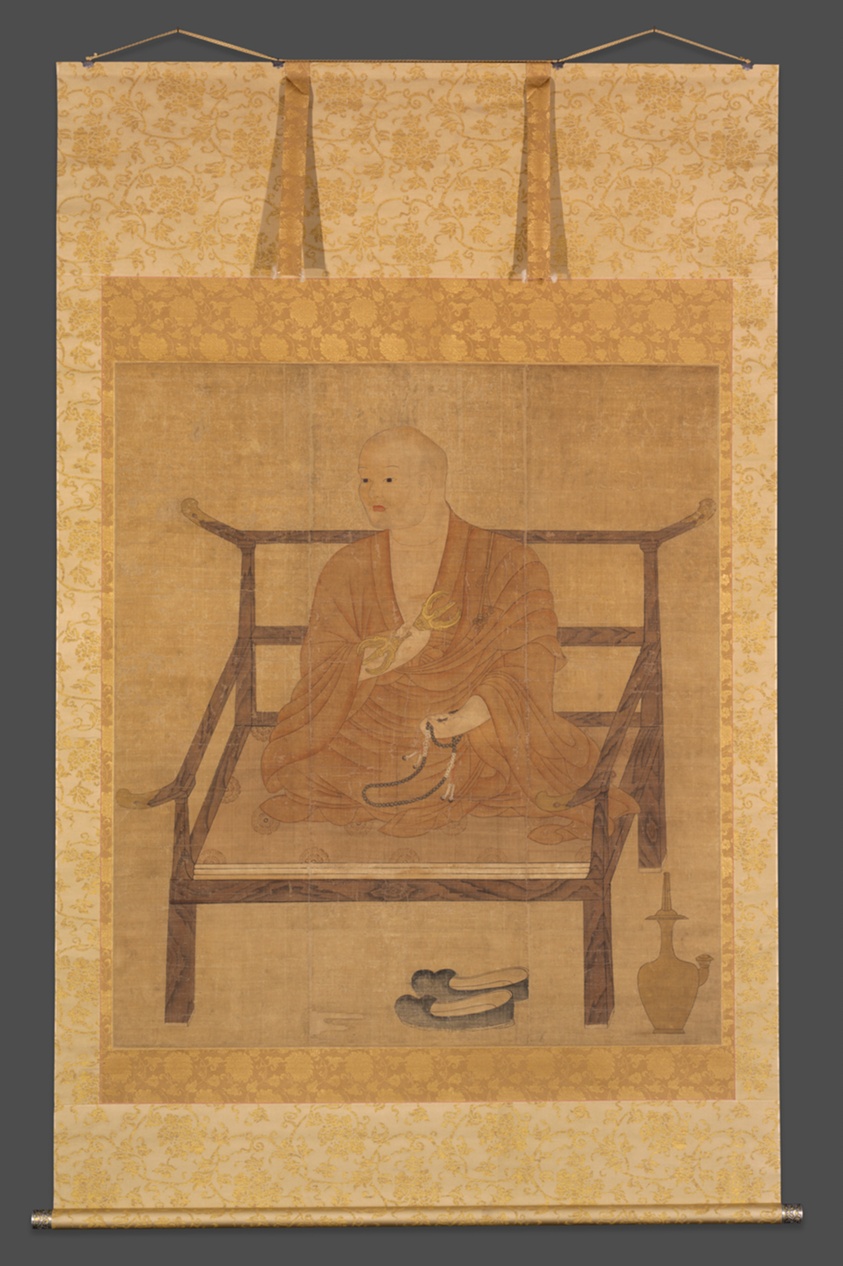
Portrait of Kobo Daishi (Kukai): A Study in Materiality and Mastery
Introduction: The Intersection of Devotion and Craft
In the hallowed corridors of heritage preservation, few artifacts command the reverence afforded to the Portrait of Kobo Daishi (Kukai). This hanging scroll, executed in ink, colors, and gold on silk, transcends its role as a mere religious icon. It stands as a testament to the pinnacle of classic silk craftsmanship, a medium that, like the finest tailoring on London’s Savile Row, demands an unwavering commitment to precision, texture, and enduring elegance. As Senior Heritage Specialist for the Lauren Fashion Heritage Lab, I approach this artifact not only as a historian of sacred art but as a curator of material culture, where every fiber and pigment tells a story of spiritual aspiration and artisanal rigor.
The Silk Substrate: A Foundation of Fluid Elegance
Silk, the chosen material for this scroll, is no arbitrary support. In the context of Japanese Buddhist art, silk was revered for its luminosity, its ability to absorb and reflect light in ways that enhanced the ethereal quality of divine figures. The Portrait of Kobo Daishi is rendered on a finely woven silk fabric, its threads so delicate that they create a surface akin to a whispered breath. This is not the coarse silk of everyday garments; it is a luxury textile, meticulously prepared to receive the artist’s hand. The weave is tight yet supple, allowing the scroll to be rolled and unrolled without cracking, a practical necessity for a portable object of veneration. The fluid elegance of the silk is palpable—it drapes with the same quiet authority as a bespoke suit from Huntsman or Anderson & Sheppard, where the cloth itself dictates the silhouette.
The choice of silk also speaks to the socio-religious hierarchy of the Heian and Kamakura periods. Only the finest materials were deemed worthy of depicting Kobo Daishi, the founder of Shingon Buddhism. The silk’s natural sheen, when combined with the application of gold, creates a halo effect around the figure, elevating him from the mundane to the transcendental. In this sense, the materiality of the scroll is not merely decorative; it is doctrinal. The silk becomes a metaphor for the pure, unblemished nature of enlightenment, a surface upon which the divine can manifest.
Ink, Colors, and Gold: The Palette of Prestige
The technical execution of this portrait is a masterclass in restraint and opulence. The ink, derived from soot and animal glue, provides the foundational lines—sharp, deliberate, and unerring. These contours define Kobo Daishi’s facial features, his robes, and his meditative posture. The ink is not applied with haste; each stroke is a meditation in itself, echoing the calligraphic traditions that Kukai himself championed. The black is deep, almost velvety, against the silk’s pale ground, creating a contrast that is both stark and harmonious.
Color is introduced with measured precision. Mineral pigments—azurite for blue, malachite for green, cinnabar for red—are ground and mixed with animal glue to create a paste that adheres to the silk without bleeding. These hues are not garish; they are subdued, almost reverent, as if the artist understood that vibrancy could distract from the subject’s spiritual gravity. The robes of Kobo Daishi are rendered in a deep indigo, a color associated with wisdom and the night sky, while the undergarments hint at ochre, a nod to the earthiness of monastic life.
Gold, however, is the crowning element. Applied as gold leaf or powdered gold mixed with a binding medium, it highlights the intricate patterns of the robes and the halo that encircles the saint’s head. The gold does not dazzle; it glows, catching the light in a way that suggests an inner radiance. This technique, known as kinpaku, requires a steady hand and an intimate understanding of how metal interacts with silk. Too thick, and the gold would crack; too thin, and it would lose its luster. The result is a surface that feels alive, shifting with the viewer’s perspective—much like the play of light on a well-tailored lapel.
Classic Silk Craftsmanship: A Parallel to Savile Row
The creation of this scroll mirrors the ethos of Savile Row tailoring, where the relationship between material and maker is sacrosanct. Just as a master cutter on Savile Row selects a length of worsted wool or cashmere based on its drape, weight, and resilience, the artist of this portrait chose silk for its ability to hold pigment and gold while remaining flexible. The process of preparing the silk—stretching it on a frame, sizing it with alum and glue to prevent absorption—is analogous to the basting and pressing of a bespoke garment. Both traditions demand patience, a deep understanding of the material’s behavior, and an acceptance that the final product will be judged not by its flashiness but by its quiet perfection.
Consider the goldwork: in Savile Row, gold buttons or embroidery are applied with the same care as the gold on this scroll. They are not ostentatious; they are accents that signal quality. Similarly, the gold on Kobo Daishi’s portrait is not there to impress but to illuminate. It is a subtle declaration of the subject’s sanctity, much like the understated elegance of a hand-stitched buttonhole on a dinner jacket. Both are marks of a tradition that values substance over spectacle.
Preservation and Legacy: The Artifact’s Future
As a heritage specialist, I must consider the fragility of this object. Silk is inherently vulnerable to light, humidity, and handling. The gold, while durable, can flake if the scroll is unrolled too frequently. The ink and pigments, though stable, are susceptible to fading. The Portrait of Kobo Daishi is not merely a painting; it is a living document of a bygone era of craftsmanship. Its preservation requires the same meticulous attention that went into its creation. Climate-controlled storage, minimal exposure to UV light, and careful rotation in display are non-negotiable. We must treat this scroll as we would a bespoke suit from a bygone era—with reverence, but also with the understanding that it was made to be seen, to inspire, and to endure.
Conclusion: The Art of the Enduring
In the Portrait of Kobo Daishi (Kukai), we find a convergence of faith and artistry that is as rare as it is profound. The silk, the ink, the colors, and the gold are not mere materials; they are the vocabulary through which a spiritual narrative is told. This artifact reminds us that heritage is not static—it is a dialogue between the past and the present, between the maker and the beholder. For those of us at the Lauren Fashion Heritage Lab, it serves as a benchmark for what is possible when craftsmanship is elevated to an act of devotion. And in the quiet elegance of its silk, we hear the echo of Savile Row’s own creed: that true luxury is never loud, but always felt.