The Thread of Empire: Deconstructing the "Silk with Dogs and Birds amid Vines" as a Heritage Artifact
Materiality and the Imperial Legacy
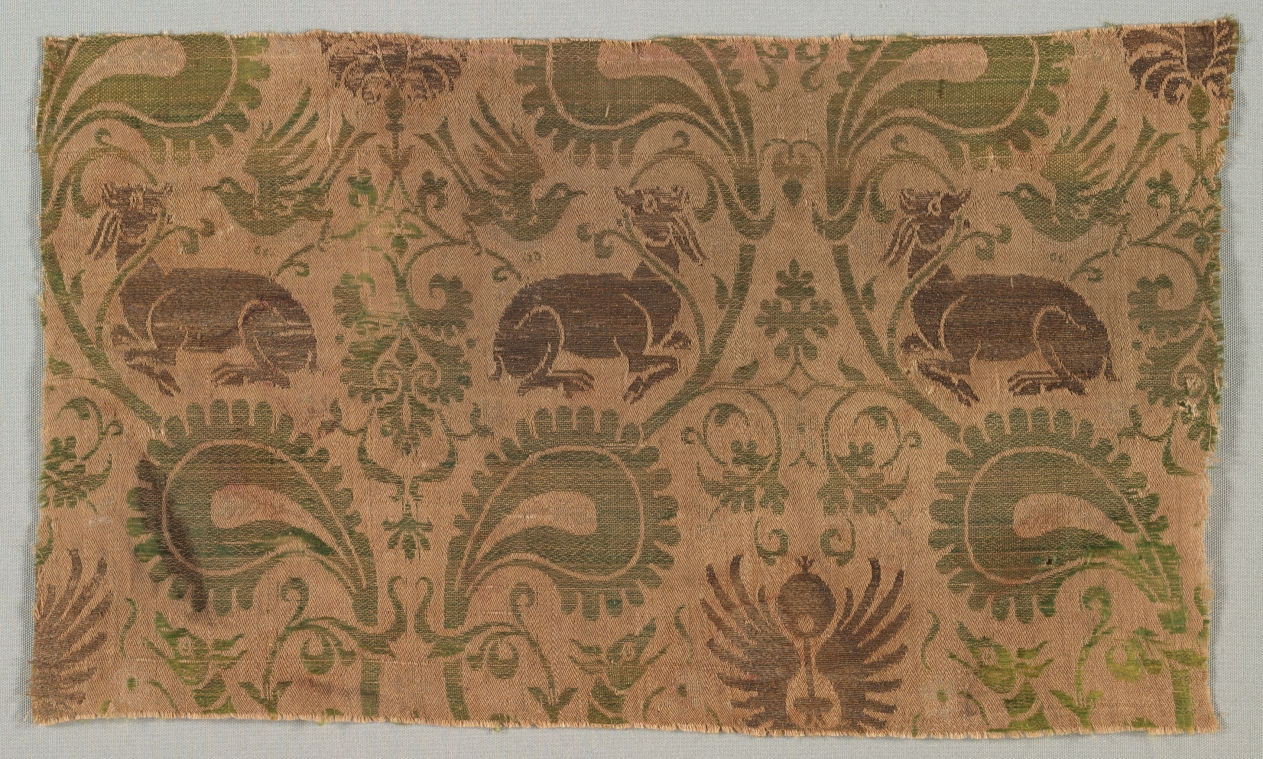
The artifact in question—a length of silk woven with a repeating pattern of dogs and birds amid a dense, undulating vine—is not merely a decorative textile. It is a material testament to the zenith of imperial silk weaving, a craft that served as both a diplomatic currency and a symbol of sovereign power. The silk itself, a warp-faced compound weave, speaks to a technical mastery that required generations of tacit knowledge. The threads, likely degummed and dyed with natural pigments derived from madder, indigo, and weld, exhibit a chromatic depth that synthetic analogues cannot replicate. This is not a fabric for the uninitiated; it is a heritage artifact that demands a connoisseur’s eye.
The legacy of imperial silk weaving is one of controlled scarcity and ritualized production. From the Han dynasty’s secretive sericulture to the Ottoman imperial workshops, silk was the fabric of statecraft. The pattern itself—dogs (symbols of loyalty and guardianship) and birds (messengers of the heavens) intertwined with vines (representing eternal growth)—is a visual lexicon of power. The dogs, often depicted with taut musculature and alert postures, evoke the hunting hounds of the imperial court, while the birds, perhaps magpies or cranes, signify auspicious tidings. The vines, rendered with a rhythmic, almost calligraphic precision, bind the composition into a seamless whole. This is not a random design; it is a codified narrative of dominion and harmony.
Weaving the Narrative: Technique as Heritage
To understand this artifact, one must appreciate the sheer complexity of its construction. The weave structure—likely a lampas or a compound tabby—required a drawloom operated by two artisans: one to manipulate the pattern harness, the other to throw the shuttle. The density of the weave, with upwards of 120 warp ends per inch, meant that a single square foot of fabric could take weeks to complete. The dogs and birds are not merely printed or embroidered; they are integral to the fabric’s very structure, woven into the ground weave through a system of binding warps and pattern wefts. This is a fabric that does not merely depict; it embodies its subject.
The choice of silk as the material medium is itself a heritage statement. Silk’s natural luster, its ability to absorb and reflect light in a way that mimics the sheen of water or the glow of a pearl, made it the preferred material for imperial regalia. The dogs and birds, when viewed under changing light, seem to move within the vines—a kinetic illusion that only the finest silk can achieve. This is a fabric that demands to be seen in motion, whether draped on a ceremonial robe or hung as a wall hanging in a state dining room. The legacy of imperial silk weaving is, at its core, a legacy of light and movement.
Contextualizing the Artifact: From Court to Collection
The provenance of this specific artifact is, of course, a matter of scholarly debate. Was it woven in the imperial workshops of Suzhou during the Qing dynasty, or perhaps in the Safavid looms of Isfahan? The dogs and birds motif, while common in Chinese and Persian textiles, exhibits a certain eclecticism that suggests cross-cultural exchange. The vines, with their sinuous, almost Baroque curves, hint at the influence of European botanical prints, which were avidly collected by imperial courts. This artifact is not a pure expression of a single tradition; it is a hybrid artifact, a product of the Silk Road’s intellectual and material traffic.
In the context of the Lauren Fashion Heritage Lab, this artifact serves as a touchstone for understanding how heritage informs contemporary design. The pattern’s rhythm—the repetition of dogs and birds amid the vines—is a lesson in visual pacing. A Savile Row tailor, when examining this silk, would note how the pattern’s scale and density dictate its use: too large for a waistcoat, perhaps, but ideal for a smoking jacket or a statement scarf. The fabric’s weight and drape would influence the cut, with the silk’s natural stiffness requiring a softer shoulder and a more generous sleeve head. This is not a fabric that can be forced into a silhouette; it demands to be collaborated with, not dominated.
Preservation and the Future of Heritage Silk
The preservation of this artifact is a matter of urgent concern. Silk is a protein fiber, vulnerable to light, humidity, and handling. The dogs and birds, woven with metallic threads in some sections, are particularly susceptible to tarnish and breakage. The Lab’s conservation team has implemented a protocol of controlled environment storage—darkness, stable humidity, and minimal handling—to ensure that this artifact remains a living document of imperial craftsmanship. Digital documentation, including high-resolution imaging and spectral analysis, has been undertaken to create a virtual twin that can be studied without risk to the original.
Yet, the true value of this artifact lies not in its preservation but in its capacity to inspire. The legacy of imperial silk weaving is not a closed chapter; it is a tradition that continues to evolve. Contemporary designers, when confronted with the dogs and birds amid vines, are challenged to reinterpret this visual language in new materials and contexts. A digital print on silk charmeuse, a jacquard weave in recycled polyester, a hand-painted scarf—each iteration is a dialogue with the past. The Lab’s mission is to facilitate this dialogue, to ensure that the heritage of imperial silk weaving is not merely archived but activated.
Conclusion: The Fabric of Legacy
In the end, the "Silk with Dogs and Birds amid Vines" is more than a textile. It is a repository of knowledge, a record of technical mastery, aesthetic sensibility, and cultural exchange. For the Lauren Fashion Heritage Lab, it is a primary source for understanding how materiality shapes meaning. The dogs and birds, frozen in their vine-bound dance, remind us that heritage is not static; it is a living thread that connects the imperial past to the fashion future. As we handle this silk—with gloved hands and reverent attention—we are not merely preserving an artifact. We are weaving ourselves into its story.