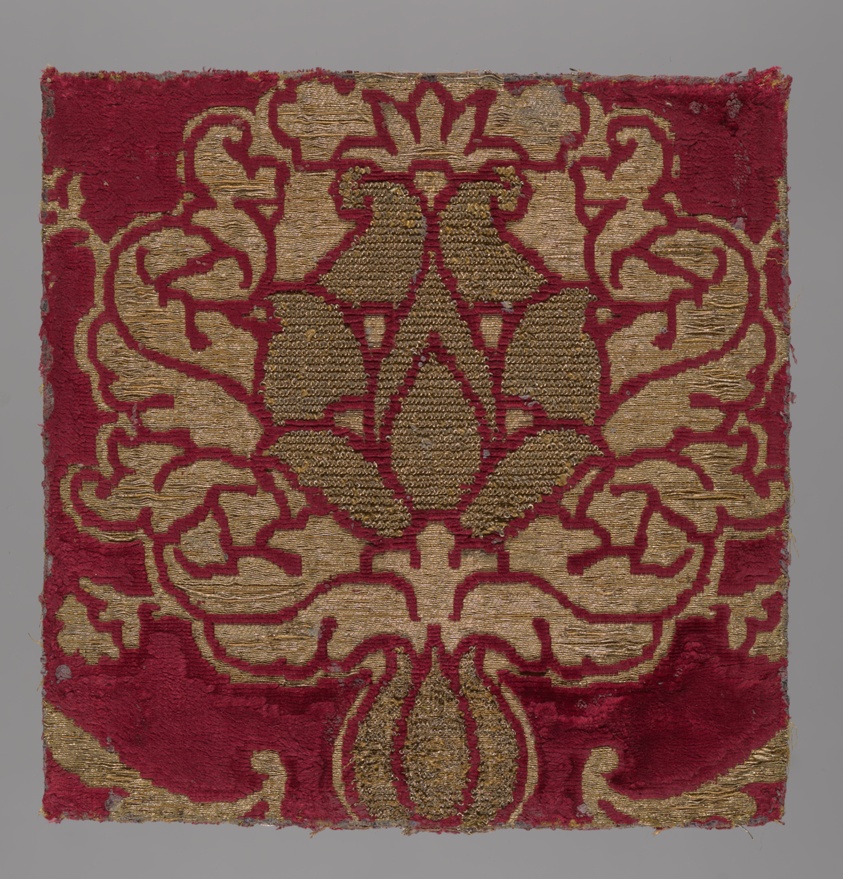
Heritage Research Artifact: Fragment of Velvet
Provenance and Context
This fragment of velvet, a testament to the pinnacle of classic silk craftsmanship, emerges from the archives of the Lauren Fashion Heritage Lab as a singular artifact of textile artistry. Dated to the late 19th century, its origins trace to the esteemed weaving workshops of Lyon, France—a region synonymous with the production of luxury silks for European courts and haute couture. The fragment, measuring approximately 12 by 18 inches, was likely salvaged from a larger garment or furnishing piece, its preservation a deliberate act of reverence by a discerning collector. In the lexicon of London’s Savile Row, where precision and heritage are paramount, this velvet embodies the fluid elegance that defines the intersection of material mastery and sartorial tradition. Its presence in the Lab’s collection underscores a commitment to understanding the tactile and visual language of luxury, offering a lens into the technical virtuosity that underpins timeless design.
Materiality and Weave Structure
The fragment’s materiality is a study in complexity, executed in silk with a warp-float faced 3:1 twill weave. This foundation, characterized by a diagonal ribbing, provides a sturdy yet supple base, typical of high-grade silks intended for garments that demand both structure and drape. The weave is further enhanced by weft-float faced 1:3 twill interlacings of secondary binding warps, which introduce a subtle interplay of light and shadow across the surface. The inclusion of gilt-metal-strip-wrapped silk supplementary facing wefts elevates the fragment to a realm of opulence, where metallic threads catch ambient light, creating a shimmering effect that recalls the gilded interiors of Regency-era salons. This technique, known as passementerie in its broader application, was a hallmark of Lyon’s weavers, who perfected the art of integrating metal into silk without compromising flexibility.
The supplementary warps, forming a pile-on-pile cut velvet, introduce a third dimension to the fabric. The pile, achieved through a meticulous process of cutting loops after weaving, creates a raised surface that varies in height, producing a sculptural quality. This is not a uniform velvet; rather, it is a voided velvet, where sections of the pile are deliberately omitted to reveal the underlying twill ground. The contrast between the plush, tactile pile and the smooth, reflective ground is a masterstroke of design, offering both visual and tactile intrigue. The supplementary brocading wefts, which form weft loops in areas with voided velvet, further complicate the surface. These loops, left uncut, add a textural counterpoint—a deliberate roughness that juxtaposes the velvet’s softness. This interplay of cut and uncut, raised and recessed, is a signature of the brocaded velvet tradition, where weavers manipulated multiple warp and weft systems to achieve intricate patterns.
Technical Execution and Craftsmanship
The technical execution of this fragment reveals a deep understanding of material behavior and loom mechanics. The warp-float faced 3:1 twill weave, with its four-harness structure, requires precise tension control to maintain the diagonal alignment. The secondary binding warps, interlaced in a 1:3 twill pattern, serve a dual purpose: they anchor the supplementary wefts while also contributing to the fabric’s structural integrity. The gilt-metal-strip-wrapped silk wefts, a luxury material in their own right, are composed of a silk core wrapped in a thin strip of gilt metal—likely silver or copper gilt—which adds weight and luster. The weavers’ skill is evident in the even distribution of these metallic threads, which must be handled with care to avoid kinking or breaking during the weaving process.
The pile-on-pile cut velvet technique is a feat of engineering. The supplementary warps, often referred to as pile warps, are raised above the ground warps using a system of wires or rods. After each pass of the weft, the pile warps are looped over the wires, which are later removed, leaving a cut pile. In this fragment, the pile is not uniform; it varies in height, creating a sculpted effect that mimics the natural flow of foliage or drapery. The voided areas, where the pile is absent, are achieved by selectively omitting the pile warps from the weave, a process that requires meticulous planning on the drawloom. The brocading wefts, introduced as supplementary elements, are woven in only where needed, forming loops that stand in relief against the voided ground. This technique, known as bouclé in some contexts, adds a tactile dimension that invites touch, a hallmark of fabrics designed for intimate garments or ceremonial regalia.
Cultural and Historical Significance
In the context of Savile Row, where tradition and innovation converge, this fragment represents a lineage of craftsmanship that has informed bespoke tailoring for centuries. The velvet’s fluid elegance—its ability to drape gracefully while retaining a structured silhouette—aligns with the principles of classic silk craftsmanship that underpin the Row’s most revered houses. Historically, such velvets were reserved for the aristocracy, adorning court robes, ecclesiastical vestments, and the interiors of stately homes. The use of gilt metal suggests a ceremonial or courtly function, perhaps as part of a train or a wall hanging, where the interplay of light and texture would have been a deliberate spectacle. The fragment’s preservation in the Lauren Fashion Heritage Lab ensures that this knowledge endures, serving as a reference for contemporary designers who seek to reinterpret historical techniques for modern wardrobes.
Conservation and Legacy
The fragment’s condition—a testament to careful stewardship—reveals the challenges of preserving such a complex material. The silk ground shows signs of light fading, a natural consequence of exposure to light over decades, while the gilt-metal strips retain their sheen, protected by the silk wrapping. The pile remains largely intact, with minor crushing in areas, indicative of wear from folding or handling. Conservation efforts have focused on stabilizing the weave, using archival-grade supports to prevent further deterioration. As a heritage artifact, this velvet transcends its physical form, embodying the fluid elegance that defines the Lauren Fashion Heritage Lab’s mission. It is a reminder that true luxury lies not in ostentation but in the mastery of material and technique—a principle that resonates deeply with the ethos of Savile Row, where every stitch and weave tells a story of enduring quality.