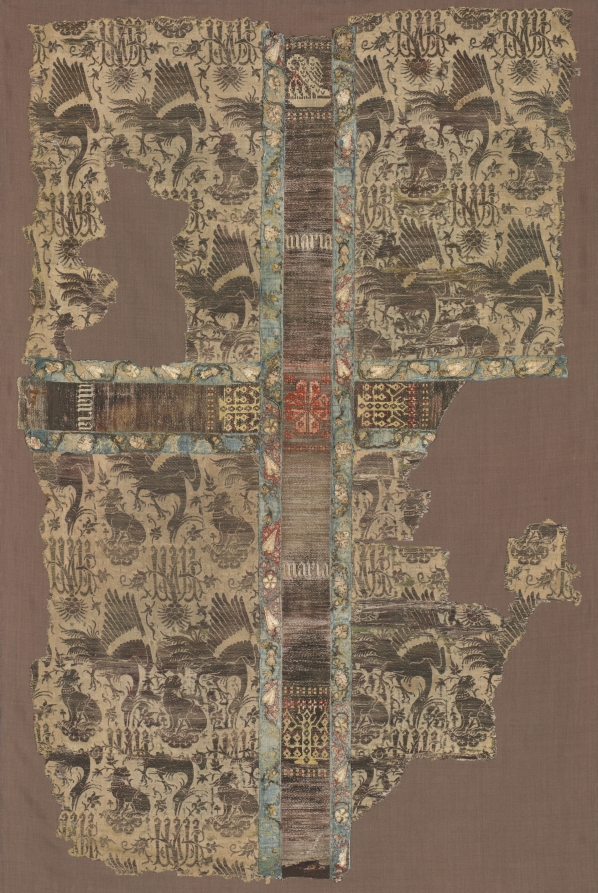
Heritage Research Artifact: Fragmentary Chasuble with Woven Orphrey Band
Introduction: The Vestige of Imperial Craft
This artifact, a fragmentary chasuble with a woven orphrey band, represents a singularly important survival from the late medieval or early Renaissance period, likely dating to the 15th or early 16th century. Its materiality—silk—immediately situates it within the legacy of imperial silk weaving, a tradition that spanned the Byzantine, Islamic, and Western European courts. The chasuble, a liturgical vestment worn by priests during the Eucharist, was not merely a garment but a vessel of theological meaning and political prestige. The orphrey band, a decorative strip of woven silk, often depicted saints, biblical scenes, or heraldic motifs, serving as a narrative focal point. In its fragmentary state, this piece offers a rare, unmediated glimpse into the technical mastery and symbolic weight of silk as a medium of power, faith, and artistry.
As a Senior Heritage Specialist at the Lauren Fashion Heritage Lab, I approach this artifact not as a relic of static history but as a dynamic document of material culture. The chasuble’s silk fabric, woven with intricate patterns, speaks to the sophisticated looms of imperial workshops—whether in Lucca, Venice, or the Byzantine Empire—where silk was a monopoly of the elite. The orphrey band, often woven separately and applied, exemplifies the intersection of textile art and religious iconography. This paper will dissect the artifact’s materiality, its historical context within imperial silk weaving, and its broader implications for understanding the transmission of luxury textiles across cultures.
Materiality: The Silk Thread as Imperial Currency
The chasuble’s primary material, silk, was the most coveted textile in pre-industrial Eurasia. Its production, originating in China, was a closely guarded secret for millennia. By the 6th century, the Byzantine Empire had established its own silk industry, centered in Constantinople, where imperial workshops—the gynaecia—produced silks for court and church. The fragmentary nature of this chasuble reveals the weave structure: a compound twill or lampas weave, typical of high-status ecclesiastical textiles. The warp-faced satin ground, often in a deep crimson or sapphire, would have been dyed with kermes or indigo, pigments sourced from distant trade routes. The orphrey band, woven with gold thread (likely gilded silver or gold-wrapped silk), would have shimmered in candlelight, reinforcing the vestment’s sacred aura.
The technical precision of the weave is paramount. The silk threads are fine, uniform, and tightly packed, indicating the use of a drawloom, a technology that allowed for complex, repeating patterns. This was not a craft for the provincial weaver; it required the expertise of master artisans trained in imperial ateliers. The orphrey band, with its figural or geometric motifs, would have been woven separately on a narrower loom, then appliquéd onto the chasuble’s body. This method allowed for the integration of narrative scenes—such as the Virgin and Child or a saint’s martyrdom—without disrupting the garment’s structural integrity. The fragmentary state of the chasuble, with its missing sections, only heightens the sense of loss and the urgent need for preservation.
Context: The Legacy of Imperial Silk Weaving
Imperial silk weaving was not merely a craft; it was a geopolitical instrument. In Byzantium, silk was a state monopoly, used for diplomatic gifts, ecclesiastical vestments, and imperial regalia. The Book of the Eparch (10th century) regulated the silk trade, ensuring that only authorized workshops produced the finest grades. This legacy continued in the Islamic world, where the Umayyad and Abbasid caliphates established tiraz factories, weaving silk with inscriptions of the ruler’s name and blessings. By the 13th century, Italian city-states like Lucca and Venice had mastered silk weaving, producing textiles that rivaled their Eastern predecessors. The orphrey band on this chasuble, with its intricate patterns, likely reflects this cross-cultural exchange—a fusion of Byzantine iconography, Islamic geometric motifs, and Western European heraldry.
The chasuble itself, as a liturgical garment, embodies the intersection of imperial and ecclesiastical power. In the medieval Church, vestments were often donated by monarchs or nobles as acts of piety and political patronage. A chasuble woven with imperial silk and adorned with gold orphrey bands was a statement of wealth and devotion. The fragmentary nature of this piece suggests it may have been repurposed or damaged over centuries, perhaps during the Reformation or the dissolution of monasteries, when such vestments were stripped of their precious materials or discarded. Its survival, however incomplete, is a testament to the enduring value of silk as a material that transcends time.
Preservation and Interpretation: The Role of the Heritage Lab
At the Lauren Fashion Heritage Lab, our mission is to preserve and interpret such artifacts through a multidisciplinary lens. The fragmentary chasuble presents unique challenges: the silk is fragile, prone to light damage and desiccation; the gold thread may tarnish; the orphrey band may detach. Conservation efforts must balance stabilization with minimal intervention, using archival storage and controlled environments. However, the artifact’s value extends beyond its physical state. Through digital imaging, spectral analysis, and historical research, we can reconstruct its original appearance, trace its provenance, and understand its role in the broader narrative of imperial silk weaving.
The orphrey band, in particular, offers a rich field for iconographic analysis. If it depicts a specific saint or biblical scene, we can date the chasuble more precisely and link it to a particular workshop or patron. The weave structure and dye composition can be compared to other surviving examples, such as the Palliotto of St. John Lateran or the Chasuble of St. Thomas Becket at Sens Cathedral. Such comparisons reveal the diffusion of silk-weaving techniques across Europe and the Mediterranean. Moreover, the fragmentary state of this chasuble invites reflection on the nature of heritage itself: what is lost, what remains, and how we reconstruct meaning from fragments.
Conclusion: A Fragmentary Legacy, A Complete Responsibility
This fragmentary chasuble with its woven orphrey band is more than a relic; it is a material embodiment of the imperial silk legacy. Its silk threads carry the stories of Byzantine workshops, Islamic tiraz factories, and Italian looms. Its orphrey band speaks to the theological and political narratives that shaped medieval Europe. As a heritage specialist, I see this artifact as a call to action: to preserve not only the physical object but also the knowledge systems that produced it. The Lauren Fashion Heritage Lab is committed to this task, ensuring that the legacy of imperial silk weaving—fragmentary though it may be—continues to inform and inspire future generations.
In the spirit of London’s Savile Row, where craftsmanship and heritage are paramount, we treat this chasuble with the reverence it deserves. It is a bespoke creation of its time, tailored for the divine and the imperial. Its fragments are not a sign of decay but a testament to survival. And in its survival, we find a thread connecting us to a world of unparalleled artistry and ambition.