An Heirloom of the Loom: Deconstructing the Legacy of Imperial Silk Weaving Through a Singular Fragment
In the hushed, wood-panelled ateliers of Savile Row, where the air is thick with the scent of fine worsteds and the quiet hum of decades-old sewing machines, we speak of provenance. We speak of lineage. A bolt of cloth is not merely a length of fabric; it is a document, a testament to a specific time, a specific hand, and a specific standard of excellence. The artifact under examination today—a single, carefully preserved fragment of imperial silk—embodies this philosophy with a gravity that transcends its modest dimensions. It is a material witness to a world where weaving was not a trade but a statecraft, where the loom was an instrument of power, and where the very threads were imbued with the authority of an empire.
Materiality and the Language of the Loom
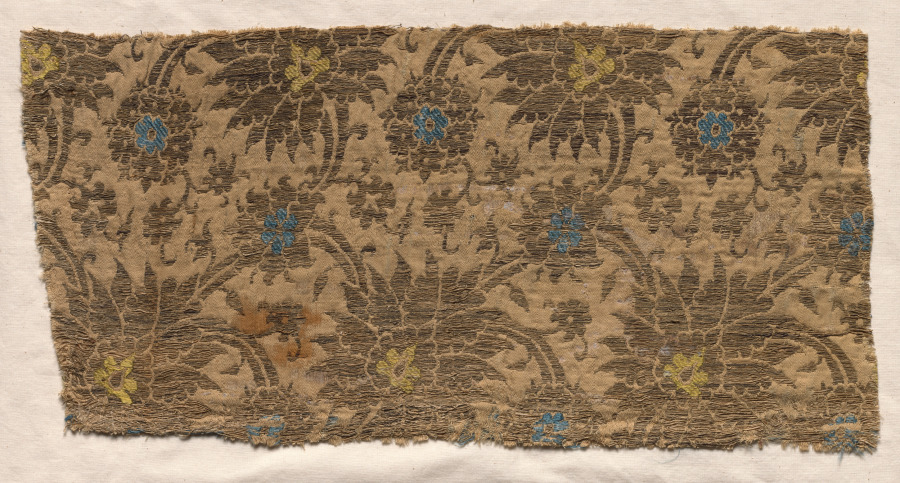
The fragment, measuring approximately 30 by 40 centimetres, is a study in disciplined opulence. The base weave is a satin ground, its surface a mirror of deep, resonant indigo—a colour historically derived from the indigofera plant, a pigment of immense value and symbolic weight in imperial China. The warp and weft are of the finest mulberry silk (Bombyx mori), a filament so continuous and lustrous that it catches the light with a liquid, almost metallic sheen. This is not the silk of a provincial workshop; it is the product of the Imperial Silk Workshops of Suzhou or Nanjing, centres of production that were as closely guarded as the imperial treasury itself. The density of the weave is exceptional, with over 200 threads per centimetre, a technical feat that speaks to the mastery of the weaver and the exacting standards of the court. The fragment’s edges are cleanly cut, suggesting it was once part of a larger garment—perhaps a dragon robe (longpao) or a ceremonial hanging—before being preserved as a sample or a remnant of a specific commission.
Pattern and the Grammar of Power
The design woven into the silk is not merely decorative; it is a coded language of authority. The fragment features a repeating pattern of five-clawed dragons (mang) chasing the flaming pearl of wisdom and spiritual energy across a field of stylised clouds and auspicious symbols. The dragons are rendered in a gold-wrapped thread—a core of silk filament encased in a thin strip of beaten gold leaf—a technique known as jinyu or “gold thread.” The gold is not a mere accent; it is a declaration. In the hierarchy of imperial textiles, the number of claws on a dragon was strictly regulated. The five-clawed dragon was the exclusive prerogative of the Emperor, his immediate family, and the highest-ranking members of the court. To wear a five-clawed dragon without imperial sanction was an act of treason. The precision of the pattern—the dragons’ sinuous bodies perfectly aligned, their claws grasping the pearl with a dynamic symmetry—indicates the use of a drawloom, a complex apparatus requiring two weavers: one to operate the treadles and one to pull the pattern cords. This was a collaborative art form, a dance of human skill and mechanical ingenuity that produced textiles of a quality that modern power looms, for all their efficiency, cannot replicate.
Context: The Silk Road and the Imperial Mandate
To understand this fragment is to understand the Silk Road not as a single route but as a vast, interconnected system of trade, diplomacy, and cultural exchange. For over two millennia, Chinese silk was the ultimate luxury commodity, a currency of empire. The Han Dynasty (206 BCE–220 CE) established the first official silk routes, sending caravans laden with bolts of silk westward in exchange for horses, jade, and glass. By the time of the Ming (1368–1644) and Qing (1644–1912) dynasties, the production of silk had been centralised under the Imperial Household Department, which managed vast workshops employing thousands of artisans. The silk woven in these workshops was not for commerce; it was for the state. It was used to clothe the Emperor, to bestow upon loyal officials as a mark of favour, and to gift to foreign emissaries as a symbol of Chinese supremacy. The fragment in our possession likely dates from the Qianlong period (1735–1796) of the Qing Dynasty, a golden age of textile production when the imperial workshops reached their zenith of technical and artistic achievement. The Qianlong Emperor was a passionate patron of the arts, and his reign saw the creation of some of the most intricate and luxurious silks ever woven.
Preservation and the Art of the Fragment
The fragment’s survival is itself a story. It has been preserved in a silk-lined archival box, protected from light and humidity, its colours still vibrant after centuries. The gold thread, remarkably, has not tarnished, a testament to the purity of the metal and the skill of the thread-makers. The silk itself retains a supple, almost fluid quality, a sign that it has not been over-handled or exposed to the degrading effects of pollution. In the context of a heritage research lab, this fragment is not a relic to be admired from a distance; it is a primary source. Through microscopic analysis, we can identify the species of silkworm, the twist of the thread, the type of mordant used to fix the indigo dye. Through spectral imaging, we can reveal the under-drawing of the pattern, the weaver’s initial sketches hidden beneath the surface. Each piece of data adds a layer to the narrative, transforming the fragment from a beautiful object into a historical document.
Conclusion: The Thread That Binds
For the gentleman of Savile Row, a suit is a bespoke creation, a collaboration between client and tailor that results in a garment of singular fit and character. This silk fragment is the ultimate bespoke—a textile commissioned by an emperor, woven by a master, and worn by a man whose word was law. It reminds us that the finest cloth is never just cloth. It is a record of human ambition, of technical mastery, and of the enduring human desire to clothe ourselves in meaning. As we handle this fragment, we are not merely conservators of a material; we are custodians of a legacy. The thread that binds us to this past is fragile, but it is unbroken. And it is our duty to ensure that it remains so for the generations of weavers, scholars, and connoisseurs yet to come.