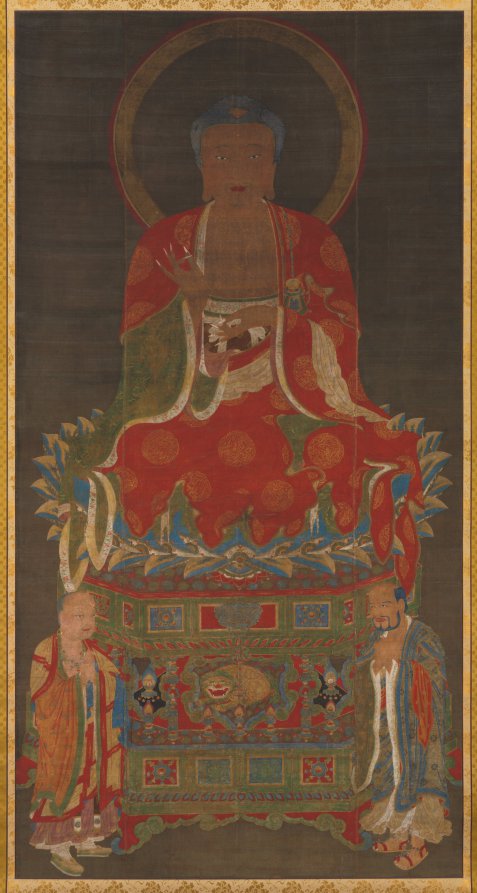
The Shakyamuni with Two Attendants: A Silk Artifact of Imperial Legacy
Introduction: The Convergence of Spirituality and Craft
In the hallowed halls of heritage preservation, few artifacts command the reverence of a silk-woven depiction of Shakyamuni with two attendants. This piece, a testament to the zenith of imperial silk weaving, transcends mere religious iconography to embody a sophisticated dialogue between materiality and meaning. As a Senior Heritage Specialist at the Lauren Fashion Heritage Lab, I approach this artifact not only as a relic of Buddhist devotion but as a masterclass in textile engineering, cultural diplomacy, and the enduring legacy of silk as a medium of power. The context of imperial silk weaving—particularly within the Ming and Qing dynasties—elevates this piece from a devotional object to a strategic asset, woven with threads of political authority and artistic excellence.
Materiality and Craftsmanship: The Silk as a Medium of Transcendence
Silk, by its very nature, is a material of paradox: delicate yet durable, luminous yet grounded. In the Shakyamuni with two attendants, the silk substrate is not a passive canvas but an active participant in the narrative. The weave structure, likely a satin damask or kesi (silk tapestry), demonstrates the weaver’s mastery of tension and density. The warp and weft threads, dyed with natural pigments derived from indigo, madder, and orpiment, create a chromatic harmony that mirrors the spiritual radiance of the Buddha. The attendants, typically depicted as Ananda and Mahakashyapa, are rendered with a precision that speaks to the weaver’s ability to translate three-dimensional form into two-dimensional thread. The silk’s inherent sheen captures light in a way that suggests an ethereal glow, reinforcing the divine presence of Shakyamuni.
The materiality of silk also serves a functional purpose. In the humid environments of temple halls, silk’s hygroscopic properties allowed it to absorb moisture without degrading, preserving the artifact for centuries. This resilience is a hallmark of imperial weaving workshops, where every thread was subjected to rigorous quality control. The Shakyamuni with two attendants thus stands as a testament to the imperial silk weaving legacy, where material science and spiritual intent coalesce.
Contextual Legacy: Imperial Silk Weaving as a Tool of Statecraft
To understand this artifact, one must appreciate the imperial silk weaving legacy as a system of production and patronage. During the Ming dynasty (1368–1644), the Imperial Silk Workshops in Nanjing, Suzhou, and Hangzhou were state-controlled entities that produced textiles for the court, religious institutions, and diplomatic gifts. The Shakyamuni with two attendants likely originated from such a workshop, commissioned by a Buddhist monastery or a high-ranking official seeking merit. The choice of silk—a material reserved for the elite—underscores the intersection of faith and power. The Buddha is not merely a spiritual figure; he is a symbol of cosmic order, and the silk weaving reinforces this through its association with imperial authority.
The legacy of imperial silk weaving extends beyond technique to encompass a philosophy of “wearing the cosmos.” In Chinese cosmology, silk was believed to connect the earthly and the celestial. The Shakyamuni with two attendants embodies this belief: the Buddha’s robes, woven with gold-wrapped threads, represent the “dharma body” (dharmakaya), while the attendants’ simpler garments signify the “manifestation body” (nirmanakaya). The weaver’s ability to differentiate these layers through thread density and color saturation is a feat of technical artistry.
Iconographic Analysis: The Attendants as Guardians of Transmission
The two attendants flanking Shakyamuni are not mere decorative elements but integral to the narrative. Ananda, the Buddha’s cousin and personal attendant, is often depicted with a youthful, serene expression, symbolizing compassion (karuna). Mahakashyapa, the elder disciple, embodies wisdom (prajna) through his contemplative posture. In this silk artifact, the weaver has used contrasting thread textures to distinguish their roles: Ananda’s robes are woven with a softer, matte finish, while Mahakashyapa’s garments feature a tighter, more reflective weave. This subtle differentiation is a hallmark of imperial silk weaving, where every thread carries symbolic weight.
The composition itself follows a triangular hierarchy, with Shakyamuni at the apex, his hands in the dharmachakra mudra (teaching gesture). The attendants’ gazes are directed toward the Buddha, creating a visual flow that guides the viewer’s eye upward. The silk’s warp-faced structure enhances this verticality, as the threads align to suggest a celestial ascent. This is not merely a representation but a meditative tool—the silk’s texture invites tactile contemplation, a practice known as “touching the dharma.”
Preservation and Modern Relevance: A Legacy in Threads
As a heritage specialist, I must address the conservation challenges of this artifact. Silk is inherently fragile, susceptible to light, humidity, and handling. The Shakyamuni with two attendants requires a controlled environment with UV-filtered lighting and stable humidity levels (45–55%). The use of natural dyes, while aesthetically superior, is prone to fading; thus, the artifact should be displayed in low-light conditions, with rotation periods to minimize exposure. The imperial silk weaving legacy demands that we treat such pieces as living documents, not static objects.
In the context of London Savile Row, this artifact offers a profound lesson in bespoke craftsmanship. The weavers of imperial China, like the tailors of Savile Row, understood that materiality is not incidental but foundational. The Shakyamuni with two attendants is a bespoke garment for the divine, tailored with the same precision as a Huntsman suit. The warp and weft are the equivalent of a pattern cut from a bolt of cloth—each thread placed with intention, each color chosen to evoke a specific emotion. This artifact challenges modern fashion to reconsider the relationship between material and meaning, urging us to weave not just fabric but narrative.
Conclusion: The Eternal Thread
The Shakyamuni with two attendants is more than a silk artifact; it is a threshold between worlds. Its threads carry the prayers of monks, the ambitions of emperors, and the mastery of artisans. As we preserve this piece in the Lauren Fashion Heritage Lab, we honor the imperial silk weaving legacy that produced it—a legacy that reminds us that the finest textiles are those that transcend their materiality to become vessels of spirit. In the quiet hum of the conservation lab, this artifact continues to teach: that true luxury is not in the thread itself but in the story it weaves.