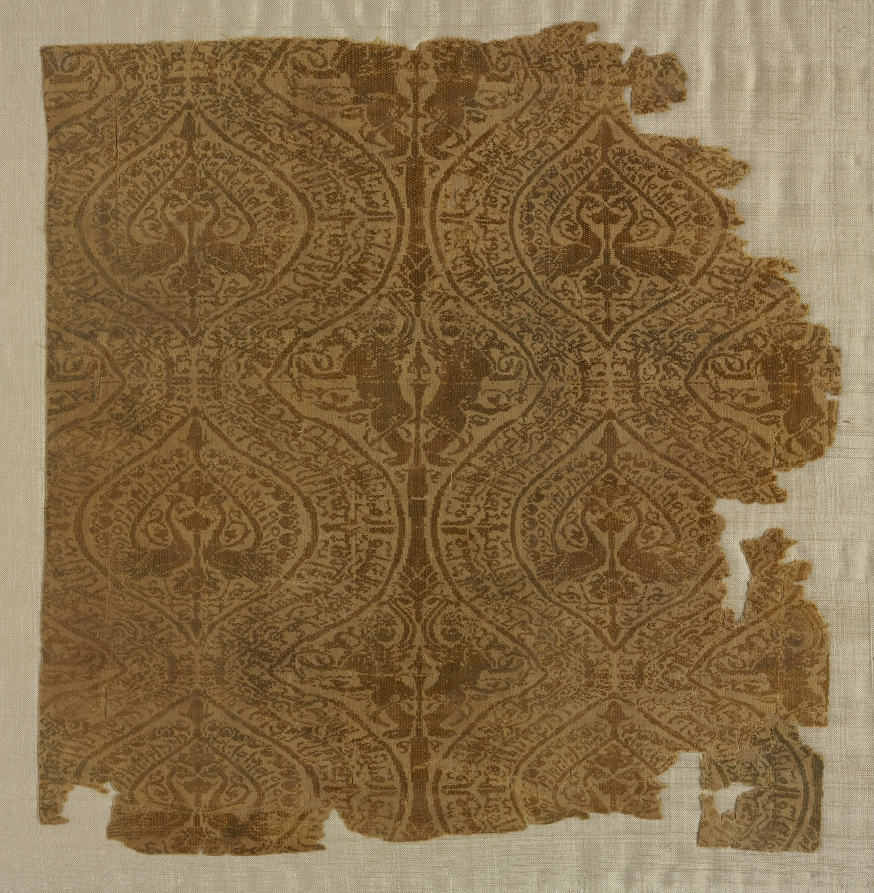
The Fragment with Peacocks in Ogival Pattern: A Study in Imperial Silk Weaving and Its Enduring Legacy
Introduction: The Artifact as a Testament to Craft
As a Senior Heritage Specialist at Lauren Fashion Heritage Lab, I have the privilege of examining artifacts that transcend mere fabric to become narratives of power, artistry, and economic might. The Fragment with Peacocks in Ogival Pattern, rendered in silk, is one such piece. This fragment, likely dating from the late 16th to early 17th century, originates from the Safavid or Mughal imperial workshops—centers of silk weaving that rivaled the finest ateliers of Renaissance Europe. Its materiality is not incidental; silk, a fiber of unparalleled lustre and strength, was the chosen medium for dynastic expression. The fragment’s survival offers a rare window into the legacy of imperial silk weaving, a tradition that shaped global trade, sartorial codes, and the very definition of luxury for centuries.
In the context of London’s Savile Row—a district synonymous with bespoke tailoring and uncompromising quality—this fragment resonates deeply. Savile Row’s ethos of precision, heritage, and material integrity finds a parallel in the imperial looms of Isfahan or Lahore. Here, the weaver’s hand and the designer’s eye converged to produce textiles that were not merely decorative but emblematic of sovereignty. The peacock, a motif of celestial beauty and regal authority, and the ogival pattern, a geometric framework of infinite repetition, together create a visual language that speaks to order, opulence, and eternity.
Materiality: The Silk Thread as Imperial Currency
Silk’s journey from the cocoon of the Bombyx mori moth to the loom is a story of meticulous labor and technological mastery. The Fragment with Peacocks exemplifies the highest grade of silk—a filament of continuous, unbroken length, known as “filature” silk. This material, when woven, produces a surface that is both supple and luminous, capable of capturing light in a way that mimics the iridescence of a peacock’s plumage. The fragment’s weave structure, likely a compound twill or lampas, allowed for the integration of multiple warp and weft threads, creating a dense, durable fabric that could withstand the rigors of courtly use—whether as a robe, a hanging, or a ceremonial cloth.
The legacy of imperial silk weaving is inextricably linked to the control of this material. From the Silk Road’s caravans to the East India Company’s ships, silk was a currency of power. The Safavid shahs, for instance, established royal workshops (karkhanas) where master weavers, often prisoners of war or skilled artisans from conquered territories, produced textiles for the court and for diplomatic gifts. The Mughal emperors, too, patronized silk weaving as a means of asserting cultural and political dominance. The Fragment with Peacocks embodies this imperial ambition: its silk threads are not just fibers but conduits of authority, woven into a pattern that would have been immediately recognizable as a mark of elite status.
The Ogival Pattern: Geometry and Symbolism
The ogival pattern—a repeating, pointed arch form—is a hallmark of Islamic and Persian textile design. Its origins lie in architectural motifs, where the ogee arch symbolized the transition from the earthly to the divine. In the Fragment with Peacocks, the ogival framework serves as a structural grid, within which the peacocks are symmetrically arranged. This pattern is not merely decorative; it reflects a deep understanding of proportion and repetition, principles that resonate with Savile Row’s approach to tailoring. Just as a bespoke suit relies on precise measurements and balanced proportions, the ogival pattern imposes order on the fabric’s surface, creating a rhythm that guides the eye and enhances the textile’s visual impact.
The peacock, meanwhile, is a motif laden with meaning. In Persian and Mughal iconography, the peacock is associated with immortality, beauty, and the celestial realm. It appears in garden scenes, symbolizing paradise, and in courtly settings, representing the emperor’s divine right to rule. The juxtaposition of the peacock with the ogival pattern creates a dialogue between the organic and the geometric, the natural and the man-made. This tension is central to the fragment’s aesthetic power: the peacocks, with their flowing tails and intricate detailing, seem to move within the rigid confines of the arches, suggesting a world where nature is tamed but not subdued.
Context: The Legacy of Imperial Silk Weaving
To fully appreciate the Fragment with Peacocks, one must understand the broader legacy of imperial silk weaving. This tradition was not static; it evolved through cross-cultural exchange, technological innovation, and shifting political landscapes. The Safavid and Mughal empires, for example, borrowed techniques from Chinese silk weavers, such as the use of gold and silver threads (zar-baft), and adapted them to local tastes. The result was a hybrid aesthetic that combined Persian floral motifs with Chinese cloud bands and Indian animal forms. The Fragment with Peacocks reflects this synthesis: the peacock, while native to South Asia, is rendered in a Persianate style, with elongated forms and intricate patterning.
The legacy also extends to the economic and social structures that sustained silk weaving. Imperial workshops were hierarchical, with master weavers, dyers, and designers working under royal patronage. The skills required to produce a fragment like this were passed down through generations, often within family guilds. This tradition of craftsmanship mirrors the apprenticeship model of Savile Row, where tailors spend years perfecting their art. The fragment, therefore, is not just a product of its time but a link in a chain of knowledge that continues to inform contemporary luxury.
Conclusion: The Fragment’s Relevance to Modern Heritage
In the context of Lauren Fashion Heritage Lab, the Fragment with Peacocks in Ogival Pattern serves as a touchstone for understanding the enduring principles of quality, design, and cultural significance. Its silk materiality, its geometric precision, and its symbolic depth offer lessons for modern fashion: that luxury is not merely about expense but about intention, that pattern can convey meaning, and that heritage is a living dialogue between past and present. For Savile Row, this fragment is a reminder that the pursuit of perfection is a timeless endeavor, one that requires respect for materials, mastery of technique, and an eye for the extraordinary. As we preserve and study such artifacts, we honor the legacy of imperial silk weaving and ensure that its lessons continue to inspire future generations of artisans and designers.