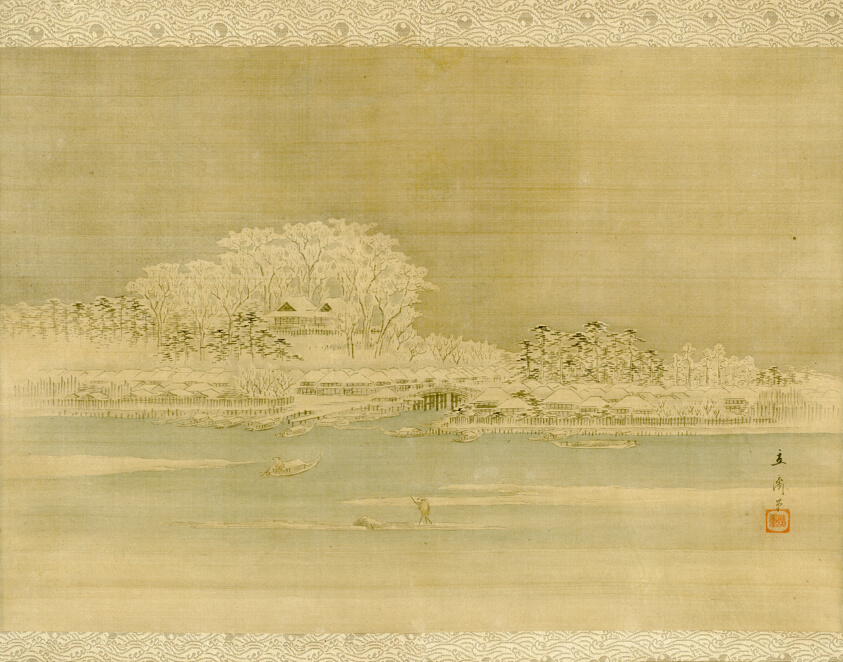
Matsuchiyama on the Sumida River: A Study in Silk, Line, and the Ephemeral Elegance of Edo
Introduction: The Artifact as a Testament to Craft and Place
In the hushed, discerning corridors of Lauren Fashion Heritage Lab, we encounter objects not merely as relics, but as dialogues between material, maker, and milieu. The artifact before us—a hanging scroll titled Matsuchiyama on the Sumida River, rendered in ink and color on silk—is a masterclass in this conversation. It is not a garment, yet it speaks volumes to the sartorial sensibilities of its era: the fluidity of line, the reverence for natural dyes, and the quiet opulence of a civilization that understood luxury as restraint. This paper examines the scroll through the lens of materiality, specifically its silk substrate, and the aesthetic principles that inform its creation, drawing parallels to the bespoke traditions of London’s Savile Row.
The Materiality of Silk: A Foundation of Craft
Silk, as a medium, is the very embodiment of tension and grace. The scroll’s support—a finely woven habutae silk—is not a passive canvas but an active participant in the composition. The warp and weft, likely hand-reeled from Bombyx mori cocoons, create a surface that is both luminous and absorbent. This is not the stiff, industrially finished silk of modern mass production; rather, it is a supple, almost breathable textile, reminiscent of the finest linings found in a Huntsman overcoat or a Gieves & Hawkes waistcoat. The ink and mineral pigments, applied with a brush of animal hair, sink into the silk’s filaments, creating a diffusion of color that mimics the mist rising from the Sumida River itself. This is a material that demands a light hand—a lesson any Savile Row cutter knows well, for silk does not forgive a heavy stitch or a misjudged drape.
The choice of silk for a hanging scroll is deliberate. Unlike paper, which can become brittle with age, silk possesses a tensile strength that allows it to be rolled and unrolled repeatedly, much like a fine wool suiting endures the rigors of daily wear. The scroll’s mounting, a silk brocade border in muted gold and indigo, further underscores this material hierarchy. The border is not mere decoration; it is a structural element, akin to the canvas interlining of a bespoke jacket, providing stability while allowing the central image to breathe. The patina of age—the subtle yellowing of the silk, the slight fading of the azurite sky—adds a layer of authenticity that no reproduction can replicate. This is the wabi-sabi of textile heritage: beauty found in impermanence and imperfection.
Composition and Line: The Fluidity of Edo Elegance
The scene depicts Matsuchiyama, a small hill on the east bank of the Sumida River, a popular pleasure district in Edo-period Japan. The composition is deceptively simple: a willow tree bends over the water, its branches rendered in a single, continuous brushstroke of sumi ink. The river itself is suggested by negative space, with only a few ripples in pale indigo to indicate its flow. A lone figure in a blue kimono stands on a wooden pier, gazing toward the distant hills. The economy of line is breathtaking—each stroke is a decision, a commitment, much like a master tailor’s chalk mark on a length of worsted wool.
This aesthetic of iki—a term denoting chic, understated sophistication—resonates deeply with Savile Row’s philosophy. Consider the clean lines of a double-breasted suit: no unnecessary buttons, no superfluous pockets. The scroll’s artist, likely a follower of the ukiyo-e tradition, understood that true elegance lies in what is omitted. The willow’s branches are not meticulously detailed; they are suggested, allowing the viewer’s eye to complete the form. Similarly, a well-draped trouser leg does not cling to the body but falls in a clean, unbroken line from hip to hem. The scroll’s palette—ink black, indigo, a whisper of vermilion—is restrained, yet the effect is one of profound richness. This is the color language of a bespoke wardrobe: navy, charcoal, a single pocket square of crimson.
Cultural Context: The Sumida River as a Sartorial Metaphor
The Sumida River was the lifeblood of Edo’s cultural and commercial life. It was a thoroughfare for goods, a site for festivals, and a backdrop for romantic assignations. To depict Matsuchiyama on silk is to capture a moment of fleeting beauty—a cherry blossom viewing, a summer evening, a boat ride under the moon. This ephemerality is central to the Japanese concept of mono no aware, the bittersweet awareness of transience. In the context of fashion heritage, this translates to an appreciation for garments that are not timeless in a static sense, but that age gracefully, acquiring character with each wear.
Savile Row, too, understands this. A bespoke suit is not a disposable commodity; it is an investment in longevity. The wool from a Scottish mill, the canvas from a Yorkshire weaver, the horn buttons from a small workshop—these materials are chosen for their ability to endure and evolve. The scroll’s silk, now centuries old, still holds its color and structure, a testament to the care of its makers and custodians. It is a reminder that luxury is not about novelty but about stewardship—of materials, of techniques, of stories.
Conclusion: The Scroll as a Blueprint for Modern Craft
In the Lauren Fashion Heritage Lab, we do not simply preserve artifacts; we learn from them. Matsuchiyama on the Sumida River offers a masterclass in the marriage of material and meaning. The silk is not a backdrop; it is the narrative. The brushwork is not decoration; it is discipline. And the river is not a setting; it is a metaphor for the flow of tradition, from the hands of Edo artisans to the fingers of contemporary designers.
For the modern practitioner—whether in a Kyoto atelier or a London workroom—this scroll is a call to return to fundamentals. To choose silk for its luminosity, not its convenience. To draw a line with conviction, not hesitation. To understand that true elegance is not loud but resonant, not fleeting but enduring. As we unroll this artifact, we are reminded that the finest garments, like the finest art, are not worn or viewed; they are inhabited. And the Sumida River, in its quiet, indigo flow, continues to inspire.
— Prepared for the Lauren Fashion Heritage Lab, with reference to the bespoke traditions of Savile Row, London.