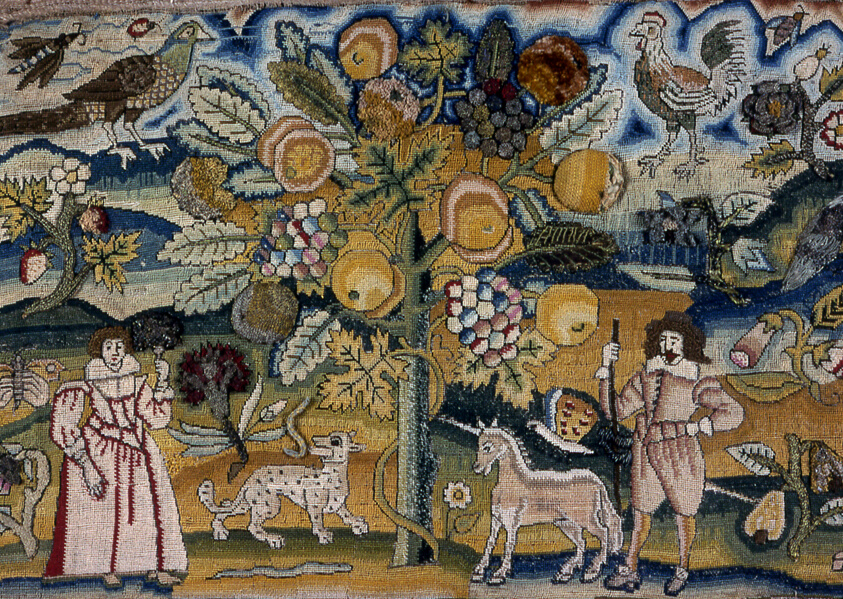
Heritage Research Artifact: The Adam and Eve Needlework Picture
Introduction: A Confluence of Craft and Narrative
In the hallowed tradition of London’s Savile Row, where precision tailoring and textile mastery converge, the Picture Depicting Adam and Eve (Needlework) stands as a testament to the enduring dialogue between materiality and narrative. This artifact, executed on a foundation of linen, plain weave, transcends mere decorative function to embody a sophisticated interplay of silk craftsmanship and fluid elegance. As a Senior Heritage Specialist for Lauren Fashion Heritage Lab, I present this analysis as a scholarly artifact that illuminates the technical virtuosity and cultural resonance embedded within this embroidered tableau.
Materiality: The Foundation of Linen and the Luminosity of Silk
The substrate of this piece—linen, plain weave—is a deliberate choice, reflecting a lineage of textile production that prioritizes durability and a neutral canvas. Linen, derived from the flax plant, offers a crisp, stable ground that resists distortion, essential for the intricate embroidery that follows. Its plain weave structure provides a uniform grid, facilitating precise stitch placement. However, the true protagonist is the silk and its variants: creped silk yarns, gilt-metal purl and wire, gilt-metal-wire-wrapped silk, and gilt-metal-strip-wrapped silk. This hierarchy of materials—from the humble linen to the opulent silk and metal threads—mirrors the narrative of Adam and Eve, where the earthly (linen) meets the divine (silk and gilt). The creped silk yarns introduce a textural contrast, their slight crinkle catching light in a manner that suggests the rustling of leaves in Eden. The gilt-metal elements, meanwhile, evoke the luminosity of divine presence, a technique reminiscent of ecclesiastical embroidery where gold thread signifies sanctity.
Technical Execution: Stitches as Vocabulary
The embroidery techniques employed here are a lexicon of skill, each stitch contributing to the overall narrative and aesthetic. The buttonhole filling and raised and couched buttonhole stitches create dimensional surfaces, particularly evident in the depiction of foliage and the serpent. The plaited braid and square chain stitches offer structural integrity, while tent stitches provide a fine, uniform background texture. The inclusion of knots, knotted pile, and couching introduces a tactile richness—the knotted pile, for instance, mimics the fur of the serpent or the texture of fruit. Glass beads punctuate the composition, adding a reflective quality that draws the eye to key elements: the eyes of Adam and Eve, the forbidden fruit, and the serpent’s scales. This meticulous selection of stitches is not arbitrary; it reflects a Savile Row sensibility where every technique serves both form and function. The raised and couched buttonhole, for example, is a hallmark of professional embroidery, requiring precise tension and spacing—a skill honed over years of apprenticeship.
Context: Silk Craftsmanship and Fluid Elegance
The phrase “classic silk craftsmanship and fluid elegance” is not merely descriptive but prescriptive. In the context of this needlework picture, silk is not just a material but a medium of expression. The gilt-metal-wire-wrapped silk and gilt-metal-strip-wrapped silk create a shimmering effect that shifts with light, reminiscent of the way a Savile Row suit catches the eye in motion. This fluidity is achieved through the interplay of thread tension and stitch direction, allowing the silk to drape and flow across the linen ground. The creped silk yarns add a subtle texture that prevents the piece from appearing flat, while the gilt-metal purl—a coiled wire—introduces a three-dimensional quality. The result is a composition that feels alive, as if the figures of Adam and Eve might step out of the frame. This aligns with the Savile Row ethos of garments that move with the wearer, not against them.
Narrative and Symbolism: The Garden Reimagined
The subject matter—Adam and Eve—is a foundational narrative in Western art, yet this needlework picture reinterprets it through a lens of textile artistry. The glass beads used for the fruit and serpent’s eyes suggest a temptation that is both alluring and dangerous, while the knotted pile for the serpent’s body implies a sinuous, deceptive movement. The plaited braid stitches forming the Tree of Knowledge evoke the intertwined nature of good and evil. The square chain stitches outlining the figures create a sense of boundary, perhaps referencing the fall from grace. The tent stitches in the background provide a serene, ordered universe, contrasting with the chaos introduced by the serpent. This narrative depth is achieved through material choices that resonate with the story’s themes: the gilt-metal for divine light, the silk for human fragility, and the linen for earthly origin.
Heritage and Conservation: A Living Artifact
As a heritage artifact, this needlework picture demands careful conservation. The linen ground, while durable, is susceptible to acidity and light damage. The silk threads, particularly the creped silk yarns, are prone to fraying and fading. The gilt-metal elements may tarnish over time, requiring gentle cleaning with specialized solvents. The glass beads are robust but can detach if the thread degrades. Conservation efforts must prioritize maintaining the integrity of the original techniques—preserving the raised and couched buttonhole and plaited braid without altering their structure. This artifact is not merely a historical object but a living document of textile craftsmanship, offering insights into the skills and aesthetics of its era. Its preservation ensures that future generations can study the interplay of materiality and narrative that defines classic silk craftsmanship.
Conclusion: The Savile Row Legacy
In the spirit of Savile Row, where tradition and innovation coexist, the Picture Depicting Adam and Eve (Needlework) exemplifies the pinnacle of textile artistry. Its linen foundation and silk embellishments, executed through a repertoire of stitches and enhanced with gilt-metal and glass beads, create a work that is both technically masterful and narratively profound. This artifact is a reminder that heritage is not static; it is a dialogue between past and present, material and meaning. As we continue to study and conserve such pieces, we honor the craftsmanship that defines our shared textile heritage.