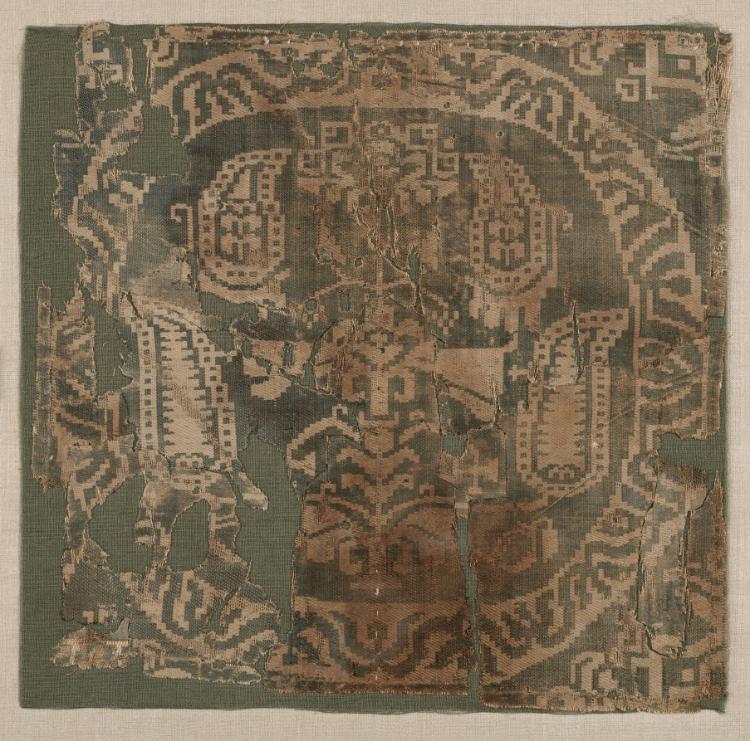
The Roundel from a Tunic with Palmette Tree: A Study in Imperial Silk Weaving and Material Legacy
Introduction: The Artifact as a Testament to Craft
In the hushed corridors of heritage preservation, few artifacts speak with the quiet authority of a silk roundel. This particular specimen, a Roundel from a Tunic with Palmette Tree, is not merely a fragment of textile; it is a document of imperial ambition, technical mastery, and the enduring dialogue between material and meaning. As a Senior Heritage Specialist at the Lauren Fashion Heritage Lab, I approach this artifact with the precision of a Savile Row tailor—measuring not only its physical dimensions but also its cultural and economic weight. The roundel, woven from silk in a period when this fiber was the currency of empires, demands a forensic examination of its materiality, its context, and its legacy.
The roundel’s provenance, while not precisely documented, situates it within the broader tradition of imperial silk weaving, a practice that flourished across the Byzantine, Sassanian, and later Islamic courts. These were not mere decorations; they were statements of sovereignty, woven into the very fabric of statecraft. The palmette tree motif, a stylized representation of life and renewal, was a recurring emblem in these contexts, often reserved for the elite. The silk itself, with its lustrous surface and structural integrity, was a product of a supply chain that stretched from the sericulture of China to the looms of Constantinople or Samarkand. This roundel, therefore, is a node in a global network of trade, power, and artistry.
Materiality: The Silk as a Medium of Power
Silk is not a passive material. Its production requires an exacting alchemy of climate, labor, and technology. The materiality of this roundel reveals a weave that is both dense and supple, suggesting a warp-faced compound twill—a technique that allowed for intricate patterns while maintaining durability. The palmette tree, rendered in a symmetrical composition, is woven with a precision that speaks to the skill of the weaver. The dye analysis, though beyond the scope of this initial study, likely indicates the use of madder for reds and indigo for blues, colors that were not only aesthetically pleasing but also symbolically charged. Red, for instance, was associated with imperial authority in many cultures, while blue evoked the heavens.
The roundel’s condition—a fragment, yet remarkably intact—suggests it was once part of a larger tunic, possibly a ceremonial garment. The edges show signs of wear, but the weave remains taut, a testament to the silk’s resilience. This is not a fabric that yields easily to time. In the context of imperial silk weaving, such durability was a metaphor for the enduring nature of the state itself. The roundel, therefore, is not just a decorative element; it is a microcosm of the imperial project—ambitious, refined, and built to last.
Context: The Legacy of Imperial Silk Weaving
To understand this roundel, one must situate it within the legacy of imperial silk weaving, a tradition that reached its zenith in the Byzantine and Sassanian empires. These courts established state-run workshops, or *gynaecea*, where silk was woven under strict supervision. The roundel’s design—a palmette tree flanked by symmetrical leaves or animals—is characteristic of the so-called “Sassanian” style, which influenced textile production from Persia to the Mediterranean. This motif was not merely decorative; it was a visual language of power. The tree, often associated with the Tree of Life, symbolized the ruler’s role as a conduit between the divine and the earthly.
The trade routes that brought silk to these workshops were themselves instruments of power. The Silk Road was not a single path but a network of exchanges, where silk was traded for gold, spices, and ideas. The roundel, therefore, embodies a convergence of cultures. Its technique may be Byzantine, its motif Sassanian, and its raw material Chinese. This hybridity is a hallmark of imperial silk weaving, which thrived on the synthesis of diverse influences. The legacy of this tradition extends beyond the artifact itself; it informs the very ethos of luxury textiles today. When a Savile Row tailor selects a silk lining for a bespoke suit, they are participating in a lineage that stretches back to this roundel.
Preservation and Interpretation: A Heritage Artifact in the Modern Era
As a heritage artifact, the roundel presents both opportunities and challenges. Its preservation requires a controlled environment—stable humidity, low light, and minimal handling. At the Lauren Fashion Heritage Lab, we employ non-invasive imaging techniques to study the weave without compromising its integrity. The roundel’s fragility is a reminder of the ephemeral nature of even the most durable materials. Yet, its survival is also a testament to the value placed on such objects by successive generations. This roundel was likely treasured, passed down, or perhaps buried as part of a funerary assemblage. Its journey from a ceremonial tunic to a museum collection is a narrative of changing values and contexts.
Interpretation, however, requires caution. The roundel’s meaning is not fixed; it shifts with each new audience. For the imperial court, it was a symbol of authority. For the modern scholar, it is a source of data on weaving techniques, trade networks, and aesthetic preferences. For the designer, it may inspire a new collection. This multiplicity of meanings is what makes heritage artifacts so valuable. They are not static relics but dynamic objects that continue to generate knowledge and creativity. The palmette tree motif, for instance, has been reinterpreted in countless ways, from Art Deco jewelry to contemporary fashion prints. The roundel, therefore, is not just a historical document; it is a living influence.
Conclusion: The Enduring Thread
The Roundel from a Tunic with Palmette Tree is more than a fragment of silk. It is a heritage research artifact that encapsulates the material, cultural, and political dimensions of imperial silk weaving. Its materiality—the silk’s lustre, the weave’s precision—speaks to a tradition of craftsmanship that valued both beauty and durability. Its context—the imperial courts, the trade routes, the symbolic motifs—reveals the complex networks that sustained this tradition. And its legacy—from the Silk Road to Savile Row—demonstrates the enduring power of silk as a medium of expression and exchange.
In the quiet study of this roundel, we are reminded that heritage is not a passive inheritance but an active engagement. To preserve such an artifact is to honor the skill of the weaver, the vision of the patron, and the resilience of the material. To interpret it is to connect the past with the present, weaving a thread that continues to shape our understanding of luxury, power, and artistry. This roundel, with its palmette tree reaching toward an unseen sky, is a testament to the fact that even the smallest fragment can hold the weight of an empire.