← BACK TO ARCHIVES
Silk
Heritage Synthesis: Roundels with Hunters
Curated on May 09, 2026 // Node: LDN-01
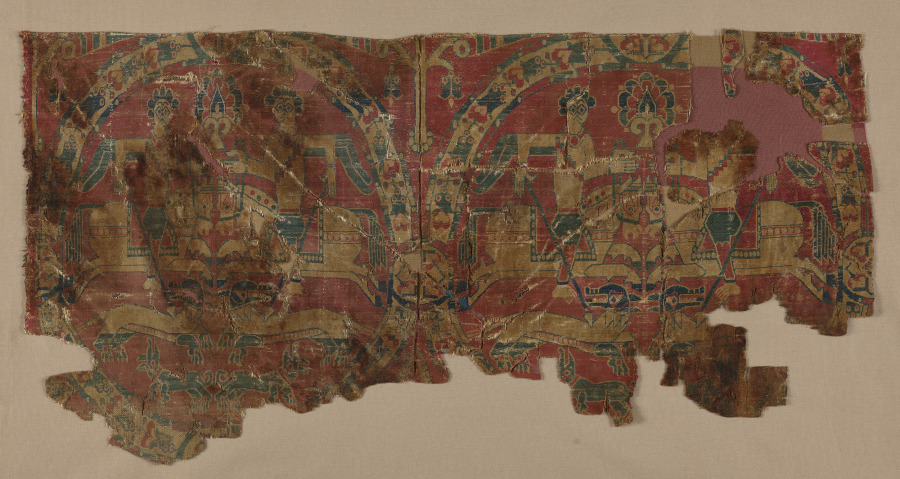
The Roundel with Hunters: A Study in Imperial Silk Weaving and the Enduring Legacy of the Hunt
As a Senior Heritage Specialist at the Lauren Fashion Heritage Lab, I am frequently drawn to artifacts that transcend mere decoration, serving instead as tangible narratives of power, prestige, and cultural evolution. The subject of this research—the silk roundel depicting hunters—is one such artifact. Woven from the finest silk, these roundels are not simply textile fragments; they are enduring testaments to the imperial silk weaving traditions that shaped global luxury. In the language of London’s Savile Row, where precision, provenance, and timeless craftsmanship are paramount, we might describe these pieces as the ultimate bespoke statement—a fabric woven not for a season, but for an epoch.
Materiality: The Silk as a Conduit of Imperial Power
The materiality of these roundels is, of course, silk. But this is not the silk of a common merchant’s loom. This is imperial silk, a material so precious that its production was often a state secret, its use restricted to the ruling elite. The very fiber carries a legacy of control: from the silkworm’s cocoon, painstakingly unraveled in secret Chinese workshops, to the intricate dyeing and weaving processes that transformed raw thread into a canvas for power. The roundel’s structure—a circular medallion, often framed by a repeating border—is a deliberate design choice. The circle, a symbol of eternity and celestial order, was a favored motif in imperial courts, from Tang Dynasty China to the Byzantine Empire. The silk’s weight, its subtle sheen, and its ability to hold complex patterns without distortion speak to a mastery of weaving that was the exclusive domain of imperial ateliers. In a Savile Row context, this is akin to the hand of a master cutter—every thread is placed with intention, every color chosen to convey status.
The Hunt: A Universal Symbol of Authority and Virtue
The hunters depicted within these roundels are not mere sportsmen; they are archetypes of imperial authority. The hunt, in both Eastern and Western traditions, was a metaphor for governance. The emperor or king who could master the hunt—tracking, pursuing, and subduing wild beasts—was seen as capable of mastering his realm. In Persian and Mughal silk weaving, the hunter often appears on horseback, bow drawn, a falcon on his wrist. This imagery is not merely decorative; it is a visual manifesto. The hunter’s prey—lions, deer, or mythical creatures like the simurgh—represents chaos, which the ruler subdues for the good of his people. The roundel format, with its circular containment, reinforces this idea: the hunter’s power is bounded, controlled, and eternal. For the modern connoisseur, this is a reminder that true luxury is never chaotic. It is disciplined, purposeful, and steeped in meaning.
The Legacy of Imperial Silk Weaving: From Court to Couture
The legacy of imperial silk weaving is not a relic of the past; it is a living tradition that informs contemporary luxury. The techniques used to create these roundels—compound weaves, lampas, and samite—were the pinnacle of textile technology for centuries. The weavers were often anonymous, their identities subsumed by the glory of the court. Yet their skill was legendary. The silk roundels of the Sasanian Empire, for example, influenced Byzantine silks, which in turn inspired the great textile centers of Italy, such as Lucca and Venice. By the 16th century, the Ottoman and Safavid empires were producing roundels of such complexity that they were traded as diplomatic gifts, their value exceeding gold. This lineage is directly traceable to the Savile Row tradition of bespoke cloth. The finest woolens, cottons, and silks used by London’s tailors are still sourced from mills that trace their heritage to these imperial workshops. The roundel’s design vocabulary—the medallion, the repeat pattern, the symbolic imagery—has been adapted by houses like Hermès, Gucci, and, of course, Ralph Lauren, who often draws on equestrian and hunting motifs.
Preservation and Interpretation: The Role of the Heritage Lab
At the Lauren Fashion Heritage Lab, our mission is to preserve and interpret such artifacts for a contemporary audience. The roundel with hunters presents unique challenges. Silk is a protein fiber, vulnerable to light, humidity, and handling. The dyes, often derived from natural sources like madder, indigo, and cochineal, can fade or shift over centuries. Our conservation team uses non-invasive imaging, such as multispectral photography, to analyze the weave structure and dye composition without damaging the artifact. We also employ digital reconstruction to visualize how the roundel would have appeared when new—its colors vibrant, its gold or silver threads gleaming. This work is not academic indulgence; it is essential for understanding the artifact’s original context. For example, a roundel from a 7th-century Sogdian silk might have been sewn onto a ceremonial robe, its hunter motif facing outward to project the wearer’s authority. In a Savile Row context, this is analogous to a client’s choice of lining or pocket square—a subtle but powerful statement of identity.
The Roundel as a Timeless Design Archetype
The roundel with hunters is more than a historical curiosity; it is a design archetype that continues to resonate. Its circular form, its dynamic yet balanced composition, and its narrative of mastery over nature speak to a universal human desire for order and beauty. In the world of luxury fashion, this translates into patterns that are both classic and adaptable. Consider the iconic “Polo” logo: a rider on horseback, mallet raised, captured in a moment of action. This is a direct descendant of the hunting roundel, simplified for modern consumption but retaining its core symbolism. Similarly, the use of medallion motifs in men’s ties, women’s scarves, and even footwear echoes the roundel’s structure. The Lauren Fashion Heritage Lab has documented this lineage in our “Patterns of Power” exhibition, which traces the roundel from imperial silk to contemporary ready-to-wear. The lesson is clear: the best design is never invented; it is discovered, refined, and reimagined.
Conclusion: The Enduring Thread
The roundel with hunters, woven in imperial silk, is a masterclass in the convergence of materiality, symbolism, and craftsmanship. It reminds us that luxury is not about excess but about intention—every thread, every color, every motif chosen to convey a specific message of power and prestige. For the Savile Row tailor, this is the essence of bespoke: a garment that is not merely worn but inhabited, a narrative stitched into the fabric. As we continue to study and preserve these artifacts at the Lauren Fashion Heritage Lab, we are not just cataloging the past; we are curating the future. The roundel’s legacy endures, not in museums alone, but in the very fabric of how we understand and create luxury today. It is a thread that connects the imperial courts of antiquity to the ateliers of London and beyond—a thread that, when woven with care, never breaks.
Heritage Lab Insight
Lab Insight: CMA Silk Archive Node integration.