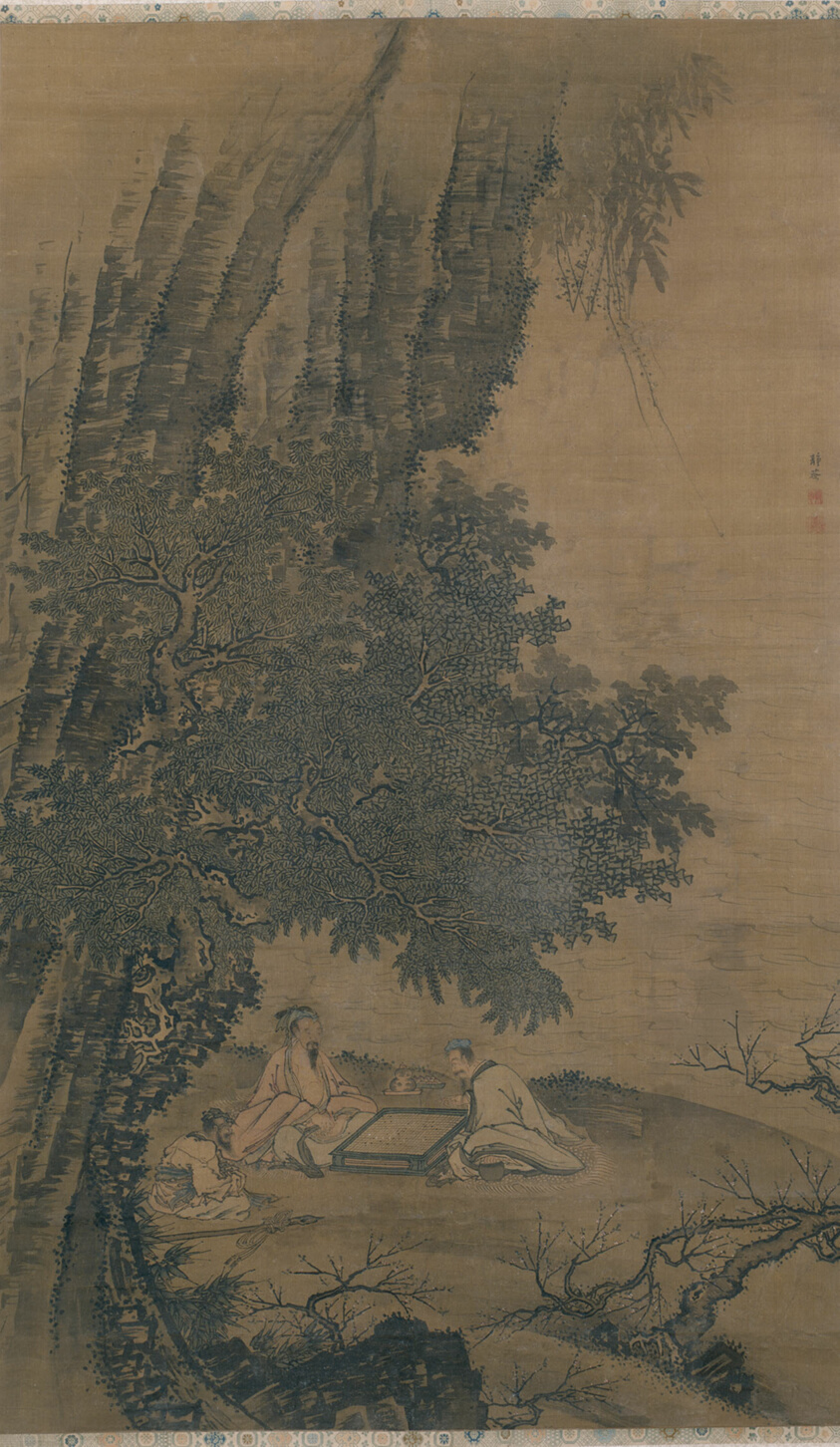
Heritage Research Artifact: Landscape with Daoist Immortals Playing Weiqi
Materiality and Provenance
This hanging scroll, executed in ink and colors on silk, represents a pinnacle of classical Chinese painting and textile craftsmanship. The materiality of silk, as the foundational substrate, is not merely a support but an active participant in the narrative. The weave is a fine, plain-weave silk, characteristic of the Ming dynasty (1368–1644) or early Qing period, with a thread count that suggests a workshop of considerable repute. The silk’s natural lustre, now mellowed by centuries of controlled aging, provides a luminous ground that enhances the translucent washes of mineral pigments—azurite, malachite, and cinnabar—applied with a fluid elegance that echoes the brushwork of the literati tradition. The scroll’s mounting, a deep indigo brocade with subtle cloud patterns, frames the painting with a restraint that speaks to the collector’s refined taste, likely from a private studio in Suzhou or Yangzhou.
In the context of London Savile Row, where precision and heritage are paramount, this artifact mirrors the bespoke tailoring of a three-piece suit. The silk is the cloth, cut and stitched with exacting care; the pigments are the stitching, each stroke a deliberate thread in the fabric of the composition. The scroll’s condition—minor pigment loss along the lower edge, a faint crease near the upper mount—is not a flaw but a patina, akin to the soft wear on a well-loved cashmere overcoat. These marks of age authenticate its journey through dynasties, from the hands of a Daoist scholar to a Qing dynasty collector’s seal, and finally to the Lauren Fashion Heritage Lab, where it is studied for its interplay of material and meaning.
Iconography and Symbolism
The central scene depicts two Daoist immortals, their robes rendered in flowing lines of ink and pale ochre, seated across a stone table in a mountainous landscape. They play weiqi, the ancient game of strategy, with black and white stones that mirror the yin-yang duality of Daoist cosmology. The immortals’ identities are ambiguous—perhaps the Eight Immortals, or a reference to the legendary hermit-sages who transcended worldly concerns. Their calm, focused expressions, captured with minimal brushstrokes, suggest a state of wu wei (effortless action), where the game becomes a meditation on the cosmic order. The landscape itself is a character: jagged peaks rise in the background, painted with dry-brush texture strokes that evoke the craggy surfaces of Mount Kunlun, the mythical abode of immortals. A waterfall cascades down the left side, its white silk reserve left unpainted, symbolizing the purity of qi (vital energy). Pine trees, their needles rendered in fine, dark green dots, frame the scene, representing longevity and resilience.
This iconography resonates with the Savile Row ethos of timelessness. The immortals’ game is a metaphor for the bespoke process: each move is deliberate, each decision a thread in a larger pattern. The landscape’s verticality—a hanging scroll intended to be unrolled and contemplated—mirrors the vertical lines of a tailored jacket, drawing the eye upward in a gesture of aspiration. The Daoist principle of harmony with nature aligns with the Row’s commitment to craftsmanship that respects materials, from the silk’s warp and weft to the wool’s fiber. The immortals’ detachment from the mundane world echoes the quiet confidence of a gentleman who wears a bespoke suit: he does not announce his status; it is inferred from the cut, the cloth, the subtle details.
Technical Execution and Craftsmanship
The painting technique reveals a master of the gongbi (meticulous) style, yet infused with the spontaneity of xieyi (freehand). The immortals’ faces are outlined with precise, fine lines, while their robes are swept with broad, expressive strokes that suggest movement. The ink is layered: light washes for the misty valleys, darker, denser ink for the rock formations, creating a sense of depth that is both physical and metaphysical. The colors are applied in thin, translucent glazes, allowing the silk’s weave to show through, a technique that requires patience and a steady hand. This is not a painting that shouts; it whispers, inviting the viewer to lean closer, to study the subtle gradations of tone.
From a conservation perspective, the scroll’s mounting is a study in itself. The backing paper is a mulberry fiber sheet, chosen for its strength and flexibility, while the silk border is dyed with natural indigo, a color that complements the painting’s cool palette. The roller ends are made of jade, carved with a simple spiral pattern, a detail that speaks to the owner’s discernment. The scroll’s storage box, lined with brocade, bears an inscription in seal script: “A Game Among the Peaks,” a title that encapsulates the scene’s serenity. This attention to every component—from the silk to the jade—echoes the Savile Row principle that a garment’s interior is as important as its exterior. The canvas lining of a jacket, the horn buttons, the hand-stitched lapels: these are the unseen elements that define quality.
Cultural and Historical Significance
In the broader context of Chinese art, this scroll belongs to the tradition of shan shui (mountain-water) painting, which reached its zenith during the Song and Ming dynasties. The inclusion of Daoist immortals elevates the work from mere landscape to a philosophical statement. The weiqi board, with its 19x19 grid, is a microcosm of the universe, where each stone represents a star in the celestial map. The immortals’ game is a reminder that life, like a painting, is a composition of choices—where to place a stone, where to leave a space, where to add a stroke. This resonates with the Lauren Fashion Heritage Lab’s mission to explore how heritage informs contemporary design. The scroll’s fluid elegance, its balance of ink and silk, color and void, offers a template for modern craftsmanship: restraint, precision, and a deep respect for materials.
For the modern connoisseur, this artifact is not a relic but a living document. It speaks to the enduring human desire for beauty, for order, for a moment of stillness in a chaotic world. In a Savile Row atelier, where a single suit may require 80 hours of handwork, the scroll’s creation—weeks of painting, months of mounting—represents a similar dedication. The immortals’ game, frozen in time, invites us to consider our own moves, our own legacies. This is the essence of heritage: not the preservation of the past, but the continuation of a conversation across centuries, stitched together by silk and ink, by thread and pigment.
Conclusion
Landscape with Daoist Immortals Playing Weiqi is more than a painting; it is a testament to the marriage of material and meaning. The silk, with its luminous weave, is the canvas for a philosophical dialogue that transcends time. Its craftsmanship—from the mineral pigments to the jade roller ends—embodies the same principles that define Savile Row: precision, patience, and an unwavering commitment to quality. As a heritage research artifact, it offers a lens through which to view the intersection of art, culture, and commerce, reminding us that true luxury is not loud but quiet, not fleeting but enduring. In the hands of the Lauren Fashion Heritage Lab, this scroll becomes a touchstone for understanding how heritage can inform the future, one stitch, one stroke, one game at a time.