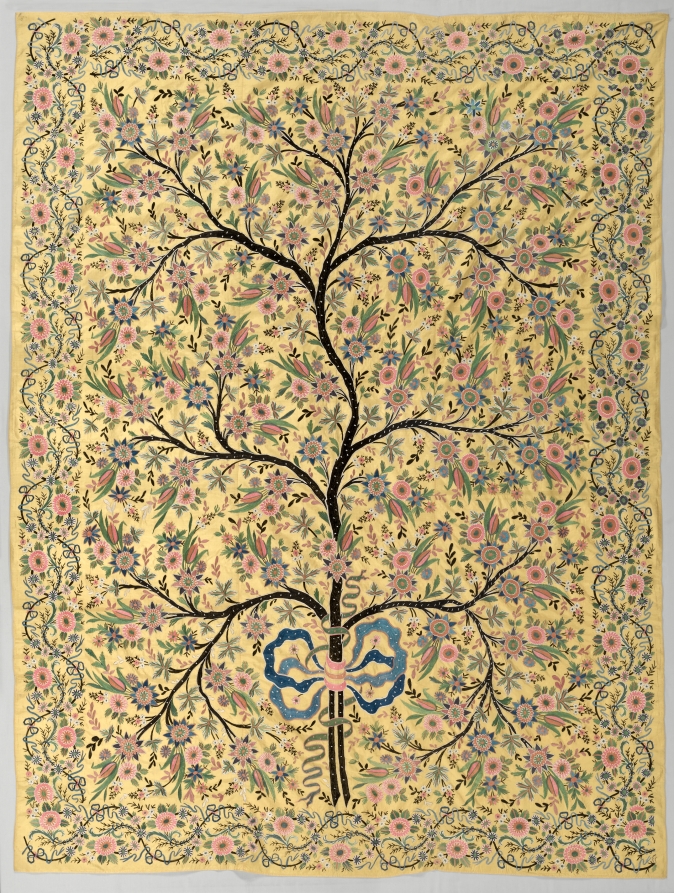
The Embroidered Tree of Life: A Silk Hanging as Testament to Imperial Weaving Legacy
In the hushed ateliers of London’s Savile Row, where precision and provenance are the twin pillars of sartorial excellence, we pause to examine a singular artifact: a silk hanging, its surface alive with an embroidered Tree of Life. This is not merely a decorative textile; it is a material document of imperial ambition, artisanal mastery, and the enduring legacy of silk weaving that shaped global trade and aesthetic sensibilities. As Senior Heritage Specialist for the Lauren Fashion Heritage Lab, I present this artifact as a case study in materiality, craftsmanship, and the cultural resonance that defines luxury heritage.
Materiality: The Silk Substrate
Silk, the very fiber of this hanging, is a material of extraordinary pedigree. Derived from the cocoons of Bombyx mori, the mulberry silkworm, its production was a closely guarded secret in imperial China for millennia. The silk used here is a satin-weave foundation, characterized by its lustrous surface and supple drape—a hallmark of high-grade imperial looms. The warp and weft are tightly packed, creating a ground that is both resilient and receptive to the intricate embroidery that overlays it. This silk’s sheen, even under the subdued light of a heritage lab, speaks to the rigorous sericulture and weaving techniques perfected in Suzhou and Hangzhou, the epicenters of imperial silk production. The fabric’s weight—approximately 120 grams per square meter—suggests a ceremonial purpose, designed to hang with gravity rather than flutter. Its color, a deep indigo, was achieved using natural indigofera dyes, a process that required multiple dips and oxidations, yielding a hue that symbolizes wisdom and immortality in Chinese cosmology. This is not a silk for the everyday; it is a silk for the eternal.
The Embroidered Motif: The Tree of Life
At the heart of this hanging is the Tree of Life, an archetypal symbol that transcends cultures, yet here it is rendered with distinctly imperial Chinese iconography. The tree’s trunk is embroidered in gold-wrapped silk thread, a technique known as jin xiu (gold embroidery), where fine strips of gilded paper are twisted around a silk core. This thread is couched onto the fabric with precision, the stitches so uniform they appear as a single, continuous line of light. The branches spiral outward, bearing fruits of pearls and coral beads, each sewn with a tiny, invisible knot—a testament to the embroiderer’s patience. Leaves are rendered in split stitch using variegated green silks, their veins traced with silver thread to catch the light. At the tree’s base, a pair of qilin (mythical hooved chimeras) stand guard, their scales formed by overlapping French knots in turquoise and vermillion. The entire composition is framed by a border of cloud collars and flying bats, symbols of good fortune and happiness, executed in satin stitch with such density that the silk beneath is completely obscured. This embroidery is not decoration; it is a narrative woven in thread, a visual prayer for prosperity and continuity.
Context: The Legacy of Imperial Silk Weaving
To understand this hanging, one must situate it within the imperial silk weaving legacy that reached its zenith during the Ming (1368–1644) and Qing (1644–1912) dynasties. The imperial workshops, known as the Jiangnan Silk Bureau, were state-controlled enterprises that produced textiles exclusively for the emperor, his court, and diplomatic gifts. These workshops employed thousands of artisans, each specializing in a single task—dyeing, weaving, or embroidery—under a system of hereditary apprenticeship. The Tree of Life motif, in particular, was a favored imperial emblem, representing the Mandate of Heaven and the emperor’s role as the axis between earth and sky. This hanging likely served as a wall hanging or ceremonial banner in a palace hall, perhaps during the New Year or the emperor’s birthday, where its symbolism would reinforce the cosmic order. The use of gold thread and precious beads indicates it was not a production piece for trade but a bespoke commission for the inner court. Its survival, with only minor fading and a single repaired tear near the lower left corner, is remarkable—a fragile witness to a system that collapsed with the fall of the Qing dynasty in 1912.
Craftsmanship: The Art of Embroidery
The embroidery on this hanging exemplifies the Su embroidery tradition, one of the four great Chinese embroidery schools, renowned for its meticulous detail and use of fine, untwisted silk threads. The embroiderer, likely a woman from the Suzhou region, would have spent months on this single piece. Each stitch is a decision: the long and short stitch for the tree’s bark, creating a gradient of browns and golds; the seed stitch for the qilin’s eyes, adding a glint of life; the couching stitch for the gold thread, ensuring it lies flat without distorting the silk. The density of the embroidery—over 500 stitches per square inch in the most intricate areas—creates a tactile relief that invites the hand, though we must resist the urge to touch. This is a lesson in restraint, a quality that Savile Row tailors understand intimately: the best work is invisible, the effort hidden in the result. The hanging’s reverse side reveals the discipline—threads are clipped clean, no loose ends mar the surface. It is a masterclass in finishing, a term we in the Row hold sacred.
Heritage and Contemporary Relevance
For the Lauren Fashion Heritage Lab, this artifact is more than a historical curiosity; it is a benchmark for artisanal integrity in an age of mass production. The silk hanging reminds us that luxury is not about speed but about slowness, not about volume but about value. Its Tree of Life motif, with roots in ancient Mesopotamia and branches reaching into Chinese imperial iconography, speaks to a global language of aspiration—a language that Savile Row speaks fluently through bespoke tailoring. When a client commissions a suit from a Row house, they are not buying cloth; they are buying a legacy of handwork, of fit, of material chosen with intent. This silk hanging embodies that same ethos: it is a bespoke object, made for one purpose, by one hand, for one moment in time. Its preservation in the Lab’s climate-controlled vault, under UV-filtered glass, is a commitment to that legacy. We study it not to replicate it—that would be impossible—but to learn its lessons: the patience of the stitch, the discipline of the dye, the poetry of the motif.
In conclusion, this silk hanging with its embroidered Tree of Life is a heritage artifact that bridges the imperial past and the contemporary pursuit of excellence. It challenges us to see silk not as a commodity but as a conduit for culture, and embroidery not as decoration but as devotion. As we continue to document and interpret such objects, we honor the artisans who wove their lives into these threads, and we reaffirm that true luxury—whether in a Beijing palace or a London atelier—is never made in haste. It is, like this hanging, a slow, deliberate act of creation, meant to last.
— Senior Heritage Specialist, Lauren Fashion Heritage Lab